











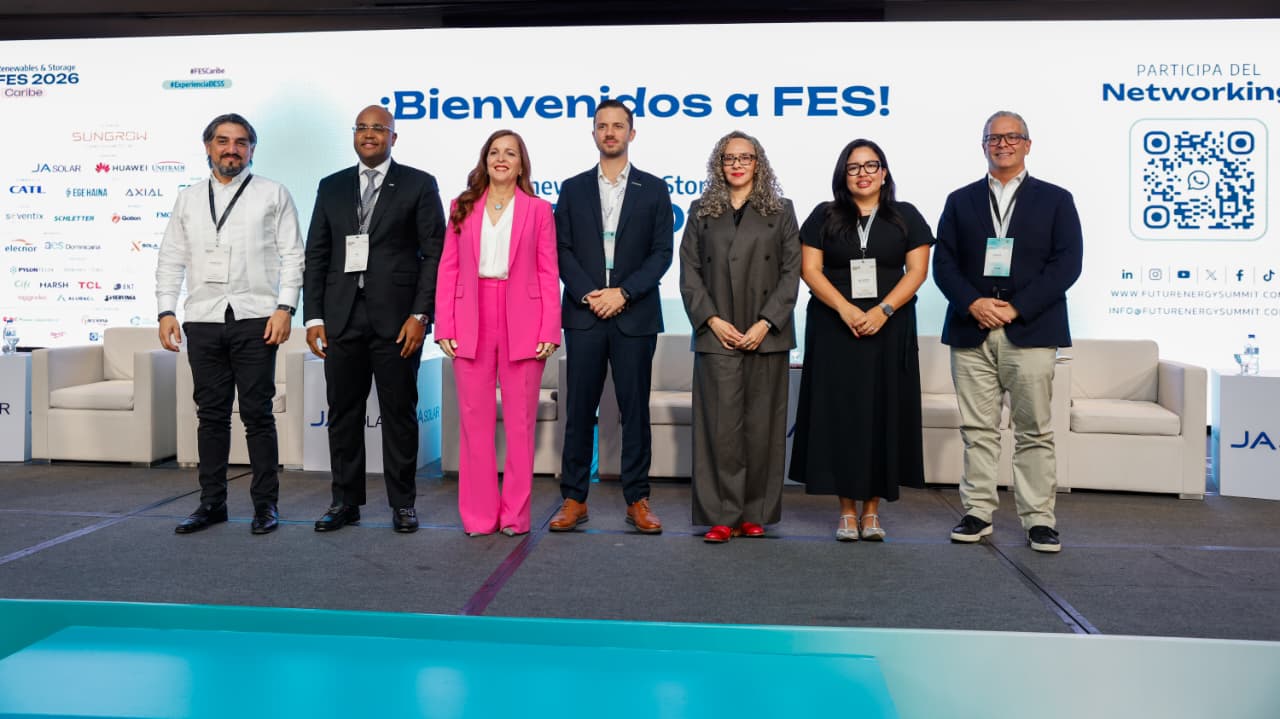
Leading energy companies operating in the Dominican Republic used the first day of FES Caribbean to define priorities for the next stage of the electricity system, at a time when high renewable penetration is already beginning to strain operations. The consensus was clear: the challenge is no longer only to add more clean capacity, but to integrate flexibility, storage and market rules that can support that expansion. With growing operational restrictions, economic losses linked to curtailment and increasing regulatory pressure, the discussion focused on how to sustain new investment and adapt the system to a more complex phase.
That new phase was reflected in data presented by EGE Haina: more than 120,000 MWh of renewable generation was lost in the first quarter of 2026, equivalent to USD 18.7 million, signalling that the debate is no longer just about how much capacity to add, but how to integrate it without compromising stability or profitability. At the same time, the country is accelerating tenders to add storage, with a pipeline that could exceed 600 MW in BESS and a projection close to 2 GW of solar PV by 2027.
In that context, Rosina Hernández, Electricity Market Director at EGE Haina, stated: “We need clarity on how all the services batteries can provide are going to be compensated,” warning that the lack of regulatory definition is limiting new investments.
“More than 220,000 megawatt-hours of renewable energy have been lost,” she added, stressing the direct impact on project viability. She also highlighted as a positive sign the creation of a government-led monitoring roundtable specifically aimed at addressing curtailment.
The regulatory framework is beginning to evolve, but executives stressed that it still does not keep pace with the speed of growth in the system. The country is moving forward with planning for tenders combining renewables and storage, following the positive outcome of the EDES-LP-NGR-01-2025 tender, where awarded capacity had to be expanded to 605.1 MW to include eight of the most promising projects amid fierce competition. However, the economic signal still does not reflect the full value of these systems.
From a structural perspective, Karla Martínez, Corporate Affairs and Sustainability Manager at CMI, focused on what she described as the main systemic risk: “The financial health of the distribution utilities remains a latent risk,” in a context of losses nearing 38% and payment delays of more than 10 months.
Relive the first day of FES Caribbean: https://www.youtube.com/watch?v=OfB3DaSHJSM
“No payment has ever been made for energy lost through curtailment,” Martínez added, noting that this is forcing a rethink of business models.
In that regard, she proposed a potential market solution: “We need to find mechanisms that protect existing investments, for example through participation in services such as frequency regulation,” introducing the concept of linking flexibility with protection against curtailment.
In parallel, attention shifted to system operations, where technical complexity is growing exponentially.
From that perspective, Oscar San Martín, Vice President of New Business and Country Manager for the Dominican Republic at InterEnergy, stated: “We cannot leave this to a human being pressing buttons,” reflecting a structural shift in system management. The company has already incorporated specialists in data and artificial intelligence to operate at millisecond timescales.
He also explained that flexibility is evolving on the thermal side: “Manufacturers are developing smaller and more flexible engines that can better adapt to renewable variability,” reducing technical minimums and improving system response.
“If we promote electric mobility, we can absorb the energy that is currently being lost during daytime hours,” the InterEnergy executive added.
On another front, system planning emerged as another critical issue, particularly regarding infrastructure and investment signals. This was highlighted by Edy Jiménez, Chief Commercial Officer at AES Dominicana, who warned: “It is not possible for transmission to be tied to the development of private projects.”
“We are competing for equipment and lead times with industries such as data centres,” he added, stressing the need to define clearer auction schedules.
Jiménez also emphasised that the integration of storage requires an orderly regulatory transition that does not abruptly alter the conditions of projects already financed and preserves long-term investment signals.
From Marsh, Vivian Acra, CEO and President of Marsh Risk, explained: “The cost of insuring projects in the Dominican Republic can be two or three times higher than in other countries,” due to catastrophe risk.
But she argued the greatest challenge lies in new technologies: “Storage has a completely different risk profile, involving fire risks, cell degradation and operational risks. The earlier risk is managed, the stronger the project profile will be.”
From the technology side, the market faces a paradox: falling global prices and rising quality requirements.
In that context, Ignacio Mesalles, Head of Sales North LATAM, Central America & The Caribbean at JA Solar, warned: “It is easy to fall into the temptation of choosing the cheapest panel,” in a context of oversupply over the past 12 to 24 months.
However, he stressed the long-term view: “These are projects with a lifespan of 30 years or more,” meaning CAPEX decisions can affect performance, insurance and operations. He also highlighted key technical advances, including improvements in temperature coefficients that help maintain efficiency in demanding climates such as the Dominican Republic.
In summary, FES Caribe made clear that the Dominican energy transition is entering a more demanding phase, where the challenge is no longer simply adding renewable capacity but integrating flexibility, regulation and financing. With a pipeline targeting nearly 2 GW of solar PV by 2027 and accelerating storage deployment, the system will need to evolve rapidly to prevent losses and structural risks from deepening.