












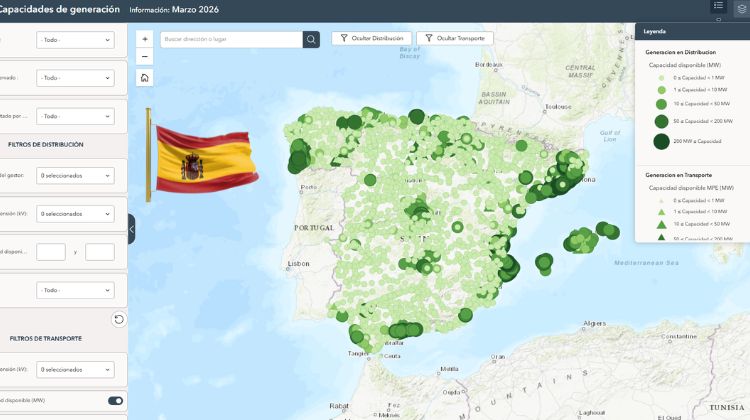
The publication of new access capacity maps by Spain’s National Commission on Markets and Competition (CNMC) has laid bare a critical constraint in the country’s power system: grid infrastructure is no longer keeping pace with renewable energy growth. While the platform improves transparency, market participants stress that the underlying challenge is structural.
The new tool consolidates information on generation and demand access capacity that was previously fragmented across network operators, allowing stakeholders to identify grid nodes with available capacity according to multiple variables. However, improved visibility does not alter the central diagnosis: real access availability remains limited across large parts of the country.
Against this backdrop, Jorge Antonio González Sánchez, Deputy General Manager at REBI, told Energía Estratégica: “This is not speculation, these are projects that have yet to materialise,” referring to the occupation of capacity at numerous grid nodes.
He explained that much of the apparent congestion is linked to projects that have not progressed for reasons unrelated to grid access itself, including administrative permitting delays and deferred investment decisions.
Even so, the impact on the market is direct, as this situation restricts the entry of new projects in regions with strong renewable energy potential.
“Developers or generators wishing to move forward have to do so through the system operators,” González stressed, noting that the map does not replace existing technical and regulatory processes.
Energy engineer José Alfonso García Jiménez offered a broader structural reading of the issue, arguing that congestion at connection nodes is a direct manifestation of wider grid limitations.
“A significant number of nodes are saturated or have virtually no available capacity,” he warned, representing a concrete barrier to the growth of the new generation.
According to García, this directly affects the energy transition by slowing the integration of new renewable energy facilities—not because of a lack of resource availability or investment appetite, but because the system lacks sufficient capacity to evacuate the electricity generated.
At the same time, the enhanced transparency also exposes system bottlenecks more clearly, particularly in regions where available capacity is practically non-existent or severely restricted. Inland regions such as Madrid and surrounding areas, Castilla-La Mancha, Castilla y León and Extremadura show high levels of congestion despite being major renewable energy development hubs.
This imbalance reflects the structure of Spain’s electricity system itself, where generation is concentrated in areas such as the Ebro Valley, the north-west and the south, while demand is centred in major urban hubs including Madrid, Barcelona and Valencia.
That dynamic requires large volumes of electricity to be transported over long distances, putting pressure on transmission corridors and limiting capacity at multiple strategic nodes.
The new maps visually identify these critical pressure points, where high renewable penetration and network constraints generate structural restrictions.
Indicators of this include:
- Substations with very limited free positions
- Nodes reserved under regulatory criteria
- High-voltage bars above 1 kV show zero available capacity
At the same time, several strategic transmission corridors are emerging as particularly critical, notably those linking high-generation zones with consumption centres:
| Key Electricity Corridor | Strategic Role | Main Challenge |
|---|---|---|
| Northeast–Central Spain | Connects renewable generation to Madrid | Transmission congestion |
| South–Central Spain | Evacuation from solar-rich southern regions | Limited reinforcement |
| Northwest–Meseta | Links wind generation to demand centres | Capacity saturation |
Pressure along these corridors is especially high, reinforcing the need for grid expansion and reinforcement to avoid blocking new renewable energy projects.
“The increased transparency represents a significant structural shift. Investment in Spain’s electricity system will gradually be reconfigured territorially,” García said, arguing that the maps can improve decision-making and reduce uncertainty in project development.
The growing investment focus on grids, substations and evacuation corridors reflects a broader paradigm shift, where infrastructure availability is beginning to weigh more heavily than renewable resource quality itself.
“Future investment will increasingly be conditioned by existing grid infrastructure,” he added.
Capacity Auctions and Demand Projects May Unlock New Access
Despite the constraints, experts are also identifying early signals that new access capacity could emerge gradually.
“New capacity will arise through capacity tenders at major nodes, through additional guarantees required for demand-side projects rather than generation, and through the new network investment cycle,” González said.
He suggested it would be valuable for the CNMC to develop additional statistics or dynamic maps showing the evolution of access capacity over time, helping investors track where new capacity is emerging.
That view aligns with Spain’s evolving regulatory roadmap, where grid capacity tenders are becoming a tool to unlock saturated nodes.
Following the allocation of 928 MW, the system has identified at least 75 nodes potentially eligible for further tender processes, signalling a new phase in access management—particularly linked to demand-side projects.
This also reflects a gradual shift in focus from generation towards demand, in line with broader efforts to balance the system and optimise existing infrastructure. In this framework, energy demand takes on a more active role in system development.
González stressed the importance of moving towards more dynamic analytical tools.
“It would be very interesting for the CNMC to develop statistics or a new map showing the temporal evolution of access capacity,” he said, highlighting the need for information that reflects trends rather than a static snapshot.
Ultimately, experts agree the new maps should be understood as a dynamic tool, not a solution in themselves.
“The grid map should not be interpreted as a static photograph,” García concluded, emphasising the need to analyse how capacity evolves over time in order to make strategic investment decisions.
In short, the CNMC has brought greater transparency to a system already showing clear signs of saturation. But it has also made evident that the main challenge lies not in access to information, but in the real capabilities of a grid that will need major expansion if Spain is to sustain the growth of its renewable energy sector in the years ahead.