










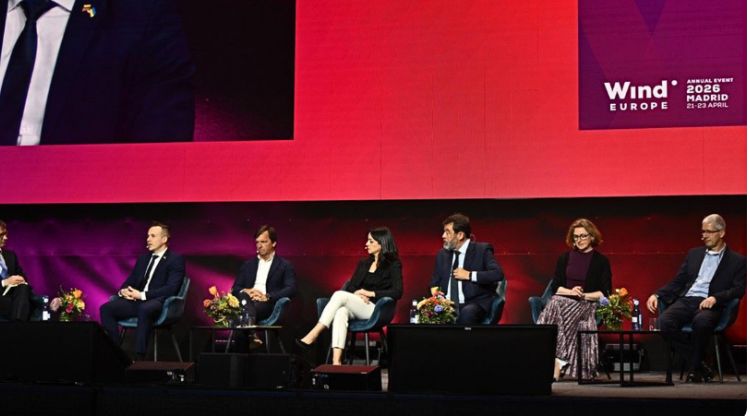
Electrification emerged as a central theme at the WindEurope Annual Event 2026, where Europe’s wind industry called on governments to elevate it to the level of strategic priority in order to reduce dependence on imported fossil fuels and reinforce the bloc’s energy security.
During the second day of the conference, industry leaders argued that Europe must accelerate the replacement of oil, coal and gas with renewable electricity — not only as a climate response, but as a tool to shield consumers and industries from energy price volatility and to restore the continent’s attractiveness for investment in renewables.
The message gained added urgency against a backdrop of renewed geopolitical tensions. According to WindEurope, the European Union still imports 64% of the energy it consumes, a dependency the association described as a structural vulnerability for the region.
In this context, wind power was presented as a critical technology to reduce exposure to imports, support price stability and sustain European industrial activity. Since Russia’s invasion of Ukraine in 2022, Europe has expanded domestic renewable generation and cut external energy purchases, although electrification is still advancing slowly and today accounts for less than a quarter of total energy consumption.
Tinne van der Straeten, Chief Executive Officer of WindEurope, said:
“Every drop of oil, every tonne of coal, every molecule of gas we replace with renewable electricity is energy we no longer need to import. Electrification is therefore a strategic imperative for Europe’s independence, resilience and prosperity.”
Against this backdrop, the association presented the Madrid Call to Action, a roadmap outlining ten measures aimed at accelerating electrification across Europe.
The proposal focuses on three fronts:
- Expanding renewable electricity supply
- Improving the link between power generation and demand
- Facilitating the uptake of electrified technologies through economic and regulatory signals
Among the priorities, WindEurope highlighted sectors where electrification could scale rapidly, particularly industry, especially low- and medium-temperature heat processes used in paper, pulp, food and beverage production.
According to sector estimates, up to 930 TWh of industrial heat demand could already be electrified using available technologies — equivalent to the combined electricity demand of France and Germany.
The association also proposed reducing VAT to zero on heat pumps and electric vehicles to stimulate demand, while revising electricity taxation, which it argues currently discourages fuel switching away from fossil fuels.
Another key proposal was to simplify European state aid rules to accelerate Power Purchase Agreements (PPAs), particularly for industrial consumers. WindEurope argued that faster deployment of these contracts could replace the equivalent of 1,000 annual LNG cargoes with renewable electricity generated in Europe.
The debate coincided with the expected launch of the Accelerate EU package, through which the European Commission is preparing measures related to electricity grids, energy taxation and regulated charges — all seen as critical to advancing greater electrification.
During the event, France was highlighted as one of the most advanced examples in this agenda. The country plans to increase support for electrification to €10 billion per year by 2030, ban gas boilers in new buildings from 2026, and ensure that two-thirds of all new vehicles sold are electric by the end of the decade.
At the regional level, WindEurope also noted that since 2022, 43.5 GW of new wind capacity has been authorised — enough to generate around 115 TWh, exceeding the annual electricity demand of the Netherlands.
Key figures highlighted by WindEurope
| Indicator | Value |
|---|---|
| EU energy is still imported | 64% |
| Industrial heat demand is already electrifiable | 930 TWh |
| New wind capacity authorised since 2022 | 43.5 GW |
| Potential annual generation from new projects | 115 TWh |
| LNG cargoes potentially displaced through PPAs | 1,000 per year |
For the wind industry, these developments show that the technologies are already available and that the main challenge now lies in accelerating political decisions and regulatory frameworks.
With this message, the sector sought to position electrification not merely as a pillar of the energy transition, but as a prerequisite for strengthening Europe’s energy security and sustaining its industrial competitiveness.