









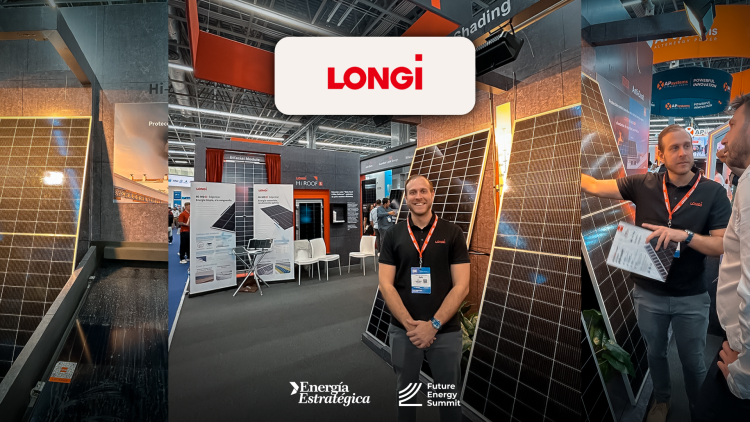
Carlo Francesco Melillo, Sales Manager for Panama, Central America, and the Caribbean at LONGi, detailed a success case in Panama where a solar PV project was on the verge of cancellation due to shading losses, but ultimately reversed course and exceeded initial forecasts. Building on this experience, the company is positioning its Hi-MO X10 module and targeting outputs of up to 670 W in a region growing between 20% and 30%.
LONGi showcased its latest photovoltaic system innovations, covering both distributed generation and utility-scale applications, with a focus on solving one of the industry’s major challenges: maintaining efficiency in complex scenarios. From hail conditions to arid environments or tropical climates such as those in Panama, Central America and the Caribbean, the Hi-MO X10 module emerges as a solution designed to adapt to multiple operational demands without compromising performance.
In conversation with this outlet, Carlo Francesco Melillo explained how this technology not only optimises performance but has also enabled the recovery of projects close to cancellation.
- To begin with, what are you presenting, and what is the focus of the technology?
The X10 technology incorporates an anti-shading system based on HPBC 2.0, which allows shading points to be managed without generating hot spots. Unlike conventional solutions—where a shadow affects an entire string of cells—in this case, only the blocked cells are impacted, preventing the performance of the entire module from being compromised, as previously occurred when shading could affect up to one-third of a panel.
- Specifically, what changes with this anti-shading technology, and how does it translate into a real case?
This differentiator is already evident in real-world applications. In Panama City, a project had been designed with another type of module without considering the impact of shading. During execution, the detected losses led to its cancellation.
However, after incorporating the Hi-MO X10, the technical solution was redefined, and the project was successfully completed. Expected losses were 20%, but in practice, they were reduced to a range between 8% and 12%, exceeding initial forecasts and validating the technology’s performance under real conditions.
- Based on that case, where does the technical difference lie that allows such a turnaround?
The X10 technology includes an anti-shading system with HPBC 2.0 that manages shaded areas without generating hot spots.
Unlike conventional solutions, where shading impacts an entire string of cells, here only the blocked cells are affected. This prevents shading from reducing the performance of the entire module, as occurred in previous technologies, where up to one-third of the panel could be impacted.
- And what impact does this have on project generation?
Compared to a conventional TOPCon module, energy generation is approximately 8% higher.
Under shading conditions, performance improves between 20% and 40%, representing a significant difference in real-world scenarios where such variables often determine project viability.
- With this improvement, how does it translate into profitability?
The cost is between 3% and 5% higher, but the increase in generation—ranging between 8% and 12%—allows the additional investment to be recovered quickly.
This directly impacts profitability, especially in projects where shading is a critical factor.
- In what type of projects does this solution become most decisive?
It is a product initially conceived for the commercial and industrial segment, but it has seen rapid adoption in the residential sector.
Demand for higher-power modules in the 600 to 650 W range has driven its positioning as a cross-segment solution within distributed generation.
- Beyond shading, how does the module perform under demanding operating conditions?
The module can be configured depending on the environment.
In hail-prone areas, the type of glass can be adjusted to withstand impacts. In arid environments, anti-dust technology is incorporated to prevent accumulation. In ground-mounted plants, it can be used in a bifacial configuration.
This enables deployment in tropical, arid or cold conditions without major limitations—something key for markets such as Panama, Central America and the Caribbean.
- Within LONGi’s strategy and portfolio, how is this product positioned?
The Hi-MO X10 is specifically designed for the distributed generation market, prioritising manoeuvrability, logistics and ease of installation.
For utility-scale projects, the company offers the Hi-MO 9, aimed at large-scale solar plants.
- Looking ahead, what evolution is expected for this technology?
Development continues to focus on advancing HPBC 2.0 technology, with the aim of increasing module power without modifying its format.
Currently, modules already reach between 655 and 660 W, and are expected to scale up to 670 W by the end of the year while maintaining the same dimensions.
They are also positioned 20 to 25 watts above standard market solutions, enabling improved generation without affecting installation or logistics.
- And at a regional level, what signals is the market showing?
Growth in Panama and the region has ranged between 20% and 30% in recent years, driven by the expansion of distributed generation.
The main challenge lies in regulatory processes, as installation timelines can extend to up to nine months, compared to two or three months previously. In this context, logistics, product availability and the opening of new distributors will be key to sustaining market growth.
In this context, the renewable energy and energy storage market in Latin America continues to consolidate its growth, driven by new tenders, evolving regulatory frameworks and increasing demand for efficient solutions, where technologies such as LONGi’s Hi-MO X10 are gaining prominence by addressing real-world limitations.
At the same time, initiatives such as the Future Energy Summit (FES) are strengthening their presence in the region, fostering connections between public and private sector stakeholders. With upcoming stops on 20–21 April in the Dominican Republic, 14 May in Guatemala and 19 May in Mexico, these events reflect the sector’s dynamism and create key opportunities for new renewable energy projects.