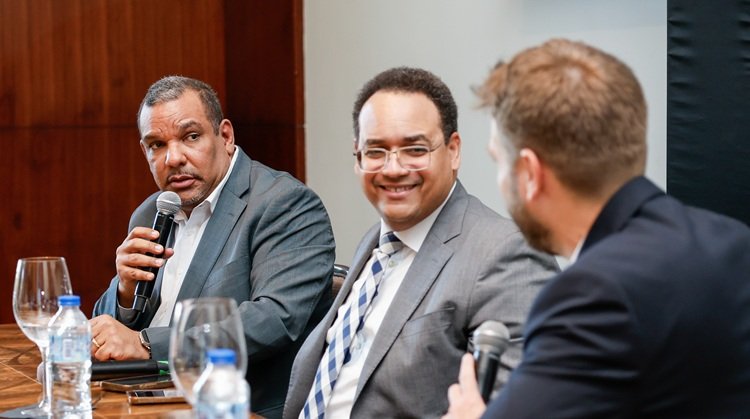










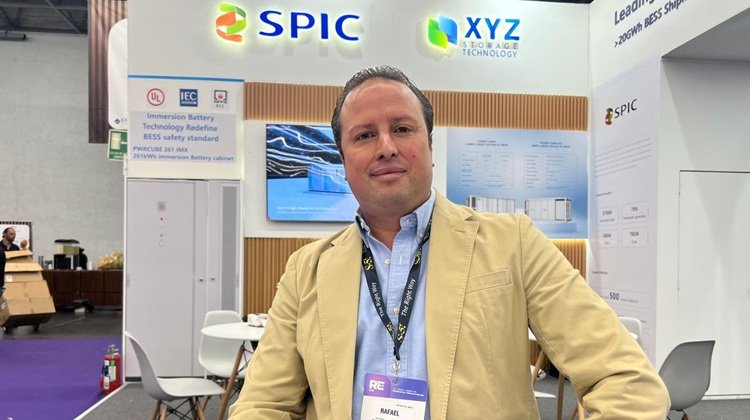
In conversation with Energía Estratégica, Rafael Díaz Maciel, CEO of OPSLAG Green Power — a company specialised in the distribution of battery energy storage systems (BESS) in Latin America, focused on EPC integration, turnkey solutions and financing options for industrial and government clients — explains why its technological proposal aims to change the sector’s logic from the ground up.
It is worth noting that OPSLAG Green Power is the distributor of XYZ Storage Technology Corp., Ltd., a subsidiary of the Chinese state-owned giant State Power Investment Corporation (SPIC), one of the world’s largest energy groups and part of the Fortune Global 500.
Interview with Rafael Díaz Maciel, CEO of OPSLAG Green Power
You mention you have a different storage technology… but if you had to explain it simply, what would you say?
Look, the simplest way to put it is this: our cells are fully submerged in a dielectric fluid. And that means there is no possibility of ignition.
Literally zero?
Literally zero. Unlike other technologies where you have to manage risk — with fire suppression systems, thermal monitoring and so on — we eliminate the possibility entirely. It is not that you control it better. It simply cannot happen.
And how does that change the conversation with a client?
Completely. Because today, whenever you speak with any company, especially industrial players or data centres, the same concern always comes up: what happens if it fails?
Everyone has protocols and safety systems… but no one can guarantee 100%. We can.
Is this an improvement, or is it something else?
It is something else. Energy storage has historically been designed on the assumption that risk is part of the system. We break with that logic.
We are not optimising an existing technology. We are rethinking how it should work from the design stage.
And is that what allows, for example, batteries to be installed inside buildings?
Exactly. That is one of the major changes. Many technologies today cannot be installed inside critical facilities precisely because of the risk. In our case, by eliminating ignition, you can bring storage inside plants, buildings or data centres.
Let me take you to that point… Why so much focus on data centres?
Because today, that is probably where it makes the most sense. A data centre cannot assume risk. At the same time, it needs constant, reliable and increasingly efficient energy.
So when a technology emerges that removes that risk, it automatically becomes highly relevant.
Is that your differentiator for this segment?
I would say today it is practically the only viable option for installing storage within facilities without compromising safety.
And what about performance? One might think: all right, it is safer… but does it perform as well?
It performs better. Because the cells operate in a thermally stable environment, you reduce degradation, maintain efficiency and extend useful life. So you gain not only in safety, but also in performance and business value.
Business value in what sense?
In every sense. Longer lifespan, fewer failures, more stability… that improves project profitability and also confidence for financing. It ends up impacting bankability.
I’m interested in understanding the context… Why do you think this technology is emerging now?
Because the problem is already evident, energy has stopped being a secondary issue. Today, it determines whether an industry can be established or not, whether it can grow or not.
In Mexico, for example, there is no shortage of industrial demand. What is lacking is the energy capacity to support it.
Would you agree that storage is becoming something more structural…
Absolutely. It stops being a complement and becomes part of the critical infrastructure. We always say: energy is not a cost, it is an asset.
At what stage are you today? Is this already a reality or still a promise?
It is already a reality. The technology has just arrived in Mexico, we have already installed a system in Puebla for validation, and now we are beginning to engage with the main market players.
What comes next?
Now comes scale. We are going to bring around 100 units in the first year and start working with distributors to expand.
Mexico as a base and then the region?
Exactly. Mexico is the spearhead. Then we move into Central America and later South America.
If you had to prioritise markets, where do you see the greatest opportunity?
Guatemala is one of the main ones. Also, Panama and the Dominican Republic. But in general, the entire region has potential because the energy problem is structural.
When you speak with clients today, what is the first thing they ask for?
Two things: savings and safety. Always those two. And safety is where the greatest doubts remain, because everyone knows it is a critical point.
To close, can you tell us more about OPSLAG’s story?
We started in 2020. In 2023, we began our relationship with the Chinese government, and today we are the sole representatives of this technology in Mexico.