








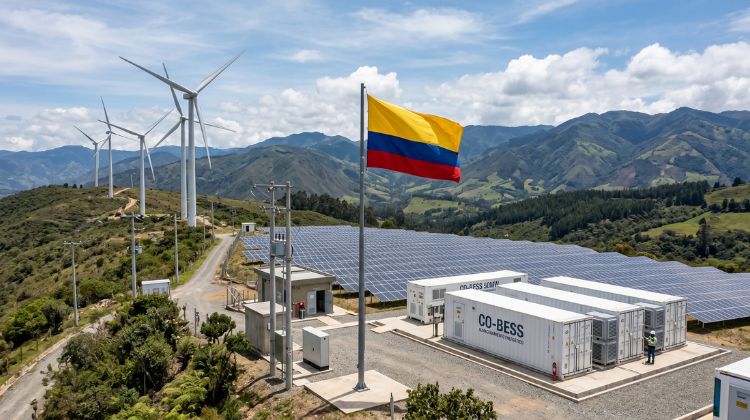
Colombia has taken a decisive step to reactivate renewable investment signals with the final version of its new long-term auction, a mechanism that not only reopens this type of contracting after five years but also substantially modifies the design initially presented to the market. The major new development is the formal incorporation of battery energy storage systems (BESS) and hybrid plants as part of the products to be awarded — a decision that transforms the scope of these auctions and moves them closer to becoming a reliability instrument rather than one focused exclusively on renewable energy promotion.
The final resolution establishes contracts with obligations starting in 2030 — and an additional 2035 window for one of the products — while awards must take place before 31 July 2026, under the operation of the Bolsa Mercantil de Colombia (Colombia’s Mercantile Exchange). The biggest change lies in the architecture of the mechanism: there will be four differentiated products, including blocks for solar energy, flat supply, hybrid schemes and energy during critical night-time hours. This last element opens a direct signal for battery-based solutions, a technology that had not had dedicated space in previous tenders.
“The country needs to move beyond energy improvisation and build energy security with a long-term vision,” said Energy Minister Edwin Palma.
In addition, the final version did not replicate without changes the proposal released months ago. The process adjusted its design, guarantees and competitive criteria following market comments and observations from the Superintendence of Industry and Commerce (SIC), particularly regarding barriers to entry and the structure of the Pay-as-Bid scheme. Parameters that appeared less developed in the draft were also consolidated, especially the participation of projects with storage systems, the configuration of hourly blocks, and the logic of maximum purchase prices and minimum selling prices.
In parallel, the government has entered the final phase ahead of the definitive call. Diego Fernando Román Dueñas, Director of Electric Energy at the Ministry of Mines and Energy, explained that following the issuance of Resolution MME 400178 and Circular 40014, the process is going through stakeholder consultation and technical adjustments regarding bidding documents and the supply contract.
“Once the call resolution and its supporting memorandum are issued, the process enters its stage of regulatory certainty,” Román Dueñas said.
The official indicated that the next milestones include the publication of tender documents with prequalification requirements, the qualification of participants through verification of guarantees and technical capabilities, and the award session led by the Bolsa Mercantil de Colombia, scheduled for June and July.
The backdrop goes beyond regulatory design. According to the Ministry itself, the tender responds to supply coverage risks from 2027 onwards and to the need to reduce demand exposure to spot market prices, particularly in the face of adverse climate events. That explains why the auction is also linked to the obligation for retailers to secure 10% of purchases from non-conventional renewable energy sources (FNCER), a target whose compliance still presents gaps.
What are the participation conditions?
From the operational side, one of the main focuses has been participant qualification. For Hemberth Suarez Lozano, founding partner at OGE Energy, the process has a decisive technical sequence for interested parties.
“The first requirement to participate is to be authorised according to the role… then comes a prequalification stage, followed by bid submission and a fourth step which is the constitution of guarantees,” Suárez explained.
The specialist detailed that retailers must be registered to participate as buyers, while sellers may enter without that initial condition, although if awarded, they must register as generators with XM, the administrator of Colombia’s electricity market. He also stressed that the scheme requires two types of guarantees — bid security and performance guarantees for awarded projects — one of the components that received the greatest attention after the adjustments were incorporated into the final version.
Suárez also highlighted a key prior filter for developers: projects must be registered with UPME in one of its three phases in order to offer energy into the auction.
For the market, this structure carries particular relevance because the 2019 and 2021 auctions awarded 20 projects totalling 2,171 MW, but this call introduces signals that go beyond adding renewable capacity: it begins to value flexibility, BESS systems and time-based coverage.
That could alter bidding strategies, particularly for hybrid projects and battery solutions, at a moment when the discussion is no longer focused solely on new capacity, but also on firmness and system resilience.
In that sense, the auction appears as a redefinition of Colombia’s renewable expansion model, and that seems to be the real message behind this final version.
Full auction timeline
| Activity | Date |
|---|---|
| Publication of draft resolution for comments | 19 Jan – 3 Feb 2026 |
| Technical opinion issued by MME | 20 Mar 2026 |
| Request for SIC opinion | 30 Mar 2026 |
| SIC opinion issued | 15 Apr 2026 |
| Resolution issuance and launch | 21–22 Apr 2026 |
| Implementation and award process | Until 31 Jul 2026 |
| Commercial operation deadline | 31 Dec 2029 |
| Start of contract obligations | 1 Jan 2030 |
| Commercial operation deadline (additional Product 1 auction) | 31 Dec 2034 |
| Start of obligations (additional Product 1 auction) | 1 Jan 2035 |