












Argentina is consolidating its position as a solar market in the region based on its technical maturity and improved financial conditions compared to previous years, after surpassing 7,900 MW of installed renewable capacity, of which more than 2,500 MW correspond to solar PV.
“Argentina has matured very quickly from a technical standpoint, to the point that today it is at the forefront technically. Meanwhile, on the financial and macroeconomic side, we went through difficult moments with the country in terms of payment structures and a series of complexities, but today it is much more stable,” acknowledged Miguel Covarrubias, Sales Director LATAM at Jinko Solar.
“So the market is mature, there is technical know-how and service expertise, which makes projects in the country highly viable both technically and economically,” he said during an interview held within the framework of Future Energy Summit (FES) Argentina.
This scenario is already reflected in the company’s strategy, having supplied nearly 30% of all solar panels currently operating in Argentina’s Wholesale Electricity Market (MEM), representing 36% of installed photovoltaic capacity, according to official CAMMESA data.
“Moreover, the conditions are in place in the country, and it is a priority market for us in LATAM, accounting for around 25% of what we supplied in the region last year,” Covarrubias noted.
Watch the full interview with Jinko Solar at FES Argentina: https://youtu.be/GHccKrwFUJ8
The weight of the manufacturer, technology and new market challenges
In this context, the bankability of solar projects is increasingly linked to the profile of the technology supplier. “It is key,” Covarrubias said, explaining that banks prioritise manufacturers with strong technical and financial backing.
At the same time, technological evolution continues pushing the boundaries of the industry. “Our core is to compete through technology and efficiency,” he said, referring to the new Tiger Neo 3.0 line, which allows outputs of 660–670 Wp in modules that previously reached around 620 Wp, without increasing their surface area.
However, part of the market is still seeking even higher power outputs, introducing new challenges. “There is a 10–15% segment still looking for larger modules,” he explained, referring to panels reaching 730–735 Wp, although these involve greater logistical and installation demands.
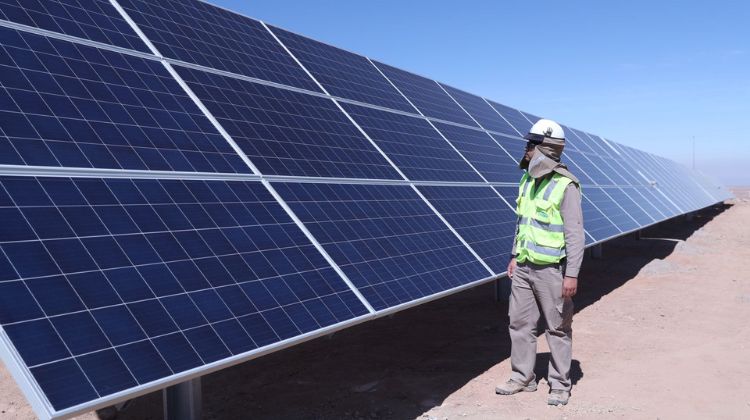
Despite these complexities, the local market has demonstrated adaptation capacity. A concrete example is the El Quemado solar park, developed by Argentina’s state-controlled energy company YPF in Mendoza. The project, which will reach 305 MW of installed capacity, already has 200 MW in operation and includes more than 550,000 panels.
“We expected there would be more failures and breakages during installation, which did not happen,” Covarrubias pointed out, validating the performance of larger-format modules.
Looking ahead, market growth will be driven by new opportunities in energy storage and regulation. Initiatives such as the AlmaSADI tender, which foresees adding 700 MW of BESS, together with the continuation of the Mercado a Término, are shaping an expansion scenario.
Nevertheless, there are still aspects to improve. “There is room for improvement linked to transmission and batteries,” the executive said, concluding that these developments will make it possible to “further expand the penetration of renewable energy, particularly solar energy.”