










Versol Solar has positioned Argentina as a core market within its Latin American growth strategy, aiming to strengthen its footprint over the coming years.
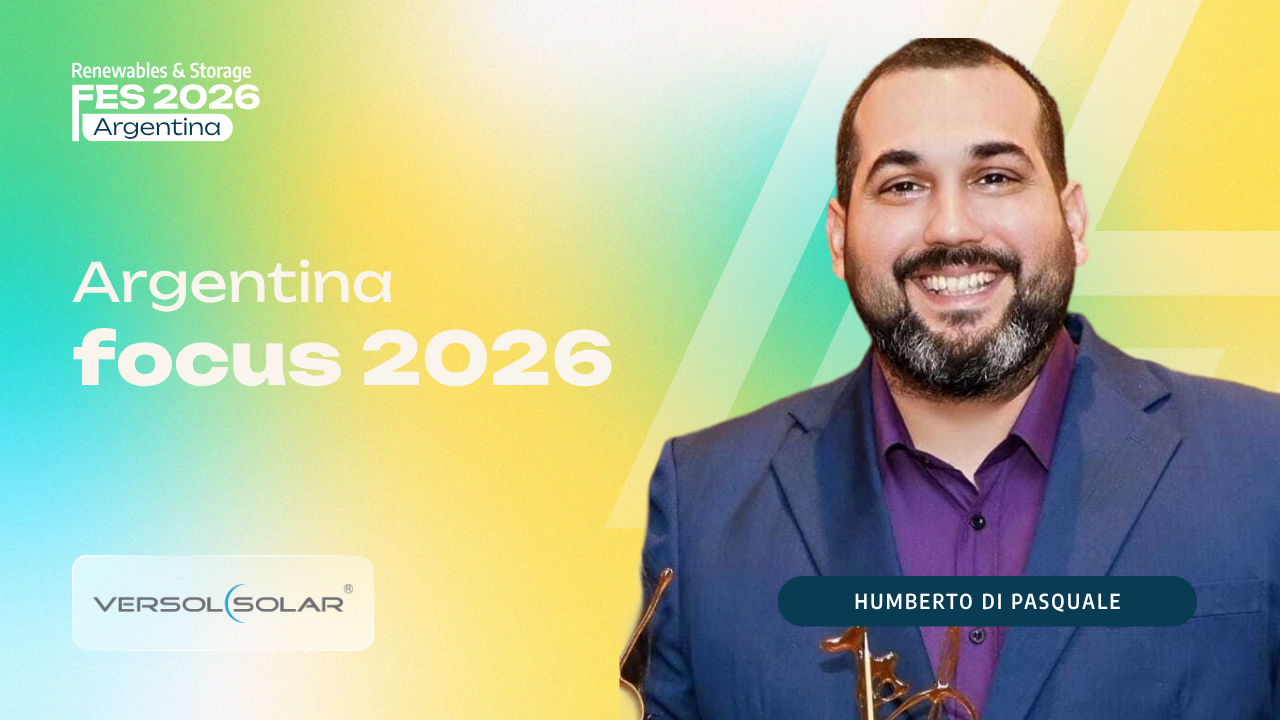
“2026 has a single name for us: consolidation,” said Humberto Di Pasquale, LATAM Regional Director at Versol Solar, outlining the company’s roadmap for the Argentine market during an interview at the Future Energy Summit (FES) Argentina.
According to the executive, the company has already completed an initial phase of market entry and internal structuring. The next stage will focus on executing and delivering on its strategic plans.
“We went through an initiation phase last year where we defined our plans, operating model and strategies. Now, 2026 is the year to act and bring those plans into reality,” he noted.
Watch the full interview: https://youtu.be/z0Ba11Py1o0
In this context, the company is working to deepen relationships with key stakeholders across the solar ecosystem—including project developers, EPC (engineering, procurement and construction) contractors, and technology suppliers—in order to position itself as a relevant player in Argentina’s solar PV market.
This push comes amid strong sector growth. Data from CAMMESA (the Argentine wholesale electricity market administrator) shows that installed solar PV capacity has reached 2,583 MW, while total renewable energy capacity stands at 7,980 MW, excluding hydropower plants above 50 MW.
Between 2025 and early 2026 alone, solar capacity added 910 MW, highlighting sustained expansion that continues to attract investment in renewables and international technology providers.
Technology, technical challenges and talent development
Versol Solar’s strategy in Argentina combines technological innovation with local capacity building.
The company is focusing on structural solutions for solar tracking systems, which currently account for a significant share of demand in utility-scale solar PV projects.
“We work with both 1P and 2P trackers, and we are known for adapting to different terrain conditions. We also optimise performance through artificial intelligence, enabling systems to respond to changing weather conditions and adopt protective positions when needed. Today, technology and AI are fundamental to the development of new solutions,” Di Pasquale explained.
These innovations are also shaped by Argentina’s demanding technical environment. The country has some of the highest wind speeds in Latin America, requiring robust structural design standards.
“From a regulatory standpoint, Argentina presents the highest wind speeds in the region. This is a major challenge for manufacturers, as we must ensure product stability over a 25–30 year lifespan,” he added.
At the same time, the executive highlighted the rapid professionalisation of the local market.
“One of the most significant changes in Argentina over the past four years has been the level of professionalisation—it is now among the highest in the region,” he stated.
In line with this trend, Versol Solar is evaluating the creation of a training centre to support the development of new talent and strengthen the technical capabilities of the local renewable energy sector, potentially in partnership with universities and technical institutions.
“We want to continue investing in local professionals—not only by training them, but by becoming a strategic partner, both professionally and academically. That is key to deepening our presence in Argentina,” Di Pasquale concluded.