







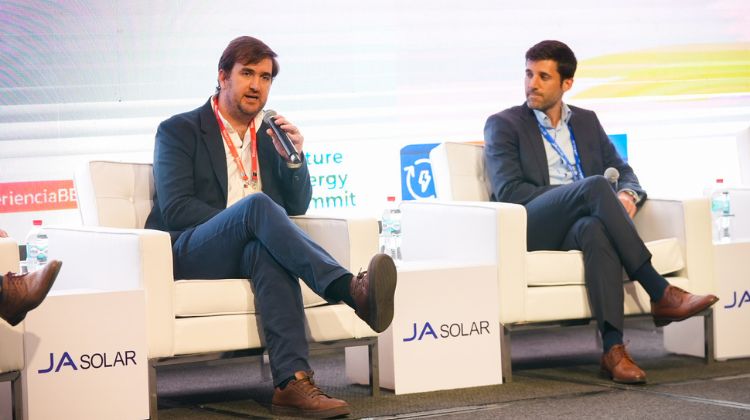
During his remarks in Panel 1 on Day 1 of FES Chile 2025, Vicente Walker, Head of Trina Storage for Latin America and the Caribbean, offered a clear outlook: the company delivered 1.2 GWh of energy storage systems this year and already has 2.5 GWh contracted for 2026, mainly in Chile and Argentina.
The executive stated that developing solar PV projects in northern Chile without storage integration at the early design stage is no longer feasible.
Curtailment, which has intensified in that region, is now expanding toward the central-southern areas of the country. This trend is driving new hybrid and stand-alone storage solutions. Trina Storage is already hybridising two major solar parks in the north and expects battery systems to begin rolling out in other regions in the coming months.
The company notes that market conditions vary widely across Latin America, requiring each solution to be adapted to its technical, economic and regulatory context. In Peru, for example, the parity between day- and night-time prices limits energy arbitrage opportunities, forcing developers to rethink revenue models.
In Argentina, Trina is implementing BESS projects that only operate during critical winter or summer months to manage peak demand. All these system designs follow a central principle for the company: developing viable and tailored models for each power system.
On the technology front, Trina is pushing substantial improvements. “We are quoting 8- to 10-hour projects,” Walker said—an upgrade from the current regional average. The company is also close to signing its first contract using 6.25 MW battery units, exceeding the 5 MW standard commonly used until now.
These advanced solutions are supported by an 800-person R&D team, which has increased energy density, reduced degradation and enhanced cycle efficiency.
The new batteries offer a 20-year lifetime, retaining 74% of their capacity at the end of that period. The company has also achieved additional percentage-point gains in round-trip efficiency, a critical factor that directly affects project profitability. “Round-trip efficiency and degradation have a major impact on a customer’s financial model,” Walker pointed out.
He also stressed the importance of optimising projects holistically, combining the company’s three business lines—modules, trackers and storage. “We can identify significant cost optimisations for the project,” he said, highlighting benefits in both technical compatibility and operational expenditures.
A central point of his presentation was grid-forming technology, which is already incorporated into the projects the company will deliver in 2026. However, its development faces a regulatory vacuum. “There is no clear regulation on how this will be required or compensated,” he warned. For this reason, Trina considers it essential for new projects to include the necessary hardware from the outset, as “it could add a few basis points to the customer’s financial model in the future,” he explained.
Walker concluded emphatically: “The combination of solar plus storage is probably the cheapest and most reliable form of power generation today.” In an increasingly competitive market, Trina Storage is betting on technology, tailored design and efficiency as the keys to maintaining its leadership in the region’s energy transition.