






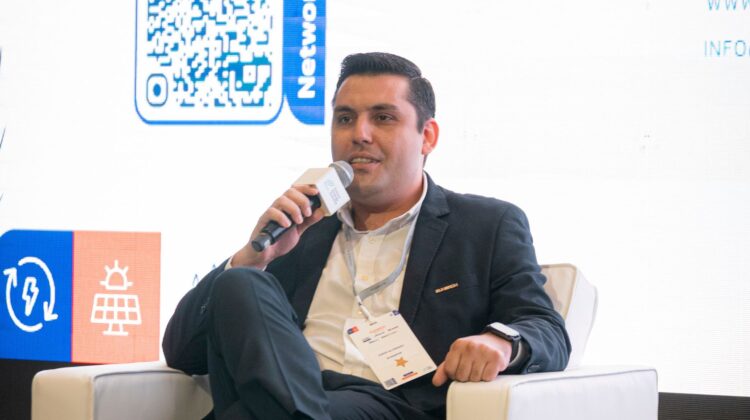
With Latin America’s energy storage market becoming increasingly competitive, Sungrow has outlined a regional expansion strategy focused on four key countries: Argentina, Peru, Chile and Colombia. The plan was detailed by Jorge Alvarado, Key Account Manager at the company, during his participation at FES Chile, where he described the conditions shaping the outlook for battery energy storage systems (BESS) in these markets.
According to the company, the strongest opportunities lie in countries that show progress in regulatory frameworks, a higher level of technical maturity among clients, and—above all—an ecosystem of stakeholders willing to operate under demanding standards.
“Today there are around 25 competitors pursuing storage projects across the region,” Alvarado noted.
To stand out in this highly competitive environment, Sungrow is betting on a technology-driven value proposition designed to reduce operational risks and anticipate market changes. This strategy combines plug-and-play solutions with energy management systems based on artificial intelligence (AI). The approach allows projects to adapt to new regulatory requirements without replacing the entire infrastructure, while also optimizing system performance in real time.
“We currently have AI-based energy management systems capable of making real-time decisions, analyzing patterns and continuously improving battery charge and discharge performance,” the executive explained, highlighting software development as a core pillar of the strategy.
“Our containers operate in plug-and-play mode: we can disconnect an inverter, reconnect it, and comply with any new regulation that may emerge,” Alvarado added, stressing that this flexibility supports regulatory evolution without disrupting operations.
This architecture is complemented by solutions such as the PowerTitan 2, a containerized system that integrates DC-to-AC power conversion within the same unit and uses liquid cooling technology to improve efficiency at the grid interconnection point.
However, technological differentiation alone is no longer enough to secure deals. According to Alvarado, storage developers are increasingly assessing projects through a comprehensive lens.
“We see four key variables for closing deals: legal, commercial, technical and financial,” he said.
The weight of these factors varies by country. In Argentina, access to financing and commercial conditions outweigh initial capital expenditure (CAPEX). In Peru, the lack of capacity or availability payments limits the bankability of BESS projects. In Chile, the focus is firmly on regulatory compliance and its impact on insurance requirements.
“A BESS plant that lacks the necessary certifications, or holds certifications that are not applicable under Chilean regulations, will face serious insurance issues. Operations can be significantly affected, as these policies are not inexpensive,” Alvarado warned.
In Colombia, where the technical framework is more advanced, Sungrow is already operating the country’s largest energy storage battery, with 7 MWh of capacity, and has deployed more than 1.4 GW in solar PV projects. This positions the company as a key player in one of the region’s most dynamic energy markets.
“With us, developers will have 100% 24/7 support—technical, commercial and after-sales,” Alvarado emphasized, underlining the importance of ensuring system availability and long-term return on investment.