







The rapid expansion of the data centre sector in Spain is reshaping the country’s electricity landscape. According to official sources, 12 GW of capacity have already been granted to projects linked to digital infrastructure—far exceeding realistic deployment forecasts, which industry players estimate at just 2 to 3 GW by 2030.
Projects currently in the pipeline represent more than 30 billion euros in potential investment, with many developments still contingent on energy supply agreements, grid connection permits and coordinated strategies between utilities, technology companies and project developers. Most initiatives are designed to run exclusively on renewable energy, with integrated energy storage and, in several cases, on-site green hydrogen production or waste heat recovery.
Data from DataCenterMap shows that Spain now hosts around 180 data center projects across more than 60 cities. Madrid and Barcelona remain the main hubs, followed by Zaragoza, Bilbao, Valencia and Seville. The ecosystem is becoming increasingly diverse, combining national and international operators through hyperscale, edge and multi-tenant models.
Renewable power at the core of advanced projects
Some of the most advanced developments are those that have already secured renewable energy partnerships. In the Aragón region, Forestalia is promoting three data centers—DCM Data, Dédalo and Blue—with a combined demand of 1,000 MW and investment exceeding 12 billion euros. All three are linked to on-site renewable generation under self-consumption schemes, co-located with the group’s wind and solar assets.
The DCM Blue project includes 146.5 MW of associated generation, while DCM Dédalo plans 81 MW and DCM Data around 70 MW, consolidating a fully traceable, 100% clean energy model for these digital campuses.
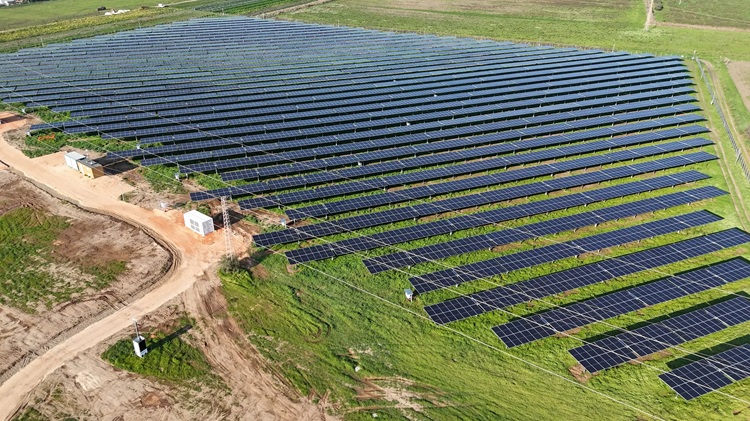
In southern Spain, Sierra DC and Go Energy are developing a 200 MW AI-focused data centre campus in Huelva, Andalusia, with an investment of 1 billion euros. The project will be powered entirely by clean energy from proprietary solar plants and supported by technology partnerships with TSK, NVIDIA and Power Electronics, ensuring full energy traceability from day one.
Strategic PPAs with global tech players
One of the most significant agreements in the market is the 150 MW power purchase agreement (PPA) signed between Microsoft and Iberdrola, aimed at supplying renewable electricity to Microsoft’s future data centers in Spain. The long-term contract includes energy storage and flexibility mechanisms to support grid integration.
Another notable deal involves TotalEnergies and Data4, under which TotalEnergies will supply 610 GWh of renewable electricity over 10 years, sourced from wind and solar assets in Spain. The contract, starting in January 2026, will be backed by renewable parks equivalent to 30 MW of installed capacity.
International interest continues to rise. Amazon, Microsoft and Google collectively have more than 1 GW under development across Aragón, Madrid and Barcelona. At the same time, companies such as Shell and NTT Data are strengthening their role as green energy providers, offering integrated clean power and storage solutions for high-consumption data centres.
Large-scale developments across regions
A key player is the joint venture Echelon Iberdrola Digital Infra, which is developing three data centre complexes in Madrid, Palencia and Álava, supported by 2 billion euros in investment approved by the European Commission. Its flagship project, Madrid Sur, already has 144 MW operational, 230 MW of guaranteed grid connection and expansion potential of up to 500 MW, all with access to high-capacity networks and renewable sources.
Other private groups are also moving forward:
-
Nostrum Group is building the Evergreen campus in Badajoz, with 500 MW planned and 1.9 billion euros in investment.
-
In Navalmoral de la Mata (Extremadura), MERLIN Properties plans two 100 MW data centres, with an initial 2 billion euros investment, potentially rising to 11 billion.
-
In Aragón, Grupo SAMCA leads the Green IT project, spanning 464,000 m², with 2.6 billion euros in investment and 2,300 construction jobs.
-
Quetta Data Centres is adding 30 MW between Molins de Rei (Catalonia) and its Tres Cantos campus near Madrid.
-
In the Valencia region, NXN, together with InfraRed Capital Partners, is developing a 30 MW campus in Paterna’s Technology Park, targeting institutional and fintech clients.
Grid planning and new regulation
Amid this expansion, Spain’s Ministry for the Ecological Transition and the Demographic Challenge is finalising the 2025–2030 Electricity Grid Development Plan, which will allocate an additional 3.8 GW of capacity specifically for data centres. The objective is to adapt the grid to accelerating digital demand without jeopardising system stability or slowing renewable deployment.
In parallel, a new Royal Decree is being prepared that will require operators with more than 500 kW of capacity to publicly report on energy efficiency, water usage, carbon footprint and waste heat recovery—setting stricter regulatory standards for the sector.
Industry debate at FES Iberia 2026
These challenges will take centre stage at Future Energy Summit (FES) Iberia 2026, to be held on February 12 in Madrid. The agenda will focus on energy storage, regulation, digitalisation and financing. One of the featured panels, “The era of renewable electrification: new solutions for an increasingly dynamic demand,” will include Arancha García, Chief Integration & Transformation Officer at Templus.
Templus is developing the first data centre in the autonomous city of Ceuta, presented in November at La Puntilla Port. The facility will be supplied with 100% renewable electricity via Red Eléctrica’s submarine cable, with commissioning expected in June 2026. Initial capacity will be 1.2 MW, expandable in later phases.
Officials from the ministry, IDAE and regional energy authorities have already confirmed their participation in FES Iberia, reinforcing the event’s role as a key forum for aligning public–private strategies in response to the exponential growth of digital demand.
With over 70% of Spain’s current power generation already coming from renewables and grid congestion emerging in several nodes, the viability of new data centres will depend on efficiency, technical feasibility and regulatory alignment. Spain is positioning itself as a competitive hub for this hybrid digital-energy infrastructure; however, its long-term success will hinge on maintaining a careful balance between digitalisation and energy sustainability.