








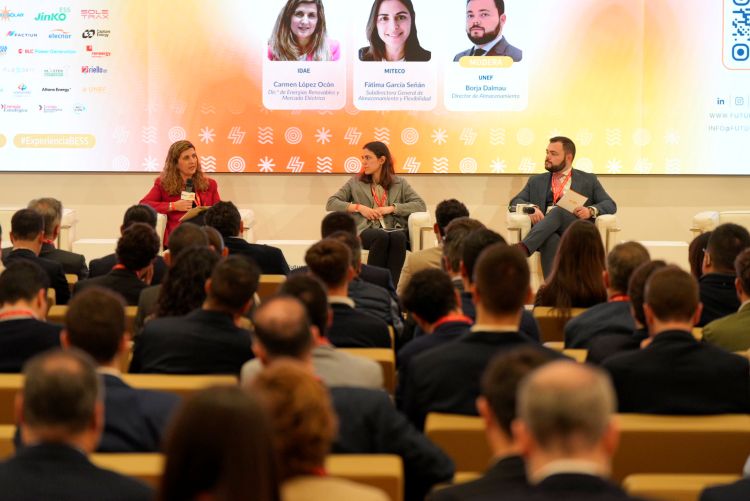
The opening of Future Energy Summit (FES) Iberia was led by senior officials from Spain’s Ministry for the Ecological Transition and the Demographic Challenge (MITECO) and the Institute for Energy Diversification and Saving (IDAE), who outlined the evolution of the renewable energy market and confirmed that funding applications have far exceeded the 700 million euros available under current calls.
FES Iberia 2026 delivered a strong signal to the market, before an audience of C-level executives, developers and investors: with more than 6 billion euros in aid requested against 700 million euros allocated, 2026 is emerging as a pivotal year for consolidating energy storage as a strategic pillar of Spain’s electricity system.
In this context, energy storage has been the segment attracting the greatest momentum. According to Carmen López Ocón, Director of Renewable Energy and Electricity Markets at IDAE, the latest European Regional Development Fund (ERDF) call, with a 700 million euros budget, received 1,750 applications requesting more than 6 billion euros in total support — “clearly demonstrating the sector’s level of interest”.
In the event’s opening keynote discussion, López Ocón and Fátima García Señán, Deputy Director-General for Storage and Flexibility at MITECO, agreed that flexibility and storage will cease to be complementary technologies and instead become structural infrastructure in a system with high renewable energy penetration.
From IDAE, López Ocón was unequivocal in defining the sector’s turning point: “With this regulatory framework, I believe 2026 will be a year in which the role of storage will be decisive.”
With an additional 10 GW of solar PV installed in 2025, Spain reached 103 GW of renewable capacity — equivalent to 70% of total installed power capacity — while renewable generation accounted for approximately 55.5% of the annual electricity mix. In this scenario, storage shifts from being complementary to becoming a condition for system stability.
From the Ministry, García Señán stated that the path towards increasing installed renewable capacity “must be accompanied by installed storage and flexibility capacity”.
She added that the system must “overcome certain challenges, such as price volatility, security of supply and renewable curtailment”.
The first concrete step has already materialised with the publication of the Royal Decree on Supply and Aggregation.
The official explained that the regulation “establishes the figure of the independent aggregator, sets the foundations of the aggregation model and mandates Red Eléctrica — Spain’s transmission system operator — to develop an operational procedure proposal”, enabling demand response to participate in the electricity market. The signal is clear: flexibility is beginning to be monetised.
In parallel, Spain’s capacity market mechanism is in the final stages of processing before the European Commission. García Señán stressed that the instrument will allow storage projects to receive remuneration for providing system services, strengthening project financing by offering stable, long-term revenues — a key element for investment in renewables and energy storage.
She further stated that the Government’s objective is “to provide credibility to a system with ever-increasing installed renewable capacity, ensuring that it remains secure and that mechanisms exist to guarantee this”.
In addition, she reiterated that one of the central objectives is precisely to reinforce confidence in a system with growing renewable penetration, ensuring both reliability and adequate safeguards.
This is complemented by forthcoming amendments to existing decrees — which will, for the first time, incorporate distributed storage — regulatory developments in non-mainland territories, and expected progress in the Demand Response Network Code, alongside instruments such as local flexibility markets and more flexible grid access schemes.
Record investor demand and industrial spillover effect
If the regulatory framework defines direction, the figures from funding calls reveal the scale of investor appetite.
López Ocón recalled that in 2021 IDAE received 13 billion euros under Spain’s Recovery Plan (NextGenerationEU), at a time when the institute had previously managed around 200 million euros annually through ERDF funds and the National Energy Efficiency Fund.
Under her leadership, 40 funding calls were launched between late 2021 and 2022, mobilising nearly 5 billion euros across green hydrogen, innovative renewables, district heating networks, fossil fuel substitution in cogeneration, energy storage and self-consumption.
Most projects involved hybridisation with existing renewable installations, although thermal storage and pumped hydro storage initiatives were also supported.
For 2026, the focus will shift to effective execution. López Ocón indicated that authorities expect projects awarded funding in recent years to begin materialising and coming online, generating a demonstration effect for subsequent initiatives.
“The challenge is ensuring that awarded projects translate into operational assets that consolidate system stability,” she stated.
Spain’s National Energy and Climate Plan (PNIEC) sets a target of 22.5 GW of storage capacity by 2030. However, López Ocón clarified that the debate is no longer centred solely on numbers, but rather on the fundamental importance of deploying storage to guarantee system stability and security.
Moreover, the energy transition is being conceived as an industrial lever. One of the funding calls incorporated a “restrictive” value chain criterion requiring minimum scoring linked to European-based manufacturing.
According to López Ocón, this approach is mobilising domestic production and strengthening technical capabilities. In this regard, she argued that the transition must advance not only towards energy independence, but also towards supply chain independence.
With aggregation already regulated, the capacity market in its final approval phase and funding demand nearly nine times higher than available resources, 2026 is consolidating its position as the year in which energy storage becomes strategic infrastructure within Spain’s electricity system.
Relive the event: https://www.youtube.com/watch?v=_G9kRTY2oU4