











Spain needs to install more than 4,500 MW of onshore wind power every year until 2030 to meet the targets set out in the National Energy and Climate Plan (PNIEC), which foresees total installed capacity reaching 59 GW. However, only 1,186 MW were installed in 2024, barely a quarter of what is required. The industry warns that, at the current pace, the target will be unattainable without urgent reforms.
“Growth should be much more linear and significantly stronger,” says Juan Virgilio Márquez, CEO of the Spanish Wind Energy Association (AEE). He stresses that annual installation volumes would need to quadruple compared to current levels, something that has never been achieved in the country’s history.
Spain currently has 31,679 MW of installed wind capacity, and wind power accounted for 23.9% of electricity generation in 2024, remaining the leading source in the national power mix for the third consecutive year. This is according to the Macroeconomic Study on the Impact of the Wind Energy Sector in Spain 2024, published by the association.
The AEE points to multiple structural barriers, including slow administrative procedures, a lack of coordination between authorities and legal uncertainty, particularly in some autonomous regions. “We have a governance problem and overly conservative criteria that are not aligned with European targets,” Márquez argues.
The most critical case is Galicia, where more than 2,500 MW that have already received authorisation are tied up in legal proceedings, corresponding to 97 wind farms, according to data from the regional government.
“We need any wind project that is mature and at an advanced stage of permitting or development not to be lost due to an administrative technicality related to a missed deadline, when that delay is not the developer’s responsibility,” Virgilio explains. “This issue was raised and partially addressed in Royal Decree-Law 7/2025, but it was ultimately not ratified.”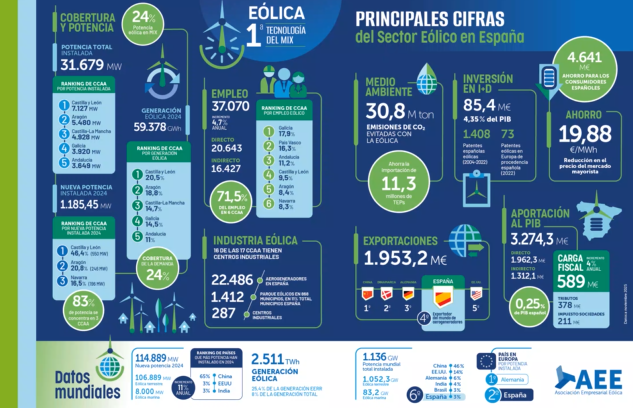
As for offshore wind, Spain still has no operational projects, but it already plays a significant role as an industrial supplier to the international market. In 2024, the offshore wind industry grew by 53% in GDP terms, driven by exports of wind turbines, floating structures and related technologies.
“Even without a single offshore wind farm, Spain is already a key player in the offshore supply chain. But it is time to accelerate domestic development as well,” underlines the AEE CEO.
Territorial deployment: three regions account for 83% of new capacity
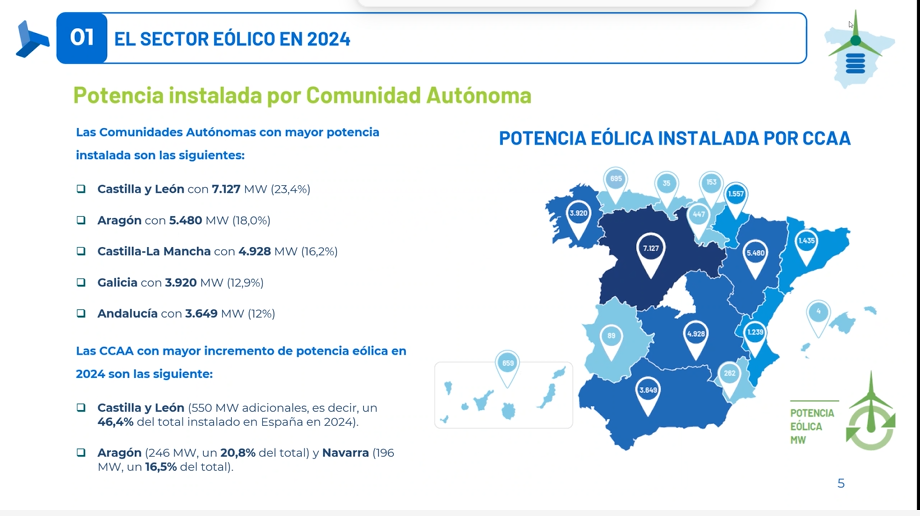
Against this backdrop, new wind capacity deployment remains highly concentrated in a small number of regions. In 2024, Castilla y León (550 MW), Aragón (246 MW) and Navarra (196 MW) accounted for 83% of newly installed capacity.
This territorial imbalance reflects differing levels of administrative efficiency and legal conflict across regions. “We hoped that this phase of the energy transition would lead to a more balanced territorial map,” Márquez notes, but disparities between regions are creating bottlenecks that slow development and complicate business planning.
Tax pressure, energy savings and PPA prices
The sector is also warning about the heavy tax burden faced by wind developers. In 2024, companies in the sector paid €588 million in taxes, equivalent to €232 for every €1,000 of revenue. “The current tax system penalises investment in renewables. We need a tax framework aligned with climate and reindustrialisation objectives,” Márquez insists.
At the same time, wind generation has delivered significant savings for consumers. In 2024, it reduced the average wholesale electricity price by €19.88/MWh, resulting in total savings of €4.64 billion.
“Wind power not only lowers the pool price, it also stabilises it, which is crucial for long-term contracts,” Márquez explains. In this context, Power Purchase Agreements (PPAs) are being signed at average prices of €60–70/MWh, reinforcing wind energy’s position as a stable and competitive option compared to other energy sources.
The impact of wind energy on the Spanish economy extends beyond the power system. In 2024, the sector contributed €3.27 billion to GDP, equivalent to 0.25% of the national total, and supported 37,070 jobs, both direct and indirect. Moreover, 46% of the sector’s added value came from industrial activities such as component manufacturing, technical maintenance and exports.
“Wind power is the only renewable technology with a 100% European value chain and a strong industrial footprint in Spain. It is a strategic asset that we must protect,” Márquez emphasises. According to the AEE, maintaining this capacity requires clear long-term signals and policies that ensure an attractive environment for manufacturers.
The Spanish Wind Energy Association insists that Spain has the natural resources, value chain, human capital and technology needed to meet its targets. However, it identifies a series of challenges that, if not addressed, could jeopardise the goal of reaching 59 GW of onshore wind and 3 GW of offshore wind by 2030.
These include accelerating the electrification of demand, improving administrative permitting, defining a clear roadmap for repowering and ensuring legal certainty in regions with high levels of project litigation. Faster grid connection processes, harmonised criteria across administrations and planning aligned with the country’s industrial capabilities are also essential.