






Spain begins shaping the next stage of electricity capacity access for new demand, after the first demand access capacity tender awarded 928 MW across five nodes of the transmission grid. The resolution marks a starting point for organizing grid access in a context of growing competition among industries, hydrogen projects, data centers and new industrial demand.
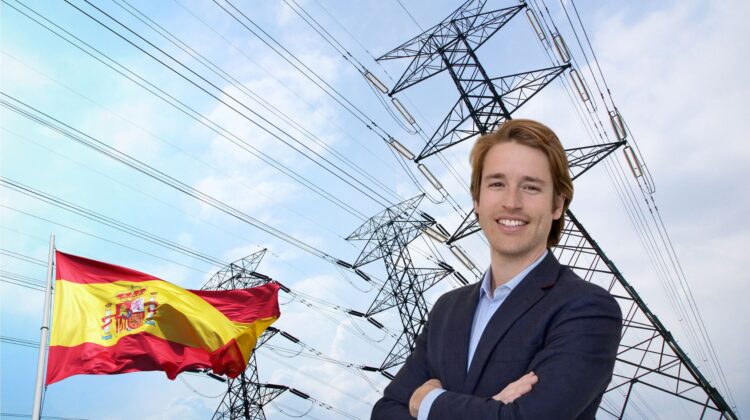
Looking ahead, the sector already expects new calls. Jorge González Onieva Johansson, Business Development Director at OSPREL, believes the next tender could move forward between the second and third quarter of the year, although regulatory adjustments are still under evaluation.
“There have been delays, but we may start to see demand tenders that move more quickly and are not stalled like generation tenders,” the executive explained in an interview with Energía Estratégica.
“The initial uncertainty is decreasing. The fact that a first process has already been called and resolved indicates that this mechanism will continue to move forward,” he added.
In this context, the executive also noted that upcoming processes could incorporate design adjustments, within a regulatory environment that is still evolving and where the sector may still provide feedback on the award criteria.
Balance of the first tender
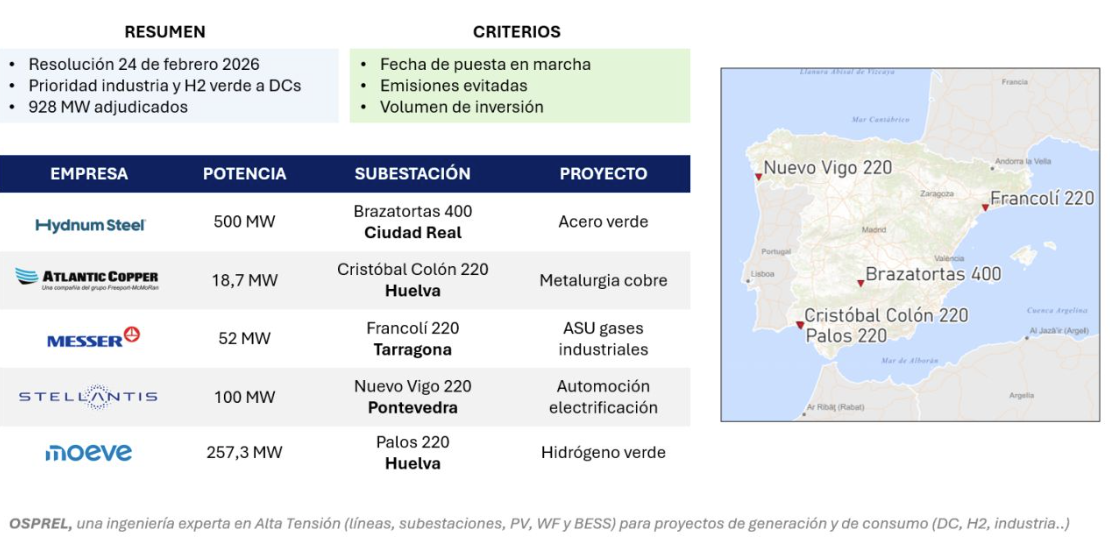
While the market awaits the next call, stakeholders are assessing the results of the first process. In total, 928 MW were awarded across five nodes of the transmission grid, with projects mainly linked to industrial electrification and green hydrogen development.
The awarded capacity was concentrated in the nodes Brazatortas 400 (Ciudad Real), Cristóbal Colón 220 (Huelva), Francolí 220 (Tarragona), Nuevo Vigo 220 (Pontevedra) and Palos 220 (Huelva).
Among the most notable projects are Hydnum Steel, which secured 500 MW for its green steel initiative in Puertollano; Moeve, with 257.3 MW linked to the Andalusian Green Hydrogen Valley; the electrification of Stellantis’ automotive plant in Vigo, as well as industrial developments promoted by Atlantic Copper and Messer.
“The resource of demand capacity is no longer something available to everyone; it has become a strategic resource and is starting to gain significant value,” the executive stated.
The tender mechanism emerged precisely as a response to the growing competition for grid access. According to González Onieva Johansson, this tool had previously been used to organize renewable generation access when certain grid nodes became saturated.
The first tender established three main evaluation criteria:
-
avoided emissions
-
project commissioning date
-
investment volume
In addition, developers were required to submit guarantees of €25,000 per MW for each criterion, as a mechanism to ensure compliance with the commitments made.
“Establishing criteria to determine which project should move forward is extremely complex, and not everyone will agree. The process compares initiatives with very different industrial profiles, timelines and impacts,” the executive warned.
One of the most sensitive factors is the comparison among projects, particularly those still under development and dependent on administrative processes.
“It is not easy to compare projects with very different levels of maturity. An industrial expansion at an already operating facility can deliver real electricity demand much faster, while a green hydrogen project usually operates on longer and more complex development timelines that depend on administrative approvals and may face delays,” González Onieva Johansson explained.
The tender design also classified projects according to their type of electricity consumption:
-
Type 1: hydrogen and renewable gases
-
Type 2: industrial electrification and mining
-
Type 3: data centers
The call prioritized the first two categories, which sparked debate regarding grid access for digital infrastructure projects.
“If the rules continue prioritizing hydrogen and industrial decarbonization, data centers could be pushed aside at certain nodes if categories 1 and 2 absorb the available capacity,” the executive noted.
This issue becomes particularly relevant as Spain is experiencing strong growth in data center projects, driven by the expansion of artificial intelligence and cloud services.
“In Spain, data center development is growing rapidly, and the bottleneck is electricity capacity. There is plenty of investment and plenty of projects,” González Onieva Johansson said.
According to official government sources, 12 GW of power capacity has already been granted to projects linked to data centers. The volume of initiatives currently under development mobilizes more than €30 billion in investment, with projects still pending energy supply agreements, grid permits and joint strategies between utilities, technology companies and project developers.
In addition, according to DataCenterMap, Spain already has around 180 data center projects across more than 60 cities, with Madrid and Barcelona as the main hubs, followed by Zaragoza, Bilbao, Valencia and Seville.
75 grid nodes identified for future tenders
At the same time, Red Eléctrica, Spain’s transmission system operator, has already identified a broad map of locations where new demand access capacity tenders could be launched.
According to an update published on March 16, 2026, there are 75 nodes in the transmission network potentially eligible for new tender calls, distributed across 220 kV and 400 kV infrastructure in different regions of the country.
These nodes are located across autonomous communities including Andalusia, Castilla-La Mancha, Castilla y León, Aragón, Extremadura, Galicia, Catalonia, the Valencian Community and the Community of Madrid, among others.
For energy developers and large electricity consumers, this map anticipates the next phase of competition for grid capacity—an increasingly decisive factor in determining the location of electrified industries, green hydrogen projects and data centers.
In this scenario, electricity demand growth emerges as a key element for the country’s economic development.
“We need more electricity consumption to grow as a country, expand our industrial base and generate more business,” González Onieva Johansson concluded.
According to the executive, the challenge now will be ensuring that future tenders move forward with greater agility, allowing the power system to keep pace with the industrial and technological expansion projected for the coming years.
Meanwhile, the sector is closely monitoring the regulatory proposal on flexible demand, which could open complementary mechanisms for certain large electricity consumers and add new alternatives to the purely competitive tender scheme.