










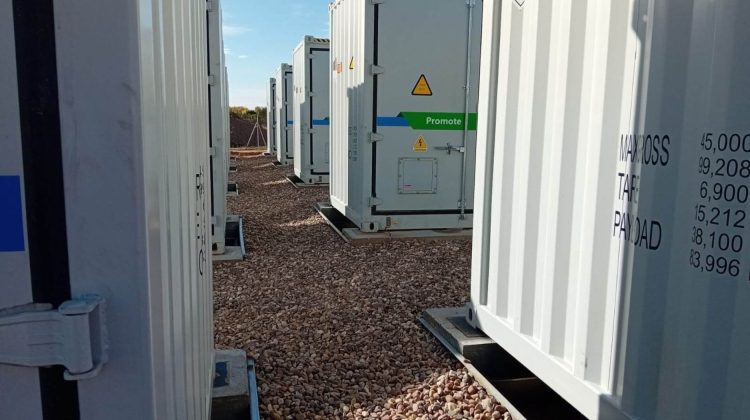
The Spanish renewable energy company Solaria Energía y Medio Ambiente has secured favourable Environmental Impact Assessments (EIA) for the installation of 480 MWh of battery energy storage systems (BESS) linked to seven solar photovoltaic (PV) plants located in Castilla-La Mancha, Spain.
The approvals allow the company to advance the hybridisation of existing renewable energy assets, enabling a more efficient use of grid infrastructure while increasing flexibility within the Spanish power system.
Hybrid solar-plus-storage configurations are increasingly seen as a key solution for grid integration of renewable energy, as they allow developers to store excess solar generation and dispatch electricity when demand or market prices are higher.
Earlier this year, in February, Solaria also announced the acquisition of 516 MWh of battery storage systems, which will be deployed across eight of its solar PV projects in Spain. The investment totals €150 million and reinforces the company’s strategy of vertical integration and optimisation of renewable assets.
The storage systems will be integrated into the projects El Baldío 2, Tordesillas 3, Valdelosa, Guleve, Draco, Juno 1, Santiz 1 and Pegaso.
With these latest approvals, Solaria now totals 3,280 MWh of battery storage capacity with environmental clearance, consolidating its position as one of the most advanced developers in utility-scale energy storage in Southern Europe.
The development of BESS projects forms a central pillar of Solaria’s strategy to integrate renewable generation, energy storage and grid infrastructure. The objective is to improve the dispatchability of renewable power, optimise participation in electricity markets and facilitate the integration of additional renewable capacity into the grid.
The company is continuing to execute its long-term growth strategy, which includes a significant expansion of energy storage capacity in Spain and other European markets. Storage is increasingly considered a critical component to ensure power system stability amid accelerating electrification of the economy, as well as rising electricity demand linked to industrial activity and digital infrastructure such as data centres.