










The global photovoltaic market is entering a transition phase after two years of intense competition and declining solar module prices, in a context where the sector is beginning to observe cost pressures linked to raw materials and regulatory changes.
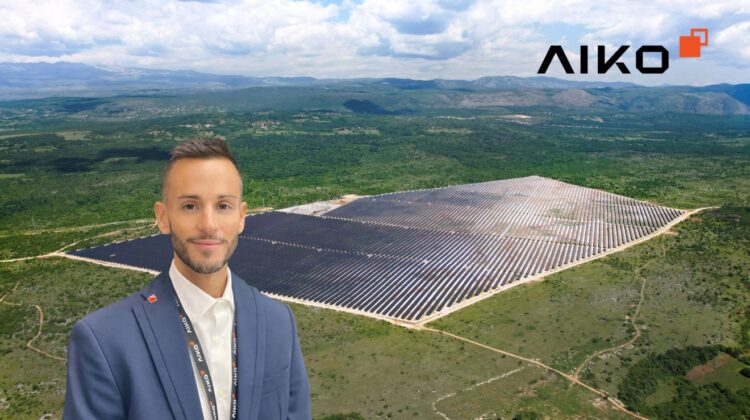
“The cost outlook for 2026 is upward and will be mainly driven by three factors: the price of silver, the increase in silicon, and the cancellation of the 9% export tax rebate as of April 2026. Considering only these three factors, the estimated increase is around +0.20–0.22 CNY/W,” said Guillermo Estébanez, Product Solution Manager Southern Europe Utility at AIKO.
The executive explained that the market has recently reached its lowest point after a prolonged period of price declines. “Over the past two years, module prices dropped drastically due to extreme competition, which in many cases deteriorated margins, but also product quality and raw materials,” he stated in an interview with Energía Estratégica.
“The price of silver rose from 8,000 to 27,000 CNY/kg during 2025, with an estimated impact on the average price of +0.13 to +0.15 CNY/W,” the executive explained.
This scenario is also compounded by fluctuations in silicon prices within the photovoltaic supply chain, another key component in cell manufacturing.
“Every 10,000 CNY per tonne increase in silicon prices translates into a module cost increase of between 0.02 and 0.03 CNY/W,” Estébanez specified.
Likewise, the executive warned that the sector will have to absorb the impact of fiscal changes in China that will affect exporting manufacturers.
“The cancellation of the 9% export tax rebate as of April 2026 will have an estimated impact of +0.05 to +0.06 CNY/W,” he added.
Meanwhile, the European market is going through a phase of moderation in its growth rate after several years of accelerated expansion.
Estébanez noted that, although global demand remains high, the region showed signs of slowdown over the past year. “With between 600 and 650 GW, in 2025, the solar market in the European Union declined slightly compared to 2024,” he indicated.
Specifically, the continent recorded around 65.1 GW installed, representing a slight year-on-year decrease of –0.7%.
According to the executive, this dynamic is mainly due to the reduction of subsidies in some countries and bottlenecks in energy infrastructure, especially in grid connection processes.
“Short-term demand remains moderate, while long-term growth is expected to be steady,” he stated.
Despite this pause in the pace of expansion, the outlook for the European market remains significant. The European Union maintains its target of reaching 750 GW of installed solar capacity by 2030, which will require sustaining a high deployment rate in the coming years.
Within this landscape, Spain continues to position itself as one of the most relevant markets on the continent. The country has set a target of reaching around 76 GW of installed solar capacity by 2030, thus driving the expansion of the renewable energy mix.
Against this backdrop, AIKO is reinforcing its technological strategy through research and development as one of the central pillars of its market positioning.
“R&D is one of our main hallmarks,” Estébanez stated.
Currently, more than 20% of the company’s employees work in this area, supported by more than €450 million invested over the past three years and more than 1,000 registered patents.
According to the executive, this approach enables the acceleration of innovation cycles and the optimisation of technology performance. “AIKO is one of the few manufacturers that control the entire value chain, from quartz, polysilicon, wafer, cell, to module,” he highlighted.
Within this framework, the company is developing solutions aimed at improving efficiency and reducing dependence on critical raw materials.
“We started some time ago to develop more reliable, low-cost solutions. One of them is the use of copper instead of silver for metallisation, which not only allows cost reduction, but also ensures supply chain stability and high reliability and conductivity,” he pointed out.
New generations of modules for different segments
In parallel with its R&D strategy, AIKO introduced new generations of modules aimed at different segments of the photovoltaic market, from residential installations to utility-scale projects. Among the new products are the Neostar, Infinite and Stellar series, which incorporate All Back Contact (ABC) technology to maximise light capture and improve panel efficiency.
According to Estébanez, third-generation models introduce improvements in power, efficiency and durability. Among them, the Neostar 3P54 stands out, reaching up to 500 W of power and efficiency close to 25%, while for large-scale plants, the company developed the second generation of Stellar, specifically the Stellar 2N+, with outputs of up to 680 W and bifaciality levels of around 80%. These solutions aim to optimise energy production, reduce electrical losses and improve project performance over their lifetime.
“We are entering an era of value-driven competition, driven by end-user needs. With module efficiency increasing from 21% to 25%, and with prospects of reaching 35% in 15 years, we are focusing on value-driven, customer-centric innovation,” concluded the company’s representative.