









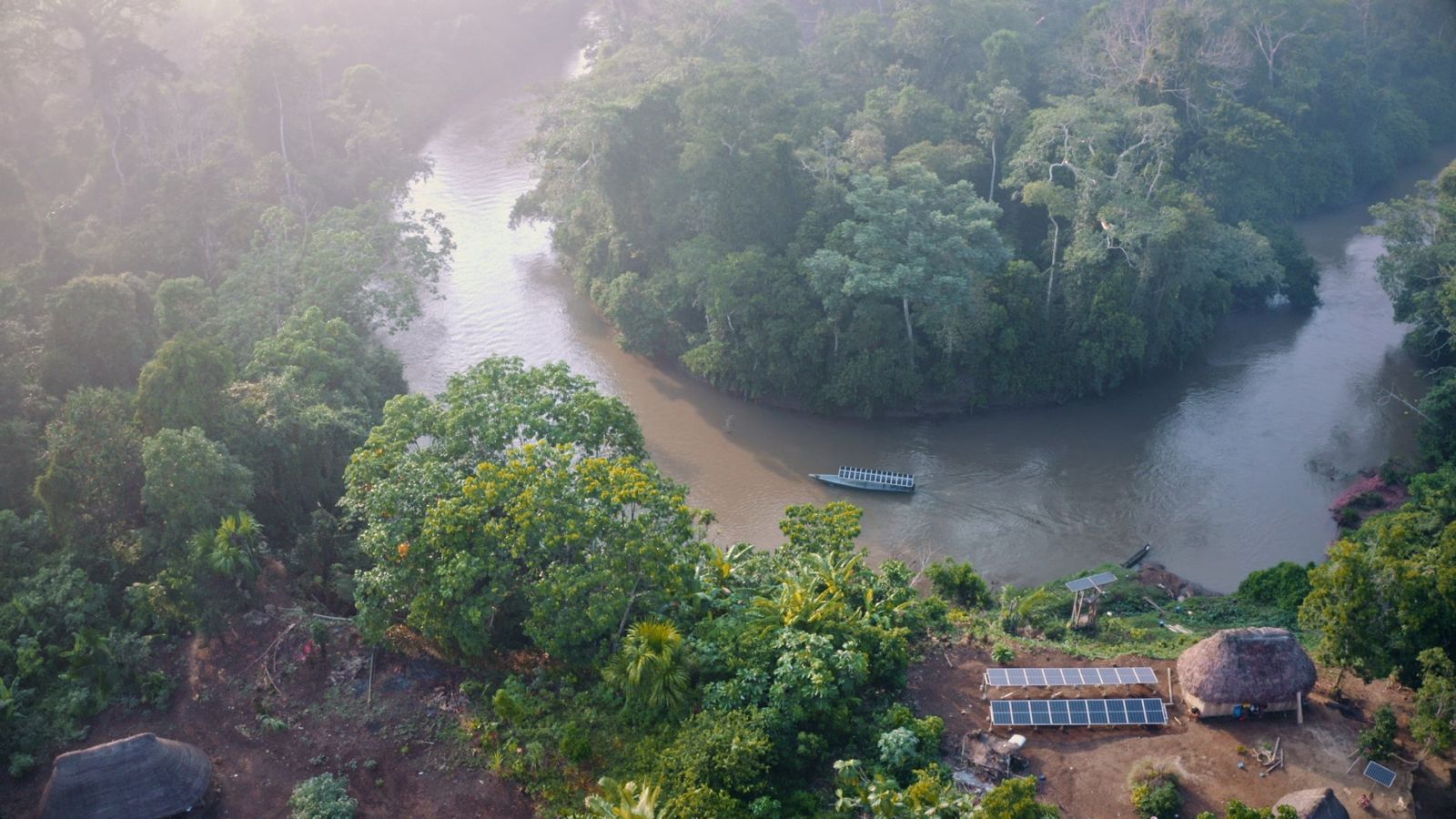
With scalability in mind, the foundation Kara Solar plans to deploy 100 electric peque-peques—small river boats widely used across the Amazon—and 25 community solar charging stations in Ecuador’s Pastaza province over the next three years.
Its long-term vision is even more ambitious: to have 10,000 electric vessels navigating the Amazon by 2030, under a sustainable mobility model designed from and for the territory itself.
The boats are lightweight and equipped with 5 kW electric motors, equivalent in power to conventional 9 HP petrol engines.
“We have already manufactured these motors specifically designed for Amazonian conditions, and 10 units will soon be deployed in the territory,” explained Walter Washikiat, a solar technician at Motores Amazonas—a joint-stock company created by Kara Solar to design and manufacture advanced, in-house motor technology adapted to the tropical rainforest.
This roadmap does not start from scratch. Kara Solar has already developed 12 community solar-powered boats, currently operating in Ecuador, Peru, Brazil, Suriname and the Solomon Islands. Fitted with rooftop solar panels or connected to land-based charging stations, the vessels carry an average of 15 passengers and up to 1,200 kilograms of cargo.
“More than an energy solution, this is a way to halt the advance of roads that destroy the rainforest,” said Nantu Canelos, president of Kara Solar. The system eliminates the use of petrol, reduces noise pollution and prevents river contamination from lubricants.
In Ecuador alone, the boats travel an average of 423 kilometres per month. This level of operation avoids the consumption of around 6,500 gallons of petrol and prevents 52 tonnes of CO₂ emissions per year.
“For us, this is not just rhetoric—it is concrete proof that everything is possible in the Amazon,” Canelos added.
The equipment produced by Motores Amazonas is simple, robust and repairable, designed to operate in environments with high humidity, intense rainfall and limited access.
Colombia cuts power exports to Ecuador as tariff dispute strains Andean energy integration
Beyond the boats themselves, the ecosystem includes community solar hubs, where batteries are recharged, and electricity is supplied to schools, health centres, tourism initiatives and environmental monitoring projects.
To sustain this expansion, Kara Solar has trained more than 50 qualified Indigenous technicians, along with hundreds of people with basic technical skills. These local teams are responsible for maintaining the solar systems, vessels and charging stations.
Alongside the development of jungle-ready electric motors, Kara Solar is also working on accessible financial models tailored to the Amazon. Through its Solar Rivers programme, communities can access the equipment via long-term payment schemes similar to leasing arrangements, helping to overcome the barrier of upfront capital in regions with limited liquidity.
Kara Solar does not seek to replicate its model rigidly. On the contrary, its expansion strategy is based on cultural and territorial adaptability, with direct community participation.
“We do not impose it—each community decides whether it wants to implement the system,” Canelos said.
The prototype has already attracted interest from other Indigenous territories and peoples. The experience of the Achuar communities—who played an active role in designing the electric peque-peques—is emerging as a reference point for future deployments across the region.
Canelos stressed that scaling up will require coordination with the state.
“Just as urban transport is subsidised, sustainable river transport systems in Indigenous territories should also receive public financing,” he argued.
Solar-powered river mobility does more than solve transport challenges. It connects essential services, supports productive activities, strengthens the bioeconomy and avoids road construction that leads to deforestation and undermines national biodiversity and climate goals.
Beyond the technical dimension, the initiative is rooted in a deep cultural narrative. “Kara means ‘dream’ in our language. The name comes from an ancestral vision of an electric fish navigating our rivers,” recalled Canelos. Today, that vision is taking tangible form through electric boats driving an energy transition from and for the Amazon.