







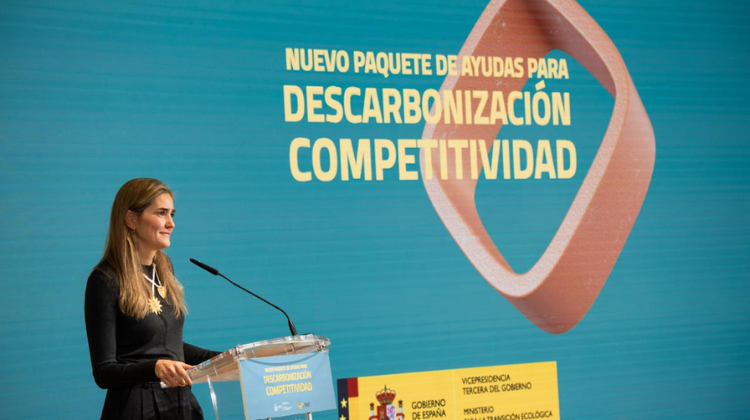
The Vice President of the Government and Minister for Ecological Transition and the Demographic Challenge, Sara Aagesen, presented this morning a new aid package for decarbonization and competitiveness, endowed with approximately €2 billion. These funds will be allocated to projects that strengthen the industrial value chain and promote the energy transition in general, with support for electric mobility, innovative renewable solutions, repowering, and energy storage, among others. Furthermore, many of the eligible projects can be implemented after August 31, 2026, the deadline for justifying the aid received under the Recovery, Transformation and Resilience Plan (RTRP).
“With just one month to go before the fourth anniversary of the PERTE ERHA (Strategic Plan for the Renewable Energy of the Habitat), half a million actions of all kinds have been implemented, and now we are continuing this work with this new package of measures aimed at further leveraging decarbonization to boost competitiveness in four key areas: the industrial value chain, the integration of renewable solutions into the economic fabric, a renewed push for electric mobility, and innovative thermal solutions in the industrial and residential sectors. In short, this package will allow us to advance the model that has enabled us to become a benchmark for economic and environmental progress, industrial modernization, and the fight against climate change,” stated Vice President Aagesen during her address, which can be viewed here .
The new package draws on funds from the Recovery, Transformation and Resilience Facility (RRF), and some of its most important lines of action fall under the European framework for state aid for clean industry (CISAF), approved last June. CISAF allows aid to be allocated until December 31, 2028—and distributed beyond that date in some cases—thus providing greater security for initiatives related to the industrial value chain.
The Commission has already approved a €700 million aid scheme under the CISAF and it is expected that other PRTR-funded but particularly complex projects, such as geothermal ones, may be implemented after the PRTR deadline of 31 August 2026.
INDUSTRIAL VALUE CHAIN
In June, €300 million was awarded for 33 value chain projects across 12 autonomous communities, focusing on photovoltaics, wind power, heat pumps, electrolyzers, and related components. New calls for proposals are now planned—one is already underway—with funding of €300 to €350 million, which will also cover the manufacture of other equipment covered by the CISAF (Spanish Association of Energy Efficiency and Manufacturing), related to energy efficiency, the electrical grid, and transformative industrial technologies, such as electric arc furnaces.
This same chapter includes a new line of funding aimed at adapting port infrastructure to develop renewable technologies such as offshore wind power, with approximately 200 million euros, the processing of which began last July.
And the promotion of renewable hydrogen will continue, for which more than €3 billion has already been allocated through numerous support programs. The new aid will provide funding for both the initial investment in projects (Capex) and hydrogen production (Opex), with a budget of €300 to €450 million.
INTEGRATION OF RENEWABLES
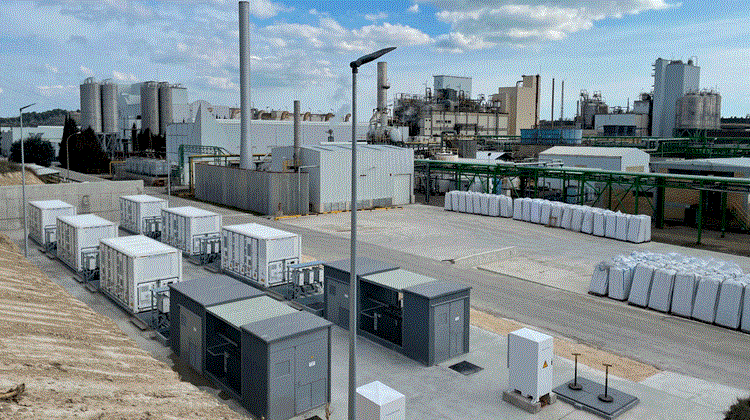
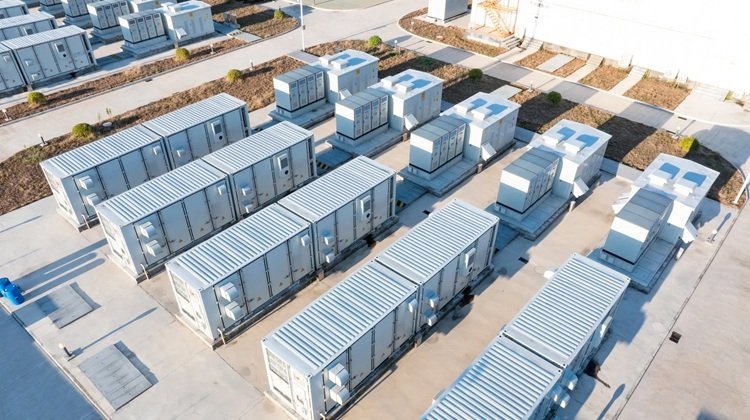
The first call for proposals for the repowering aid program awarded €186 million in October 2023. Now, in accordance with initiatives such as the future National Roadmap for Boosting Repowering, a second call will be launched, focused on wind power, which will also promote the hybridization of facilities with storage, with a budget of €300 to €350 million.
Likewise, there will be a second call for aid for pumped hydroelectric plants, essential for having more energy storage, with an allocation of 100 million, identical to the first call, decided in July 2024.
There will also be a new call for proposals for innovative renewables with storage, following the allocation of €148.5 million to the first round in July. The positive reception and transformative potential of agrivoltaic, floating photovoltaic, and infrastructure integration projects have led to the allocation of between €150 and €200 million.
On the other hand, a ministerial order is already being processed to allow renewable energy projects financed under the PRTR, but particularly complex ones, such as geothermal –120 million euros were awarded in February 2024–, marine energy or biogas, to extend their execution period until beyond August 2026. The order will be approved after receiving the European Commission’s confirmation that they fit within the new aid scheme established to improve the absorption of EU funds from the Recovery and Resilience Facility.
BOOST TO ELECTRIC MOBILITY
Regarding electric mobility, the package includes two calls for proposals to boost areas that require support, after the various calls for proposals of the Moves programs have had 2.735 billion available in recent years.
The first initiative focuses on installing charging points along major roads, with a new Moves Corridors program, which will receive between €150 and €200 million. The second initiative will address the consolidation of electrified delivery fleets, with a new Moves Fleets program that will receive €50 million.
THERMAL SOLUTIONS
The fourth axis of the Package includes two lines to promote the use of heat and cold, both in the industrial and residential sectors.
Thus, a new call for proposals will be launched to help fossil fuel cogeneration plants transition to electrification. The first call, awarded in December 2023, granted €46 million, and this new call proposes a budget of €40 to €75 million.
This same range of funds is planned for a new line of aid for heating and cooling networks, which received 35 million in the first call, in July 2023.