







In the context of Genera 2025, SolaX Power arrived with a clear message: advancing energy storage and fast-charging infrastructure in a market still searching for its equilibrium. In a conversation with Energía Estratégica, Rodrigo Ruiz Campo, Country Manager for Spain and Portugal at the Chinese manufacturer, shared his perspective on what lies ahead for the Iberian market.
—Rodrigo, as the year comes to an end… how do you assess 2025 for SolaX in the Spanish and Portuguese markets?
It has been a good year. We did not see exponential growth compared to 2024, but we achieved something important: we entered segments that we previously did not address, such as industrial and utility-scale projects. The residential segment, on the other hand, stagnated for us; we only grew in the number of batteries sold.
—Did this diversification also shift the business distribution in the region?
Absolutely. Until recently, 90% of our sales were residential and only 10% were commercial-industrial. Today the split is 75%–25%, and we expect it to reverse within two years. In other markets—such as the Netherlands or the United Kingdom—that transition already happened. Spain is moving in that direction, with large projects now underway.
 —Energy storage was one of the main highlights at the fair. How do you see that market today?
The promise of energy storage is not new. The technology has been mature for some time; what was missing was profitability. That is finally beginning to emerge this year. In some markets, like Chile or the Netherlands, storage is already viable. In Spain, it still depends too heavily on the specific application.
—What do you consider the main barrier preventing the market from taking off in Spain?
The problem is not technical. It is that electricity prices remain low, regulation is not aligned, and political uncertainty does not help. Many believed 2024 would be the year of storage… but it wasn’t. Neither will 2025. But 2026 will have no choice but to be.
—“No choice”? That sounds categorical…
Indeed. Some power plants are no longer profitable and must be hybridized, with or without subsidies. And subsidies are not the driver—they are the brake. Projects that know they cannot qualify for subsidies will be the ones that push the technology forward. Incentives often delay decision-making. What we need is a self-sustaining market because these plants must be hybridized. This should have happened last year.
—How much storage capacity should Spain be deploying today?
If we follow the Spanish Government’s targets, such as those outlined in the National Energy and Climate Plan (PNIEC), Spain should be installing between 1 and 2 GW per year. But for that you need legal, political and financial certainty—none of which is present today. Political volatility, geopolitical conflicts and certain leaders manipulating the status quo do not create the stability required for large-scale investment.
—So the country will not meet those targets?
No. Spain will move in waves. Instead of installing 1 or 2 GW per year, there will be a single year with 5 GW deployed all at once.
—And when do you expect that boom?
I believe it will come in 2027. But 2026 will already be the first year with a truly significant volume.
—Given this context, how is price competition affecting the storage market?
There is always risk when regulation is uncertain. Some players sell at a loss to penetrate the market. We don’t follow that approach; we prioritize stability and service. Many applications depend heavily on lithium, and since June the price of raw lithium has increased by 9%. That cost flows directly into cell production. Some manufacturers absorb it to remain competitive, but that jeopardizes quality. We will not lower our standards just to compete on price.
—Operationally, how long does it take to close a storage project?
It depends on the client. In commercial-industrial projects, we have seen timelines of up to 18 months. Others—already under analysis since the blackout—closed in six. Less than four months is very difficult. For utility-scale projects, the minimum is two years from the start of the technology assessment to commissioning.
—Beyond storage, you are also investing in fast chargers. How does this fit into your portfolio?
It is part of our integrated solution. We began working with fast chargers in March. Within our industrial storage cabins, we saw them as an efficient and low-cost way to manage demand peaks and reinforce grid nodes, especially in countries that are electrifying transport. They operate together with our industrial storage systems. The logic is simple: we charge at night and discharge with higher power during the day, without increasing contracted capacity. This allows vehicles to charge faster without reinforcing the grid.
—Who are the clients for this solution?
Two main profiles: integrators, to whom we provide the complete package (storage, solar PV and charger), and charge-point operators (CPOs). However, CPOs usually want a fully integrated, ready-to-deploy solution. That is why our strategy focuses on working through integrators.
—What target are you setting for Iberia for 2026?
We have several projects already at an advanced stage. If everything goes well, we could deliver up to 150 MWh of storage next year. A more realistic scenario would be around 50 MWh—not due to production capacity, as we manufacture 150 MWh per month, but because project maturation timelines in Iberia are slower.
—Beyond business results, what personal goals do you set for this new cycle within SolaX?
I am very happy at SolaX. I have been in the renewable energy sector for more than 20 years, and these 18 months have been the most enjoyable of my career. It’s not only the product quality—it’s the human team and the freedom I have to bring our message to the market.
—What message would you like to leave the sector from your position in the company?
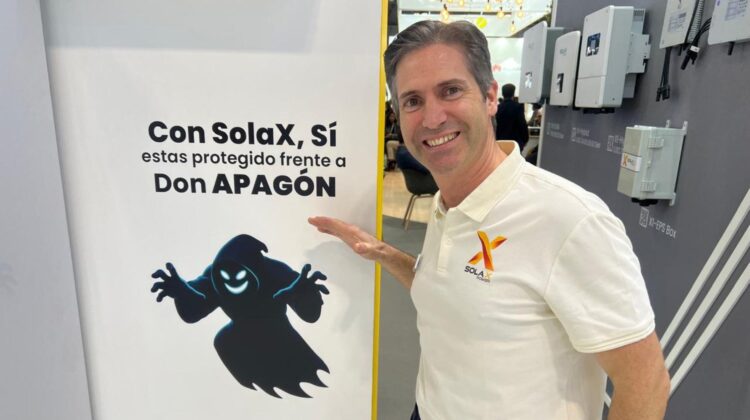
We have developed what we call the “SolaX Powers”: quality, flexibility, profitability, robustness and reliability. And we put all of these at the service of our customers to help them overcome today’s challenges—enemies like Lady Pollution, Mister Blackout and Madam Electricity Bill. That is our mission, and the mission of Super SolaX.
SolaX Power is entering the large-scale storage segments with force, adapting its portfolio to a new phase in the Iberian energy market. While subsidies continue to generate uncertainty, the company’s strategy focuses on anticipating an inevitable boom in energy storage—one that, according to its forecasts, will materialize between 2026 and 2027.
| Topic | Key Insights from Rodrigo Ruiz Campo |
|---|---|
| Market focus | Expansion into industrial and utility-scale storage; residential demand stagnated except for batteries |
| Sales mix shift | From 90% residential → now 75% residential / 25% C&I; expected reversal within two years |
| Storage profitability | Viable in markets like Chile and the Netherlands; Spain still dependent on application and regulation |
| Main barriers | Low electricity prices, weak regulatory support, political instability |
| Expected storage boom | Significant growth starting 2026; major boom forecast for 2027 |
| Annual capacity needed | 1–2 GW/year to meet PNIEC targets—currently unlikely |
| Price competition | Some players selling at a loss; SolaX emphasizes quality and service |
| Project timelines | C&I: 6–18 months; utility-scale: minimum 2 years |
| Fast chargers | Integrated with industrial storage; used to manage demand peaks and reinforce grid nodes |
| 2026 target | 50–150 MWh deployable depending on project maturation |
| Company vision | “SolaX Powers”: quality, flexibility, profitability, robustness, reliability |