








Spain stands at a crossroads: it can become one of Europe’s leading hubs for renewable energy investment or miss the opportunity due to insufficient grid infrastructure and unclear regulatory signals.
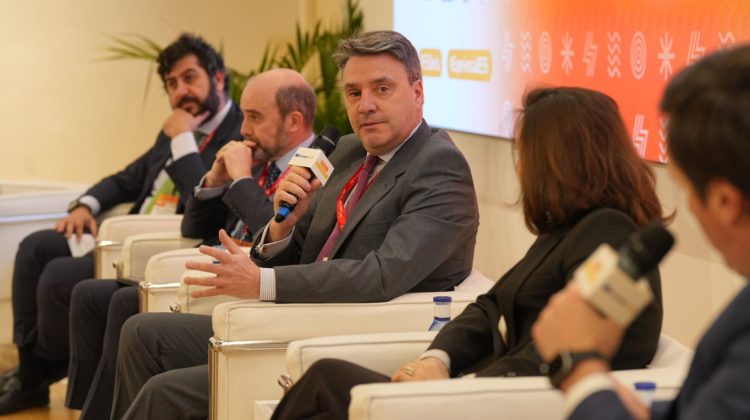
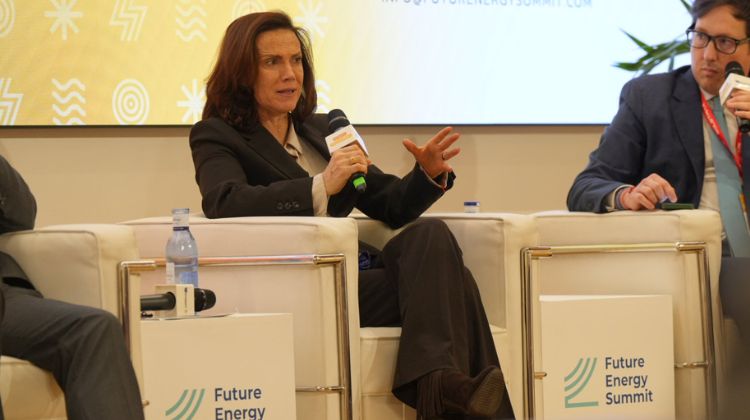
That was the warning delivered by Rocío Sicre, Chief Executive Officer of EDP Spain, during FES Iberia 2026 before an audience of 500 energy executives, as she argued that the bottleneck is no longer generation capacity but grid infrastructure and demand transformation.
“We need investment in grids and we need investment in demand. Capital is mobile and can choose to come to Spain or go elsewhere. Here we have all the conditions: competitive prices, clean energy and one of the best levels of connectivity in Europe. We must be able to capitalise on that,” Sicre stated.
The figures reinforce her position. “For every euro invested in generation, only 0.4 is invested in grids – that makes no sense,” she warned. This imbalance is compounded by a structural constraint affecting renewable energy integration across the continent: 40% of Europe’s electricity grid infrastructure is more than 40 years old.
“I would ask the regulator to seek balance. We must open the door to demand, avoid overregulation and find equilibrium between long-term visibility for investment, economic security and a stable regulatory framework – which at present does not exist,” the executive noted.
According to Sicre, this lack of predictability ultimately affects both new renewable energy projects and the development of electrified consumption. Grid node saturation and simultaneous competitive tenders for both generation and demand capacity are creating a standstill that, in practical terms, is limiting system expansion.
“We are allocating almost all grid nodes through competitive tenders, which is causing paralysis in the development of demand. It cannot be the case that we have a system with no room for additional capacity,” she argued.
She also pointed to taxation as part of the imbalance. “Electrification and the entire power sector face a tax burden significantly higher than other sectors,” she said.
For Sicre, the risk is not technological but structural. Spain has competitive renewable resources and advanced grid connectivity, yet without infrastructure modernisation and clear regulatory signals, the integration of new capacity and the inflow of renewable capital could slow.
In this context, she stressed that the energy transition can no longer be analysed solely through a climate lens. “The transition goes beyond climate. We are now talking about security and energy independence,” she affirmed.
Hybridisation and storage: a technological response to a constrained system
In response to a power system that requires greater flexibility and integration capacity, EDP has been advancing an operational model based on technological complementarity. For Sicre, the debate is no longer about adding more renewable megawatts, but about managing when and how they contribute to the system.
“We are no longer seeking to produce more megawatts; it is about when to produce the megawatt and how to produce it,” she said during the event.
This approach underpins the company’s hybridisation strategy, which began in 2016 with a pilot combining hydropower and solar PV. In 2022, EDP commissioned a floating solar project integrated with hydropower at Alqueva, Portugal. In 2023, it advanced hybrid schemes combining hydropower, solar PV and wind power in Poland and across Iberia, and it currently holds more than one gigawatt of solar projects in its regional pipeline.
The next phase incorporates energy storage as a structural component of the model. “We are about to launch our first project combining wind, solar and battery storage,” she announced.
In her view, battery energy storage systems should not be treated as conventional loads but as system management assets. However, she again pointed to the regulatory framework. “It makes no sense for storage, when applying for grid access, to compete with any other type of consumption. This is where we must introduce the concept of flexibility,” she emphasised.
For the CEO of EDP Spain, recognising the flexible nature of energy storage is essential to optimise existing grids, improve renewable energy integration and enhance system stability in a context of rising variable renewable penetration.
The group’s technological strategy therefore aligns with the structural diagnosis presented to the regulator: without modern grid infrastructure and differentiated rules for flexible assets such as storage, the power system risks losing efficiency and competitiveness in attracting renewable energy investment.