







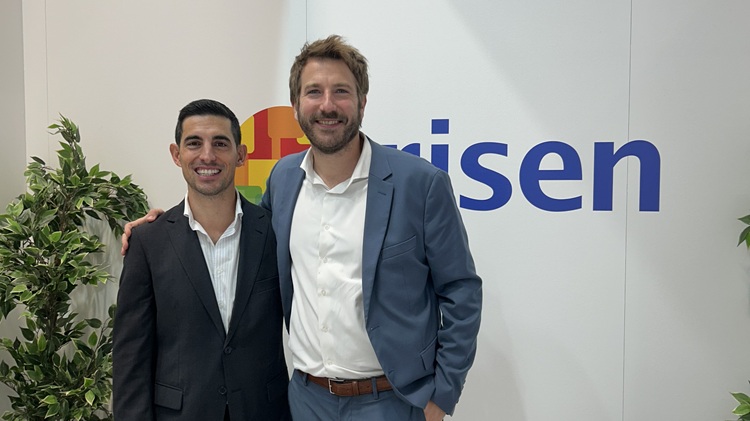
Risen Energy, long recognised as one of the major global manufacturers of solar photovoltaic modules, is expanding its European strategy with a strong push into the energy storage business. At GENERA 2025, Spain’s flagship clean-energy trade fair, the company unveiled a new line of batteries for residential, commercial and industrial (C&I), and utility-scale applications.
In conversation with Energía Estratégica, Andrés Pinilla Antón, Head of Storage for Europe and Latin America, outlines why Spain is emerging as a key driver for storage in 2026, how market conditions are evolving, and how Risen Energy intends to compete with a comprehensive ecosystem of services.
- Andrés, to begin, what new products is Risen Energy presenting this year?
Risen is significantly expanding its focus on storage while maintaining a solid position in the solar PV business. This year we are introducing new systems for the residential, C&I and utility-scale segments, reinforcing a strategy in which storage takes an increasingly central role alongside our module offering.
- Which segments are you prioritising?
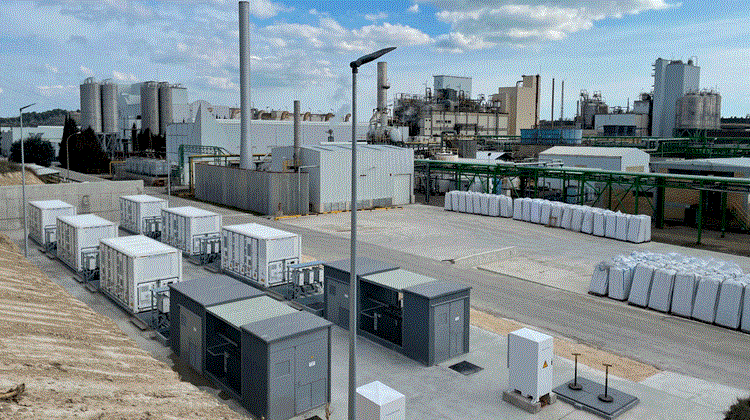
We are bringing solutions mainly for the C&I storage market. We continue offering our 100 kW / 215 kWh system, but we are now presenting a more robust option at 125 kW / 261 kWh, with 400 V output, ideal for self-consumption systems, factories and industrial facilities.
- At what moment in the market is this launch happening?
Until now, we have gone through many months of issuing quotations to gauge market appetite, running financial models and confirming whether projects are viable. All signs point to 2026 being a decisive year for storage in Europe. We believe that is when the market truly takes off.
- What is driving so much optimism?
Mainly, the data comes from Spain. In 2025, the country will have already recorded more than 800 hours of zero or negative electricity prices, which strongly affects nodes under heavy curtailment. Some projects are simply not bankable anymore without storage. ESS is no longer optional; it has become a must-have.
- Is there a shared sense that the market will grow significantly?
Yes. Many developers view storage as the pathway to making their projects viable again through hybridisation. Hybridisation permits in Spain take between 18 and 24 months, which is why the players who anticipated this trend in 2022 or 2023 are now reaching the ready-to-build stage. This is the moment when procurement begins.
- And how will Risen compete in this environment?
We do not want to simply sell a storage product. Our goal is to offer the entire ecosystem — a complete, integrated solution.
- Can you explain the model?
If you are an end customer, we support you from system selection through EPC partners, converters, medium-voltage equipment and the energy management system (EMS), all the way to two critical aspects: route-to-market and financing. We want customers to know who will operate their battery and how to maximise every revenue stream. We have partners interested in investing; the challenge lies in structuring the model correctly, building budgets and understanding how to execute revenue stacking. But the appetite to deploy capital is definitely there when the proposal is solid.
- Is this time for real?
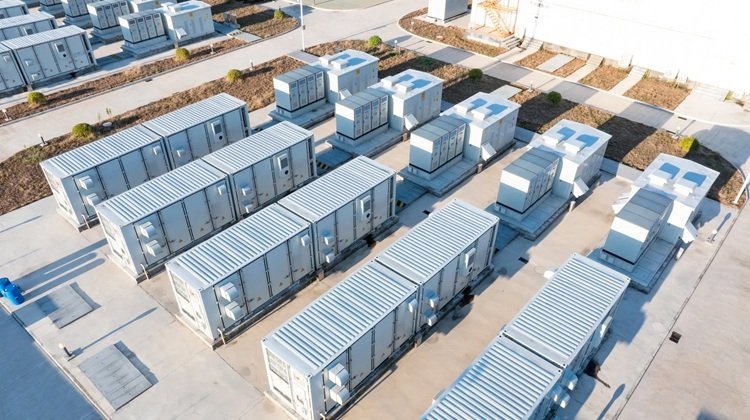
Last year, many companies were still exploring. Today, the shift is clear: the discussion is no longer about prices or technology. Battery cells — such as 280 Ah for C&I or 314 Ah for 5-MWh utility containers — are well-proven. The key question now is: who can deliver first? Bottlenecks are far more related to medium-voltage transformers, which can take up to 30 weeks, not to battery containers.
- Speaking of delivery times, what timelines can Risen guarantee?
We can guarantee 14 weeks FOB from the factory. Maritime shipping depends on the destination, but we are well-positioned. What typically delays projects is the medium-voltage transformer, where suppliers are quoting 26 to 30 weeks.
- And amid this urgency, what market position are you aiming for?
We are focusing on Spain’s FEDER program. We reached an agreement with a local strategic partner that will allow us to deliver from the first quarter of 2026 to projects already at RTB stage. It is a local-integration model: we supply the modules and key components, and our partner manages assembly, testing and dispatch.
- What size of projects are you targeting?
We can support projects across different scales, both C&I and utility. Thanks to the modularity of our systems, we can adapt to each customer’s needs. Our strategy is to compete by offering full value — complete solutions where service, integration and technical support are fundamental.
- Turning to the module market, is it still profitable?
Today, the module market is under significant price pressure. This is driven by excess manufacturing capacity in China and by the effect of tariffs. As some financially weaker players exit, we expect the market to reorganise into a more stable environment.
- Between C&I and utility-scale, where is there more activity today?
C&I decisions are much faster. We have stock in Rotterdam and can deliver in two to three weeks. Volumes are smaller, but contracts close more quickly. In utility-scale, the analysis is deeper and focuses on guarantees, performance and response times.
- And how do returns compare in both segments?
C&I customers generally aim to recover their investment in under five years, and that is being achieved. In utility-scale projects, economies of scale enable even stronger returns.
- With prices still being a key variable, what are you seeing with lithium?
Over the past 12 days, lithium prices have risen more than 10%, but they are not comparable to silicon in solar modules. The impact is not the same. We may see temporary stabilisation, but overall we expect prices to continue declining, driven more by efficiency and competitive pressure than by raw materials.
- Given this landscape, what does a solution need in order to stand out?
Higher energy density, greater capacity in less space and modularity. Twenty-foot containers with more kWh that are easy to transport — that is the path to reducing euros per kilowatt-hour, which remains the key metric.
- Looking ahead, what would you like to see by the end of 2026?
First, that the capacity market is operational, even though we know it will be technologically agnostic, and gas will capture part of it. Second, the flexibility market begins to take shape. And third, real demand-side management, in which batteries participate both from the generation side and from the load side.
With an integrated offering, strategic alliances in Spain and a clear commitment to modular and high-efficiency solutions, Risen Energy aims to secure a significant share of a storage market that, according to its own projections, is poised for rapid expansion in 2026. For Andrés Pinilla Antón, the opportunity lies in understanding that value does not reside solely in the battery itself, but in how it is operated, financed and integrated into an increasingly demanding ecosystem.