









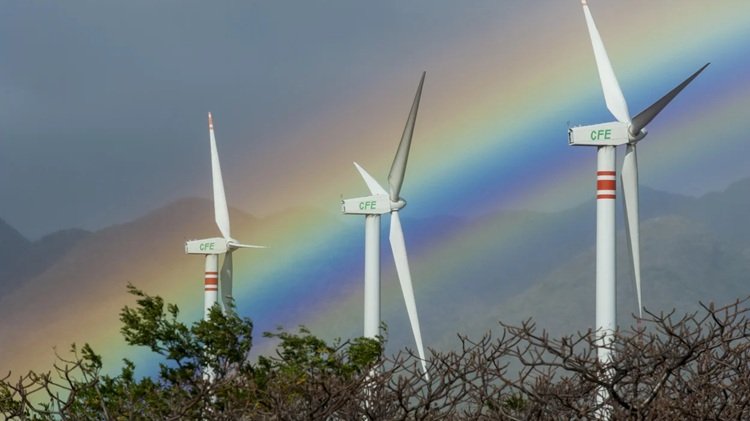
Mexico’s state-owned utility, the Federal Electricity Commission (CFE), has received an overwhelming response from the private sector to its new mixed public-private renewable generation programme.
The call for projects gathered 222 completed proposals representing 37,749 MW of capacity, far exceeding the 7,500 MW originally targeted under the scheme.
This means the project pipeline surpasses the initial requirement by 581%, signalling strong investor interest in Mexico’s emerging framework for renewable energy investment and grid expansion.
Solar power dominates the portfolio. A total of 178 solar PV projects account for 26,494 MW, followed by 34 wind power initiatives representing 9,324 MW. The remaining capacity includes nine hybrid renewable projects (1,032 MW) and one pumped-storage hydropower facility (900 MW).
More than 80 renewable energy developers are participating in the process, making it one of the largest renewable project pipelines currently under consideration in Mexico.
Leading developers by proposed capacity
Among the companies offering the largest volumes of generation capacity are:
| Developer | Approx. capacity proposed |
|---|---|
| GTE Energy | ~3,005 MW |
| Thermion | ~1,897 MW (mainly wind power) |
| Cubico Sustainable Investments | ~1,761 MW (solar and wind) |
| Fisterra Energy (formerly Blackstone) | ~1,749 MW |
| Proyener | ~1,599 MW |
| AES México | ~1,558 MW |
| Terralia | ~1,527 MW |
| Grupo Cobra | ~1,415 MW |
| Cox Energy | >1,200 MW |
Several global renewable developers with extensive experience in utility-scale projects are also present, including EDF, Invenergy, BayWa r.e., Canadian Solar, Atlantica, Elawan Energy, EDP, Actis, Opdenergy, Trina Solar and Cox.
Alongside international players, a wide range of regional and domestic developers are also participating.
These include VIVE Energía, Zuma Energía, Oak Creek Energy Solutions (OCES), Revolve Renewable Power, Saturnia Energías Renovables, Ennova América, HEG Energy, Tonachihua Energía, Kiin Energy, Cuasar Capital, Selka Capital, Genux, Gemex, Coruener, Cratus Energy, Internovum Solar, Quantum, Consorcio Polaris, Consorcio Pantera, Zora Power, Set Renovables and Generadora Fenix, among others.
More than 20 participating companies operate under project-specific entities or commercial vehicles, a common structure in large-scale energy infrastructure development.
Companies in this category include Actis Valia Energía, Asergen, Catalysta Colectiva, Catayst Energy, Cimarrón Solar, CKD Infraestructura, Generación de Energía Eléctrica, Generadores de Energía, Gestión Integral de Proyectos de Energía, Grupo SIMSA, Mota-Engil, MTS de BC, N3Henergy, Promoción Renovable del Bajío, Vindmol Solar, Winpot and SuKarne.

Several developers involved in this call were also awarded projects in the private generation process launched in December, including Gemex, Dhamma Energy, Revolve Renewable Power, Solarig and Alten.
On the public side, the call also includes 22 projects developed directly by CFE.
Of these:
- 11 initiatives are linked to the Concepción Mendizábal project, totalling 858 MW
- Additional projects are connected to the Cerro Prieto solar complex, adding 215 MW
These initiatives form part of the government’s broader strategy to expand renewable energy capacity while maintaining strong public sector participation in power generation.
Regional concentration of the renewable pipeline
A territorial analysis shows a strong concentration of projects in northern and north-eastern Mexico, areas with abundant renewable resources and proximity to major industrial demand centres.
| Region (CFE control area) | Projects | Capacity |
|---|---|---|
| Northeast | 48 | ~12,860 MW |
| Western | 53 | ~7,321 MW |
| Peninsular | 42 | ~6,235 MW |
| Eastern | 30 | ~4,835 MW |
| Northern | 12 | ~2,081 MW |
| Baja California | 22 | ~1,668 MW |
| Northwest | 9 | ~1,614 MW |
| Central | 6 | ~1,137 MW |
Another key aspect is the regulatory maturity of the proposed projects.

Of the total registered proposals:
- 105 projects (43%) already have an Environmental Impact Assessment (MIA) approved or under review
- 116 projects (48%) have initiated the MISSE regulatory process
- 125 projects (51%) have completed grid interconnection studies
However, 91 proposals (37%) have not yet begun any of these procedures, indicating that a significant portion of the pipeline remains in early development stages.
Timeline for the selection process
The programme will follow a multi-stage selection process:
- Until 6 April: technical review and preliminary selection
- 7 April: formal request for proposals
- 8–30 April: submission and evaluation of bids
- 1–29 May: final allocation, approvals and contract signing
The process forms part of Mexico’s new mixed-investment generation framework, under which CFE retains majority ownership while private companies participate in the development, financing and construction of renewable energy plants.
Projects will operate under Power Purchase Agreements (PPAs)—long-term electricity contracts that provide revenue certainty for investors and help expand clean energy capacity and grid integration.
With more than 37 GW of proposed capacity competing for just 7.5 GW of initial demand, the call highlights the existence of a far larger renewable energy pipeline than the programme originally anticipated.
The strong response suggests intense competition among developers seeking to secure a place in Mexico’s evolving energy transition strategy.