









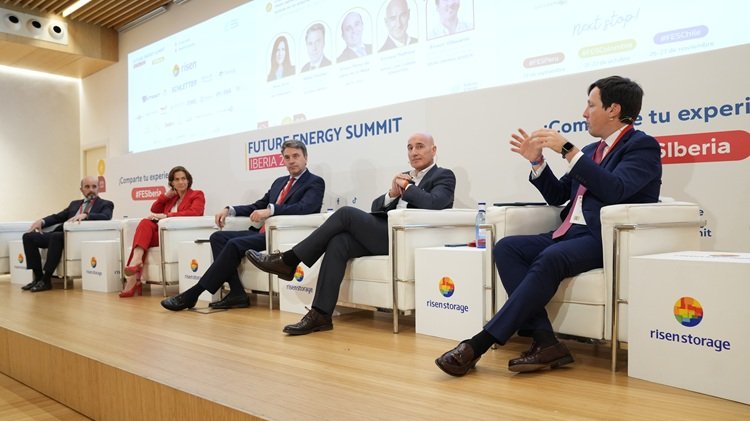
With less than a week to go, FES Iberia 2026 is preparing to once again bring together in Madrid the leading figures of the Iberian and international energy sector. Taking place on 12 February, the event has established itself as the first major strategic gathering of the year, focused on energy storage, capacity mechanisms, regulatory frameworks and public and private investment in renewables.
Featuring a line-up of senior government officials, CEOs from major energy companies and technical experts, this fourth edition comes at a decisive moment: moving beyond the large-scale deployment of renewable capacity towards its smart, resilient and system-friendly integration into the power grid.
Key participants include Carmen López Ocón (IDAE – the Spanish Institute for Energy Diversification and Saving), Fátima García Señán (Spain’s Ministry for the Ecological Transition and the Demographic Challenge), Manuel Larrasa Rodríguez (Government of Andalusia), Julio Castro (Iberdrola Renewables), Rocío Sicre (EDP), Pablo Fernández Vila (Government of Galicia), Alfonso Arroyo González (Government of Castile and León), Alberto Hernández Suárez (Government of the Canary Islands), Enrique de Ramón (Zelestra) and Andrés Hernando (Huawei), among others.
This fourth edition arrives at a critical juncture for advancing the shift from massive renewable build-out to intelligent, stable and financially viable integration within the electricity system. In this article, we look back at the previous edition and the key debates that defined the event in a pivotal year for the energy transition across the Iberian Peninsula.
FES Iberia 2025: a turning point after the blackout
The previous edition of the Future Energy Summit (FES) Iberia, held in June 2025, marked a clear inflexion point for the sector. More than 400 public- and private-sector leaders took part in an event shaped by growing tension between the pace of the energy transition and the operational limits of the Iberian power system.
The summit coincided with the Spanish government’s failed attempt to approve the so-called Anti-Blackout Royal Decree, designed to mitigate the effects of the major grid collapse that occurred on 28 April. On that day, the system entered a state of “absolute zero” due to a lack of inertia and insufficient voltage control.
That blackout became the starting point for a structural debate: how to ensure system resilience in an environment of high renewable penetration, limited flexibility and distorted price signals. The technical community was unequivocal. “The system has become weak and unstable, with oscillations and overvoltages out of control,” concluded the event’s executive summary.
The consensus was clear: the solution does not lie in reverting to synchronous generation technologies, but in accelerating the deployment of power electronics and grid-forming systems capable of providing synthetic inertia and stable voltage control at critical network nodes.
Storage, CAPEX and new business strategies
Energy storage emerged, by far, as the most frequently cited theme at FES Iberia 2025. Grenergy announced a €3.5 billion investment plan, with 70% allocated to storage and hybrid projects. Repsol highlighted its commitment to pumped hydro storage through the relaunch of the Aguayo Project, while Acciona Energía stressed active demand-side management as a key tool to address price cannibalisation in wholesale markets.
Companies such as Galp, Matrix Renewables, Saeta and EDPR shared their strategies for adapting to the new market environment: hybridisation, geographic diversification, optimised grid access and value capture through storage assets.
Regulatory issues were also front and centre. Representatives from the regional governments of Galicia, Andalusia, Murcia, the Canary Islands and the Valencian Community called for faster administrative processes, simplified permitting and greater coherence across different levels of government. Speakers underlined the urgency of aligning political ambition with stable, long-term investment signals.
Technological innovation was another major focus. Yingli Solar and Jinko showcased advances in tandem solar cells exceeding 850 W, while companies such as Chemik Group and Aerolaser presented solutions aimed at reducing CAPEX through advanced engineering and operational digitalisation. These included digital twin systems designed to prevent fires and optimise asset maintenance.
FES Iberia also featured a strong international dimension, with dedicated panels on Latin America. Countries such as Guatemala and the Dominican Republic presented opportunities for renewable energy and energy storage investment, highlighting ongoing tender processes and frameworks open to private capital. These discussions confirmed growing strategic interest in the region among major Iberian energy players.
Expectations for FES Iberia 2026
Just days ahead of FES Iberia 2026, expectations are high for what is set to be the first major energy event of the year. Additional speakers completing the agenda include Fernando Cremades (Galp), Luis Contreras (Yingli Solar), Íñigo Díaz (Ignis Energía), Domingo Jesús López Álvarez (Tera Batteries), Patricia Mora (Acciona Energía), Óscar Aira (GameChange Solar), Jesús Heras (Wattkraft), Ángel Alegría (Schletter), Guillermo Figueruelo (Fronius), Daniel Boluda (Capture Energy) and Donaji Martínez (Jinko ESS), among others.
The Future Energy Summit continues to consolidate its role as the forum where the technical, financial and regulatory coordinates of the energy transition are defined—one that no longer allows for improvisation.
In 2026, the spotlight will be firmly on energy storage, capacity mechanisms, public incentive programmes and regulatory stability as key tools to unlock further renewable deployment. The agenda will include dedicated panels on capacity auction design, the future of storage as a system asset, the impact of digitalisation on grid flexibility, the bankability of hybrid projects, financing frameworks in volatile price environments and the role of regional governments in decentralised energy planning.
Discussions will also address coordination between transmission and distribution networks, permitting modernisation, and the alignment of private capital with new public support instruments.
The event agenda is available at the following link: https://live.eventtia.com/es/fes-iberia26/Agenda
The journey from 2025 to 2026 has been anything but minor. Spain’s electricity system is no longer debating how much renewable capacity can be installed, but how to integrate it without compromising stability. In this context, the Future Energy Summit stands out as the space where the rules of the game for the next phase of the energy transition are being set.