











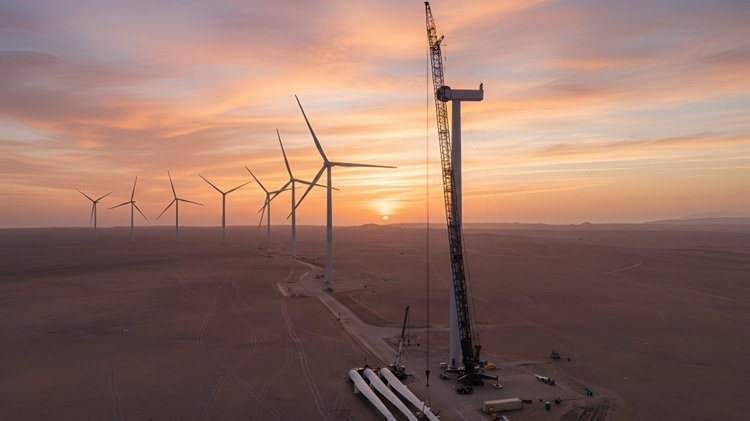
The Caravelí Wind Farm, located in the Lomas district, Caravelí province, in the Arequipa region of southern Peru, has reached 73.5% construction progress, in line with its technical timetable. Once operational, it will generate more than 600 GWh annually, supplying clean electricity to the National Interconnected Electric System (SEIN) and positioning itself as one of the largest onshore wind projects in the country.
According to María del Pilar Matto, CEO of Celaris Energy, the project is equipped with Nordex wind turbines, each with a rated capacity ranging between 5.9 MW and 6.1 MW. The technology was selected to match the wind profile of Peru’s southern coast, where 20 turbines have already been installed.
Each turbine features 105-metre-high towers and 155-metre rotor diameters, enabling operation in more stable wind layers and maximising energy capture. The foundations require approximately 480 cubic metres of concrete per unit, designed to ensure structural stability in demanding coastal conditions.
“The project is advancing under a modular execution model that allowed early development of access roads, platforms and civil works,” Matto explained. “This approach has optimised time and resources without compromising quality or technical standards. Efficient planning has been essential to maintaining construction momentum and ensuring the Caravelí Wind Farm is delivered on schedule, with a long-term vision and positive regional impact.”
More than 300 workers, including engineers, technicians and local labour, are currently involved in the project. Construction activities include civil works, electromechanical assembly and grid connection infrastructure. The Caravelí substation, now under construction, integrates over 280 kilometres of cabling and will be connected to Poroma via a 47-kilometre transmission line, enabling power evacuation to the national grid.
“This project combines large-scale infrastructure, state-of-the-art technology and execution aligned with the highest industry standards,” Matto concluded. “It demonstrates that competitive, reliable renewable energy with tangible regional benefits can be successfully developed in Peru.”