











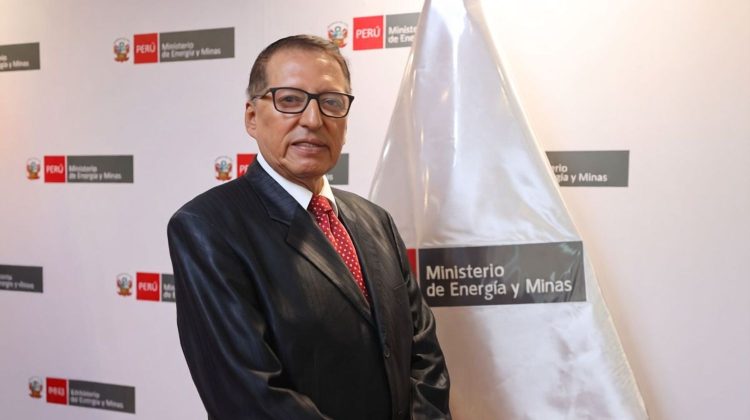
The Peruvian Ministry of Energy and Mines (MINEM) has formally appointed Nilo Pereira Torres as the new Vice Minister of Electricity, following the departure of Francisco Mendoza De Luca, who had assumed the post in September 2025 amid efforts to boost rural electrification and modernise the national power system.
The government’s decision comes less than three months before the general elections on 12 April 2026, when Peru will elect a new president, Congress and members of the Andean Parliament.
Should no candidate secure more than 50% of the valid votes, a second round is scheduled for 7 June. In this context, the new leadership at the Vice Ministry of Electricity is considered transitional, yet strategically decisive for the future of the country’s energy sector.
Pereira is a chartered electrical engineer with a master’s degree in Public Management and has held senior technical roles within MINEM itself, including positions at the General Directorate of Electricity and the Directorate of Electricity Regulation and Concessions. According to the Ministry, “his professional career has led him to head technical teams across key areas for the development of the national electricity system.”
He brings more than 25 years of experience in the power sector and has served as chief executive of state-owned utilities such as Electro Ucayali, Electro Oriente and Electro Tocache. A graduate of the National University of Central Peru, Pereira also completed specialised training in tariff regulation, corporate planning and public administration at institutions including ESAN University and the National Society of Industries. In addition, he has worked as a technical consultant at MINEM’s General Directorate of Electricity, strengthening his understanding of the public administration and Peru’s energy regulatory framework.
The new vice minister’s career is closely linked to regulatory processes, concessions and the expansion of electricity services in rural areas. However, his main short-term challenge will be the regulatory framework for renewable energy, particularly the implementation of Law No. 32249, which amends the rules governing clean energy auctions but still lacks detailed secondary regulations.
According to the Peruvian Renewable Energy Association (Asociación Peruana de Energías Renovables), more than USD 12 billion in renewable energy investments remain on hold due to the absence of clear regulations. This regulatory uncertainty is delaying new generation capacity and undermining predictability for the power system.
At the same time, Peru has more than 10 GW of renewable energy projects under permitting, driven by international and regional players such as Engie, Enel, Kallpa Generación, Celaris Energy, Sonnedix, First Solar, Atlas Renewable Energy, Solarpack and Tozzi Green, among others.
Pereira assumes office with the responsibility of advancing the implementation of this regulatory framework and defining timelines for the renewable energy auctions announced for 2026. Meanwhile, developers and investors have intensified their concerns over the lack of clear guidelines to ensure bankable conditions for new power purchase agreements (PPAs) from non-conventional renewable sources.
His tenure also coincides with the leadership of Energy and Mines Minister Jorge Luis Montero Requena, who is promoting a strengthened technical structure to accelerate infrastructure projects, smart grids and universal access to electricity. In this sense, the Vice Ministry of Electricity will not only need to manage immediate priorities but also lay the groundwork for the energy transition under the next administration.
With a limited political window and an uncertain outlook, the immediate priority will be to restore confidence among renewable energy investors and deliver tangible progress on regulation and project execution—particularly in a country that still relies heavily on hydroelectric and thermal generation.
Pereira’s appointment, given his extensive experience within the state apparatus, is seen by sector stakeholders as a bet on technical stability in the final stretch of a government that needs to send clear signals of institutional continuity. MINEM is expected to announce concrete policy guidelines in the coming days, especially regarding the implementation of Law No. 32249 and the planning of future renewable energy tenders.