











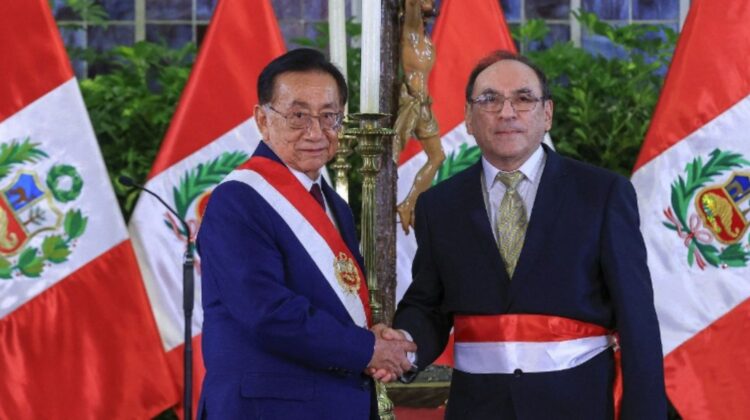
Ángelo Victorino Alfaro Lombardi was sworn in on 24 February as Peru’s new Minister of Energy and Mines during a ceremony led by President José María Balcázar at the Government Palace in Lima. The electrical engineer takes over from Jorge Luis Montero Requena less than two months before the presidential elections scheduled for 12 April, after which the president-elect will assume office in July.
His appointment comes at a dynamic political juncture and amid a demanding energy agenda. With less than half a year remaining for the current administration, the leadership of the Ministry of Energy and Mines (MINEM) will need to advance technical decisions that directly affect long-term investment and the expansion of the national power system.
His arrival coincides with a broader cabinet reshuffle. Denisse Miralles has taken over as President of the Council of Ministers after leaving the Ministry of Economy and Finance, replacing Ernesto Álvarez Miranda. The ministerial changes mark a new phase in economic and energy policy leadership, in a context of heightened sensitivity for domestic and foreign investment.
Prior to Alfaro Lombardi’s appointment, other profiles were reportedly considered to head the ministry until 28 July 2026. These included Oliver Stark, former chairman of state-owned oil company Petro-Perú, who declined the offer; Esteban Bertarelli, former general manager of the same company; and Augusto Cauti, former Vice-Minister of Mines. Ultimately, the executive opted for a candidate with a solid track record in the electricity subsector.
Alfaro Lombardi brings more than 40 years of experience in the energy sector, with specialisation in planning, management and corporate leadership in electricity generation, distribution and retail activities. His professional background includes asset management, loss reduction and the execution of public investment projects, all critical areas for a power system facing sustained demand growth.
He previously served in several terms as chief executive officer of Electro Oriente S.A., a distribution company based in Iquitos that operates in one of the country’s most complex regions due to its geography and market characteristics.
He is also listed in the registry of Osinergmin, Peru’s energy and mining regulator, as an authorised electricity supervisor, reinforcing his technical and regulatory profile. He holds a degree in electrical engineering from the National University of Central Peru and has undertaken postgraduate studies in administration and finance at ESAN and at the Pontifical Catholic University of Peru (Centrum), combining technical expertise with financial management skills.
On the political front, he does not currently hold party affiliation. Between 2007 and 2017, he was affiliated with the Peru Posible party. Publicly available information regarding his career is limited. In 2008, he was reported for alleged embezzlement related to Electro Oriente S.A. during his tenure as chief executive officer, a case that forms part of the public record associated with his management of the state-owned company.
To date, MINEM has not announced who will assume the position of Vice-Minister of Electricity, a strategic role for the implementation of generation tenders and power system planning. The post has seen recent changes following the departure of Francisco Mendoza De Luca and the subsequent appointment of Nilo Pereira Torres at the beginning of this year.
The main issue facing the new leadership of the ministry is the pending regulation of Law 32249, approved in early 2025 with the aim of revitalising renewable energy generation auctions. The law established a 120-day deadline for the issuance of the corresponding secondary regulations, yet nearly a year later, there is still no official definition or confirmed timetable.
During the public consultation process, the draft regulations received more than 1,000 comments, reflecting strong interest from the energy sector. To date, only two of the three sets of regulations required by the law have been pre-published: those governing auctions and those establishing the independent operator for isolated systems. The regulation concerning ancillary services remains outstanding.
One of the key issues under analysis by market participants is the percentage of electricity demand that will be allocated to long-term auctions. Industry representatives argue that defining an attractive volume will be decisive in capturing investor interest and ensuring effective competition in upcoming calls.
The absence of mechanisms clearly setting out the schedule and conditions of future tenders could maintain the entry barriers currently faced by developers who require long-term power purchase agreements (PPAs) to structure project financing. In this context, the lack of regulatory clarity continues to prolong investor caution.
According to the Peruvian Renewable Energy Association (SPR), 58 projects are ready to move forward, totalling 12.5 GW and more than US$12 billion in potential investment. “We have 58 projects ready to move forward. That is 12.5 GW and more than US$12 billion that could begin to be mobilised with a clear signal from the Government,” a representative of the association stated.
This volume represents a strategic opportunity in light of sustained growth in the electricity system. Peru’s interconnected grid is expanding at a rate of around 500 MW per year and will require between 2.5 and 3 GW of additional new capacity by 2030. By 2035, the requirement could rise to between 5 and 7 GW, positioning the renewable energy pipeline as a central pillar in ensuring long-term security of supply.