







The Mexican government has announced the approval of 20 private renewable generation projects with a combined installed capacity of 3,320 MW and 1,488 MW of energy storage, following the call for proposals launched last October.
The initiatives represent a total investment of USD 4.752 billion and will begin execution in 2026, with a second call for projects already confirmed for the end of January next year.
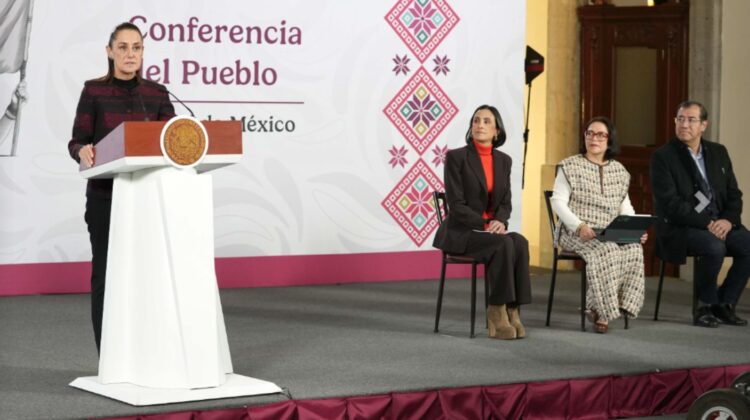
“This reflects a clear interest in investing in the country. That is why we are going to repeat this exercise,” said President Claudia Sheinbaum, adding that this new state-led planning model will be replicated next year as part of Mexico’s national energy strategy. The call, published on 17 October, was designed to accelerate the evaluation and permitting process. As previously reported by Energía Estratégica, its objective was to enable up to 6 GW of renewable capacity.
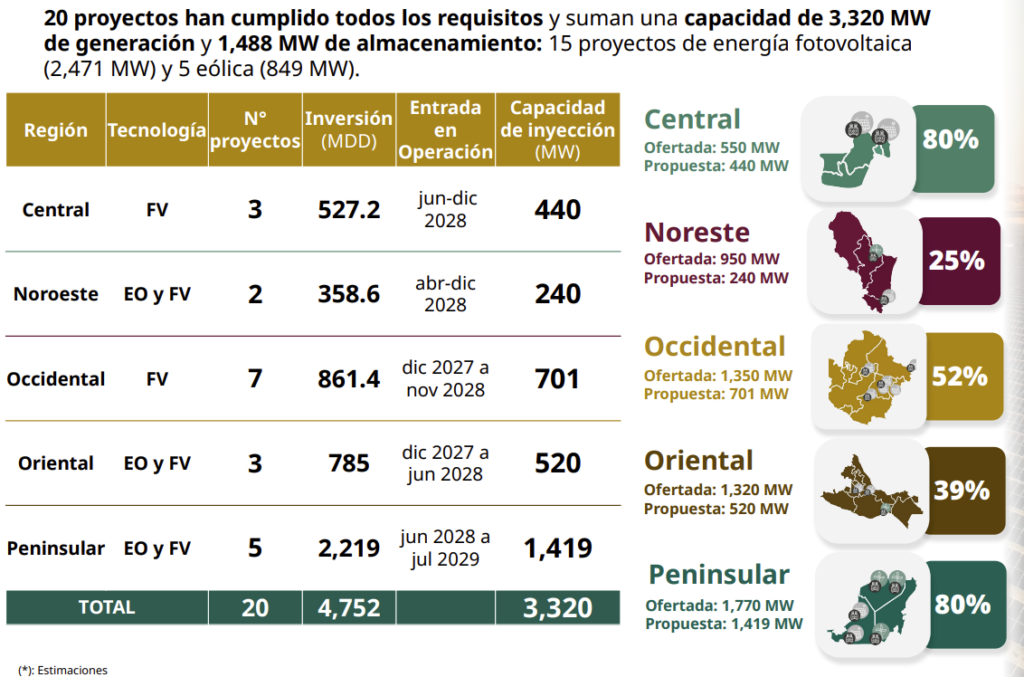
In total, 5,970 MW of renewable capacity were offered across six regions of the country. Of this volume, 3,790 MW corresponded to solar photovoltaic and wind technologies. Ultimately, 20 projects met all technical, social, environmental, financial and legal requirements and were awarded.
As a result, 55% of the generation capacity offered was covered, and 58% of the proposed projects in the first call were awarded. The selected initiatives amount to 3,320 MW of generation capacity and 1,488 MW of storage. Of these, 15 solar projects will contribute 2,471 MW, while five wind farms will add 849 MW.
Commissioning timeline and regional distribution
The commissioning schedule for the approved projects is divided into three stages: 19% will enter operation in 2027, 78% in 2028, and the remaining 3% in 2029. Start-up dates range from December 2027 to July 2029, depending on the technology and the awarded region.
The projects will be located across 11 Mexican states, including Campeche, Hidalgo, Yucatán, Guanajuato, Oaxaca, Tamaulipas, Quintana Roo, Puebla, Veracruz, Zacatecas and Querétaro.
From a regional perspective, the Peninsular region received the largest allocation, with 1,419 MW and an investment of USD 2.219 billion. This was followed by the Western region, with 701 MW and more than USD 861 million; the Eastern region, with 520 MW and USD 785 million; the Central region, with 440 MW and USD 527.2 million; and the Northeast, with 240 MW and USD 358.6 million.
The process was carried out under the framework of Binding Energy Planning (Planeación Energética Vinculante), marking a structural shift in Mexico’s permitting model. Unlike the previous scheme, which was based on individual applications from private developers, the new approach establishes centralised planning that defines where generation can take place, which technologies can be deployed and under what conditions.
This tool made it possible to reduce average permitting times from around eight months to just 2.5 months, without compromising technical rigour.
“The Ministry of Energy created a different scheme. It said: If you want to generate as a private developer, we will tell you where and with what technology you can generate,” President Sheinbaum explained, noting that the model aligns private investment with the country’s real system needs.
“We are guaranteeing sufficient electricity for the country’s development,” she added, stressing that the new framework provides “order, planning and certainty” for both the state and private investors.
Inter-institutional evaluation and grid expansion
Project selection was carried out by an inter-institutional Technical Committee comprising the Ministry of Energy (SENER), the National Energy Commission (CNE), the National Energy Control Centre (CENACE), the state-owned utility Comisión Federal de Electricidad (CFE), the Ministry of Environment and Natural Resources (SEMARNAT), and other authorities responsible for verifying compliance with social, technical, legal and environmental requirements. The entire process was channelled through a single-window system, enabling a comprehensive and simultaneous evaluation.
In addition to prioritising system reliability, continuity and security, the Committee incorporated criteria such as energy justice and technological innovation into its assessments. The official highlighted that “these projects were evaluated using social, technical and financial criteria, and they will now also be monitored during execution” to ensure compliance.
“We want permits to be more than just paperwork, and to actually be implemented,” González emphasised.
In parallel, Mexico will strengthen its transmission infrastructure to support the expansion of renewable generation. “Investment is being made in transmission lines, because generation alone is not enough – the question is how you transmit the energy. We are guaranteeing generation, transmission and distribution,” President Sheinbaum concluded.