







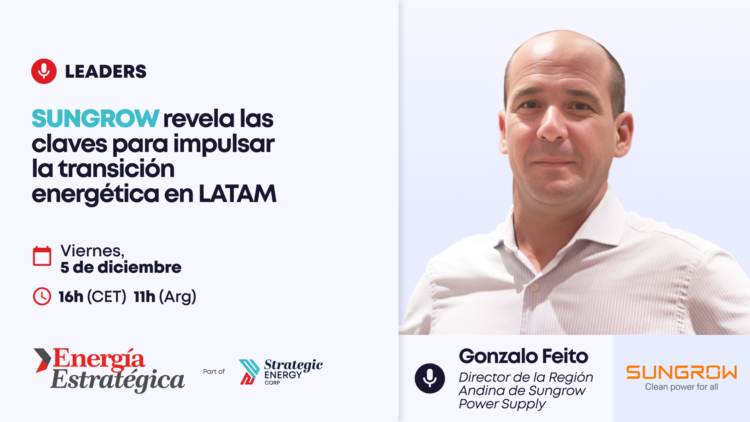
Latin America is heading towards a profound transformation in the energy storage market. According to Gonzalo Feito, Andean Region Director at Sungrow, the region will reach 20 GWh of installed BESS capacity by late 2026, consolidating a structural shift in the energy transition.
“Yes, it is entirely feasible to reach a total of 20 gigawatt-hours in the Latin American storage market by the end of next year, 2026,” Feito stated during the Leaders interview series organised by Strategic Energy Corp. This forecast is supported by signed contracts, projects under development and the growing need for grid stability across the region.
The expansion of storage systems is not only tied to the growth of the solar PV sector but also to a structural requirement of the regional power system. “Storage is entering the market out of necessity. It has been demonstrated that it is the solution for securing grid stability,” the regional director underlined.
However, the rapid growth of storage also brings its own challenges, particularly regarding logistics. Delivery and commissioning must be carried out within controlled timeframes to preserve battery lifetime, requiring precise coordination from factory to final installation.
“We are talking about extremely heavy, high-density containers. The challenges are fundamentally logistical,” Feito warned.
In geographically complex areas, such as Colombia’s mountainous regions, transporting and deploying equipment requires meticulous planning. “From the moment the unit leaves the factory to the moment it arrives on-site, we must ensure it is connected within a specific timeframe to avoid affecting the battery’s useful life,” he explained.
Sungrow, a global manufacturer of solar inverters and energy storage solutions, began operating in Latin America between late 2017 and early 2018, initially focusing on Brazil and Chile. Since then, it has accumulated 25 GW of solar PV installations across the region—8.5 GW of them in Spanish-speaking Latin America—and more than 10 GWh in signed storage contracts.
The company’s regional strategy is based on a localised approach, with technical teams in each country tailored to market-specific requirements. “We hire local staff so that customers and partners feel close to the manufacturer,” Feito stated, describing one of the keys to Sungrow’s growth.
Looking ahead, Sungrow is prioritising a gradual expansion into new strategic markets. The company has identified five priority areas: Chile, Argentina, Peru, Central America and Mexico. “Central America is positioning itself very strongly in solar and storage. Mexico, after this long pause, is going to have enormous potential,” the executive noted.
For 2025, Peru already has 850 MW of committed solar capacity for supply, while the company plans to increase its operations in Mexico and the Dominican Republic, aligned with its regional expansion strategy. Growth in these markets is driven by favourable regulatory signals and increasingly stringent requirements for electrical system reliability.
“We will continue reinforcing our local teams, providing support with a localised approach. We adapt to our customers’ needs,” Feito said, emphasising that this proximity has been key to strengthening commercial relationships with developers and utilities.
Alongside the deployment of physical technologies, Sungrow actively participates in designing regulatory frameworks for the BESS sector, collaborating with authorities and technical bodies in several countries. “We are helping, as technologists, to draft regulations with different countries,” he affirmed.
“We are trying to be part of this group of organisations that must collectively learn how we can contribute, how we can help, and how we can regulate everything related to the grid code,” Feito added, noting that it remains a young technology that requires shared learning.
Technological innovation is one of Sungrow’s pillars, with 40% of its workforce dedicated to research and development and more than 2,600 patents. In solar inverters, the company maintains a complete portfolio of both string and central systems, with a clear trend towards higher-capacity units and modular designs to optimise costs and operational efficiency.
In the BESS segment, Sungrow launched the PowerTitan 3, a 6.9 MWh solution housed in a 20-foot container, designed to maximise energy density and reduce on-site footprint. “The market trend is to increase density to optimise the economic performance and footprint of storage plants,” Feito explained.
Towards 2030, Sungrow’s strategy will remain focused on regional growth, continuous innovation and close customer engagement. “We are going to continue operating under the same strategy: local people, growing locally, working hand in hand with customers from the first day of design to the last day of the equipment’s lifetime,” the executive summarised.
The interview took place as part of the Leaders series organised by Strategic Energy Corp, where Gonzalo Feito also invited the Latin American renewable energy sector to participate in the Sungrow LATAM Summit 2025, to be held on 11 December in Chile. The event will bring together major energy industry stakeholders to discuss technological innovation, the energy transition and new challenges for storage in the region.