







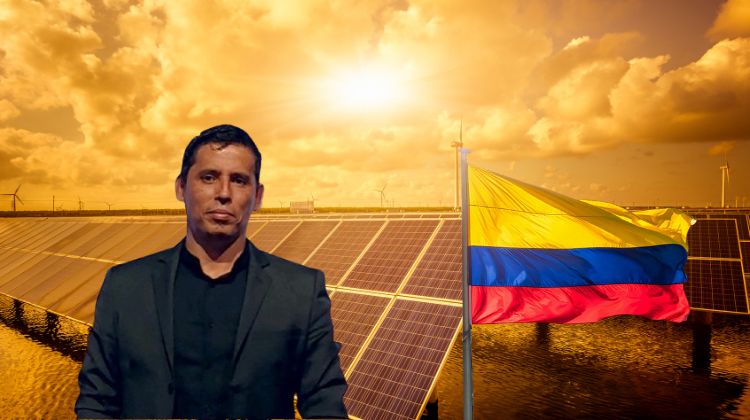
Although Colombia is planning a new Reliability Charge (Cargo por Confiabilidad) auction in March 2026, the solar sector argues that the country urgently needs specific mechanisms for renewable projects if it aims to meet its energy targets. This was stated by Miguel Hernández Borrero, president of the Colombian Solar Energy Association (ACOSOL), in an analysis of the current outlook for power system expansion.
In his view, the upcoming auction—which will assign Firm Energy Obligations (OEF) for the 2029–2030 period—will send a positive signal to the market but is not designed to enable the large-scale integration of new clean capacity. The lack of dedicated tenders is holding back the development of major projects, which currently rely almost exclusively on private decisions or bilateral agreements.
“The country still lacks specific competitive mechanisms for new renewable capacity,” Hernández Borrero stated.
Without these instruments, growth in the sector remains incremental, fragmented, and with limited aggregate impact in terms of installed capacity, he explained. Recent experience, he warned, has shown that dedicated tenders are key to providing more stable and predictable investment conditions.
The model proposed aligns with the guidelines introduced by CREG Resolution 075 of 2021, which called for competitive schemes with clear price signals, long-term horizons, and efficient risk allocation. This would also allow the integration of backup technologies such as storage and control systems, while improving coordination with grid development—one of the sector’s structural bottlenecks.
The evolution of Colombia’s operating capacity in recent years reveals a significant increase in the number of projects, but their impact on the energy mix remains marginal. Official data shows that from April 2018 to August 2022, installed capacity in self-generation reached 99.24 MW. Between then and September 2025, a further 382.79 MW was added, bringing the total to 482.06 MW.
Most of this progress came from small-scale self-generation, accounting for 298.7 MW. Despite involving over 18000 operational installations, this segment still represents less than 10% of the 6000 MW national target for 2026. The data highlights that while the sector is dynamic, it has not achieved significant leaps in effective capacity.
This lag is not due to a lack of market interest or technical constraints. Rather, it stems from a regulatory environment that continues to restrict the scale-up of projects. Although CREG Resolution 174 of 2021 improved conditions for self-generation and distributed generation, it still contains provisions from outdated regulatory models that fail to reflect today’s technological reality.
One major issue is the economic settlement scheme. Projects are still subject to charges for transmission, losses, and system restrictions, even when they do not use the national grid infrastructure. This misalignment with cost causation and efficiency principles discourages the growth of models that, in fact, offer net benefits such as reduced technical losses and congestion relief.
Further, there are technical rules that limit connection, control, and operation, with differing criteria among network operators. These inconsistencies add costs and uncertainty for investors. Hernández Borrero argued that overcoming these barriers requires a structural overhaul of the regulatory framework, not just minor tweaks.
Storage: an untapped enabler
Another key area for expanding renewables is energy storage, a technology that is already playing a vital role in other Latin American countries. In Colombia, however, regulatory and market conditions have yet to support its large-scale deployment.
Currently, energy injected by a distributed generator is paid the same regardless of the time of day. This flat-rate pricing removes any incentive to shift supply to peak hours, making storage systems less competitive than direct grid injection.
Moreover, the distribution network is generally reliable, meaning that for many developers, it is more efficient to inject directly into the grid rather than invest in local storage solutions, which come with additional costs and no explicit economic benefit.
To reverse this trend, Hernández Borrero insisted on the need for mechanisms that recognise services such as firm capacity, peak shaving, grid support, and time-based arbitrage. Without differentiated pricing signals, storage will remain a marginal complement rather than a structural enabler of the energy transition.
Financing and policy support still lacking
Unlocking the full potential of self-generation and distributed generation in Colombia will require more than just technical fixes. Access to suitable financial instruments is also crucial. The ACOSOL president highlighted the need for specialised credit lines, guarantees, and incentives that reflect the lower systemic risk of these business models.
Without such tools, growth will remain limited to small-scale, scattered projects with minimal impact on the energy matrix. In contrast, with a clear policy framework and modernised regulation, this segment could contribute significantly to the country’s energy transition goals.
“The system enables thousands of projects, but it fails to translate that momentum into substantial increases in installed capacity,” Hernández Borrero concluded.