




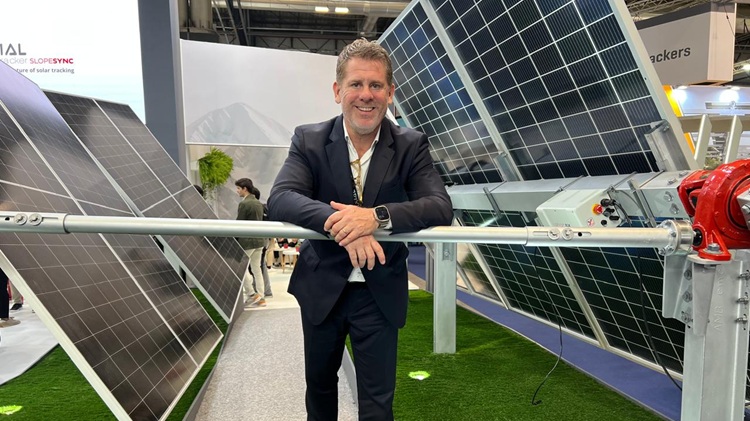
—José Luis, what changed for Axial this year compared to the previous one?
There wasn’t a dramatic shift, mainly because we’ve continued to grow. For four years now we’ve maintained high double-digit growth rates, and we’re truly satisfied. Our market positioning improves every year, and the company’s profile is strengthening across all regions where we operate. We’re consistently moving into more privileged competitive positions.
—How do you explain that sustained growth in a global market facing strong price pressure?
I wish I could give you a magic formula anyone could replicate. But I’ll use the same example I give my 10-year-old son, who plays tennis: winning is a consequence, not a cause. It’s the result of effort, motivation and consistency. Since founding Axial, we’ve always worked that way—with a clear philosophy and respect for our products, markets and clients.
When you maintain that discipline year after year, a moment comes—almost without noticing—when you break through the glass ceiling. From that point on, growth becomes recurring. Still, we never see growth as an end in itself. We’re very cautious, because the industry is full of stories of companies that scaled too fast and collapsed.
—To use a football analogy… what would you say were your “goals”?
Every company has defining moments. One of ours was staying loyal to our original product line. When solar trackers first emerged and many manufacturers abandoned fixed-tilt structures—as if they were third-division technology—we didn’t. We kept a division designing and manufacturing fixed structures.
—Did that decision translate into market share?
It gave us a strong position in markets such as the United Kingdom, Ireland and France. And later, of course, came the moment—many years ago now—to develop our own solar tracker. I said: “When Axial builds a tracker, it must be one of the best on the market.” And that’s exactly what happened.
—What do you mean by applying fixed-structure philosophy to tracker design?
When we designed our first trackers, we brought the concept of structural rigidity into the product. In 2015 we created a locking mechanism—the blocking system—and presented it at Intersolar Munich in 2017. At the time, few understood it; customers found it hard to justify the additional cost.
But soon, technical advisors began demanding higher mechanical rigidity, and our competitors started implementing locking systems in their trackers. That gave us a multi-year head start. Today, our identity is built around three pillars: staying true to who we are, delivering robust and safe products, and maintaining full customer orientation.
—What do you see ahead for the market?
We’re witnessing a strong comeback of fixed-tilt systems, largely due to project hybridization and the integration of battery energy storage systems (BESS). Storage improves energy management but increases project costs, and many developers are returning to fixed structures as a result. Not abandoning that product line proved to be the right decision.
Looking ahead, the market is shifting toward efficiency, production optimization and technical sophistication. Basic or rudimentary solutions no longer meet the needs of large-scale solar PV. Cost pressure demands reliable, safe and efficient equipment, and manufacturers need to be ready for that.
—What role does artificial intelligence play in the efficiency you’re pursuing?
A huge one. We’re applying AI primarily in areas that aren’t visible to the end user—internal processes, project management, production workflows. We’re also integrating AI into tracker hardware to enhance performance. It’s not only about software; it’s about real integration across systems.
—Is that AI innovation a long-term competitive advantage, or will the market eventually level out?
Great question. Innovating in this sector doesn’t guarantee you’ll hold a unique position for long. Sometimes a competitor releases something and you think: “But that’s exactly what we did!” It has happened to us—for example with our 1V bifilar tracker with dual crowns and a homokinetic (cardan) joint. We were early adopters, and now most manufacturers use similar designs. You can either get frustrated or feel proud for having set the industry direction. I choose the latter.
—So, is it better to innovate or to copy well and fast?
I believe innovating pays off. Even when you copy, you still have to go through trial and error, and if that process is poorly managed, you can put clients at risk. Replicating small, low-risk improvements is normal, we all do it. But having a curious, restless engineering team—that’s what creates real value.
—Of all the products you’ve launched, which one makes you the proudest?
Without a doubt, our 2V TT tracker with multi-crown locking transmission. It’s a global benchmark—reliable, highly recognized and consistently helping us win competitive bids.
—Can you share any numbers from this year—megawatts, projects?
I’d rather not give exact figures because we’re closing the fiscal year, and I prefer not to share data that could shift slightly. But I can say this: for the past four years, every year has been the best in our history. And 2025 will be another record year.
—How has Axial managed this in such a challenging environment, especially as a Spanish manufacturer competing against strong Chinese supply chains?
Using another football metaphor: when Real Madrid beats Barcelona 4–0, it’s not only because Madrid played brilliantly; Barcelona also made mistakes. Our success is a mix of many things done well—solid products, strong reputation, high-quality client service—and yes, possibly some missteps by competitors.
—In today’s uncertain landscape, what factors do you analyze when developing new products?
We look at where the energy sector is heading: the role of green hydrogen, the evolution of energy storage, the scale of new solar PV projects. All of this shapes product development. The full engineering cycle can take a year or more, depending on testing, wind-tunnel validation, certification by independent third parties… It’s not fast. But taking the time helps us avoid major mistakes.
—Have project sizes changed your internal operations?
Absolutely. A 5 MW project and a 100 MW project require almost the same level of management. And when you’re handling large volumes, resources aren’t infinite. There are moments when you must turn down smaller projects because your team and timelines simply can’t absorb them. It’s not disregard; it’s operational realism.
—Before we wrap up, let’s talk about your role as CEO…
When I founded the company, I had never managed one. I have a law degree, and my early career was in legal practice. But I’ve always focused on people. The most important thing is aligning your team with your vision—your ambition, your “madness,” if you will.
—What have you learned along the way?
As the company grew, I learned to delegate. Sometimes I don’t even recognize all the new faces—we’re 200 employees in the Valencia office alone. That’s why you need a strong leadership team. My role now is more strategic. I live five years ahead, and I try to make more right calls than wrong ones.
—Finally, I understand you played basketball. What connects the young basketball player with today’s Axial CEO?
I was the point guard the coach wanted on the court when the game got tough. I wasn’t the fastest or the best shooter, but I understood timing and who needed the ball at each moment.
—The player who performs well under pressure…
I enjoyed games where you barely cross half court yet dominate the pace.
—Until what age did you play?
I played until I was 18. My hometown team competed in Spain’s top league at the time. I retired before they could “retire” me, as they say. Later I was president of the club for a few years. Today I play tennis—I’m obsessed with tennis, too.
—What’s the club called?
It’s Llíria.