










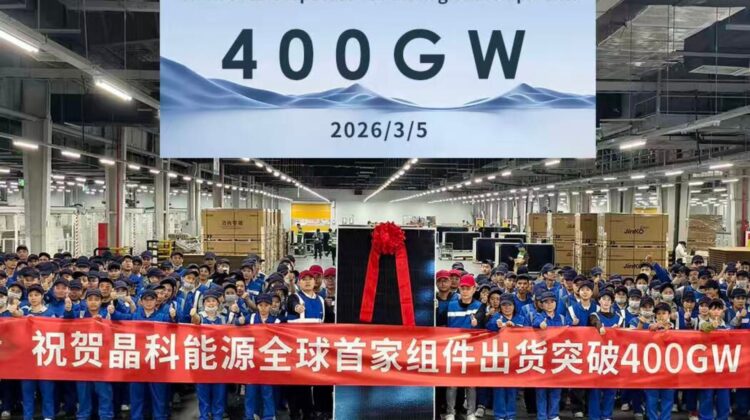
The global photovoltaic industry is undergoing a structural transformation marked by industrial scale, tax changes, technological innovation and growing demand for renewable power generation. In this context, JinkoSolar reached a new milestone by surpassing 400 GW in cumulative shipments of solar modules worldwide.
This deployment volume is equivalent to enough capacity to supply approximately 40 million homes, an indicator that highlights the magnitude of solar energy’s progress over the past two decades. According to JinkoSolar, twenty years ago solar energy cost around USD 3/W, while today the price can be around USD 0.10/W, a reduction that has completely transformed the technology’s competitiveness compared with other sources of power generation.
This expansion process is not only the result of economies of scale. It also reflects two decades of innovation in cell efficiency, improvements in industrial processes and optimisation of the photovoltaic supply chain.
According to JinkoSolar, the next stage of solar development will no longer focus exclusively on reducing costs, but rather on maximising the value the technology brings to the energy system. “The next 20 years will not be about cost, they will be about value,” the company stated.
Alongside this industrial growth, Jinko Solar Co., Ltd., the group’s main operating subsidiary, published preliminary financial results for the 2025 fiscal year. The company clarified that these figures are preliminary and unaudited, and may therefore differ from the group’s consolidated results due to accounting and consolidation differences.
For the full year 2025, Jiangxi Jinko’s preliminary unaudited revenue reached 65.49 billion yuan, representing a 29.18% year-on-year decrease. During the same period, the preliminary net loss attributable to shareholders amounted to 6.79 billion yuan, compared with a net profit attributable to shareholders of 98.9 million yuan recorded in 2024.
In addition, the preliminary net loss attributable to shareholders, excluding non-recurring gains and losses, reached 7.64 billion yuan. According to the company, these results were mainly due to a decline in the profitability of Jiangxi Jinko’s core business, as a result of falling selling prices for photovoltaic products, a phenomenon currently affecting much of the global solar industry.
At the same time, the company continues to strengthen its technological positioning. It recently launched Tiger Neo 3.0, its new module based on third-generation N-type TOPCon cells, a technology positioned among the most advanced within the photovoltaic industry.
The module reaches a maximum power output of 670 W and a conversion efficiency of up to 24.8%, parameters aimed at improving the energy performance of solar projects and reducing the levelised cost of electricity in large-scale installations.
The question now facing the sector is no longer whether solar energy will continue to grow, but how its role within the global energy system will evolve. This structural shift is also being accompanied by a new factor in the global market.
China has decided to eliminate part of the fiscal incentives for photovoltaic exports, including the rebate on value-added tax, a measure that could impact international solar module prices. Industry analysts anticipate that this adjustment could mark the end of the “ultra-cheap” panel era, with potential price increases of up to 15% in 2026.
In this transition scenario, manufacturers such as JinkoSolar believe that the future of the market will increasingly be defined by technological innovation, module efficiency and the energy value that photovoltaics can deliver to global power systems.