







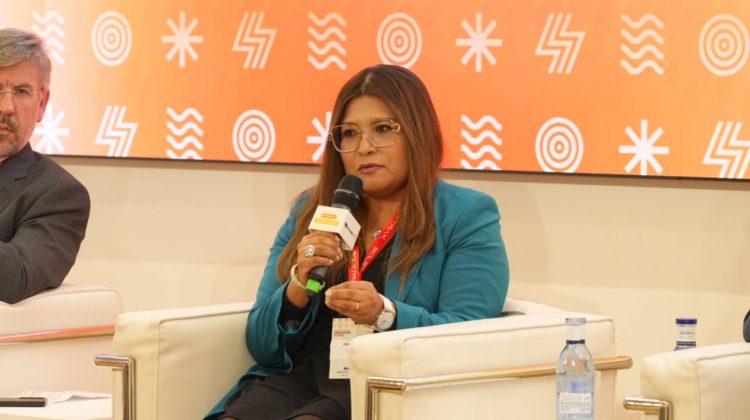
The Iberian energy storage market enters 2026 with a clear adjustment in its pricing structure. During the Future Energy Summit (FES) Iberia Renewables & Storage, Donaji Martínez, Europe Senior Sales Contract Manager at Jinko ESS, put precise figures on the current battery energy storage system (BESS) landscape.
“The fluctuation in lithium prices combined with the 3% tax rebate has resulted in product price increases. In the case of batteries, this has meant around an 8% rise in the first months of the year,” she explained.
Martínez added that the fiscal scheme will not stop there, with a further 6% adjustment expected by 2027, bringing the total to 9%. However, she stressed that correct implementation of the tax rebate mechanism is key to cost optimisation.
Following fiscal changes in China, the global renewable energy industry is beginning to rebalance. Market forecasts point to potential price increases of up to 15% in solar PV modules by 2026, as the world’s leading manufacturing hub restructures production.
Spain accelerates storage deployment
At the same time, Spain’s energy storage market is showing clear signs of acceleration. In just a few weeks, more than 570 MW of storage capacity for hybridisation projects have been processed, according to industry data, while the country awaits the design of its first capacity market auction.
This evolving regulatory framework is forcing developers and independent power producers (IPPs) to recalibrate financial models, power purchase agreement (PPA) strategies and contractual structures to maintain project bankability.
Against this backdrop, Jinko ESS has already quoted more than 11 GW of storage capacity across Iberia, primarily linked to projects supported by European Regional Development Funds (ERDF) and ongoing renewable energy developments.
“Iberian clients are among the most demanding in Europe, and rightly so. They know exactly what they want in terms of guarantees and pricing. Every cent invested must be carefully assessed, as project success depends on it,” Martínez noted.
Relive FES Iberia 2026: https://youtu.be/_G9kRTY2oU4
To address this environment, the company is promoting tailored contract frameworks that allow for larger volumes over multi-year horizons.
“If we want to optimise pricing, what we offer is a contract framework that enables us to scale volumes, anticipating customers’ needs over one to five years,” Martínez explained.
Hybridisation is emerging as a structural pillar of the Iberian renewable energy market. Southern Europe, with high solar PV and wind power penetration, is consolidating its role as a natural hub for integrating DC-coupled storage to maximise revenue streams and enhance grid integration.
“If you delay your decision further, the revenue stacking market — particularly ancillary services such as aFRR (automatic Frequency Restoration Reserve) — will eventually become saturated,” she warned, underscoring the importance of timing in capturing value from energy storage assets.
Financing remains a critical barrier for many storage projects. Payment structuring is increasingly central to achieving financial close and ensuring investment in renewables remains attractive.
“Through contractual agreements, we can defer payments and structure different payment milestones,” Martínez said, highlighting flexible schemes designed to support project bankability.
Technical support is also becoming a key differentiator. Jinko ESS is advancing the launch of its service centre in Imola, Italy, aimed at providing ongoing assistance to European clients.
“We help customers optimise projects from the grid connection point to container configuration, inverters, logistics timelines and port selection,” she added.
In summary, the nearly 8% increase in battery costs in early 2026 has not slowed Iberia’s dynamic BESS market. Instead, it is reshaping the financial equation. For Jinko ESS, the response lies in technical optimisation, structured contracting and volume assurance — backed by more than 11 GW already quoted in a region where energy storage is becoming a structural component of the renewable energy business model.