











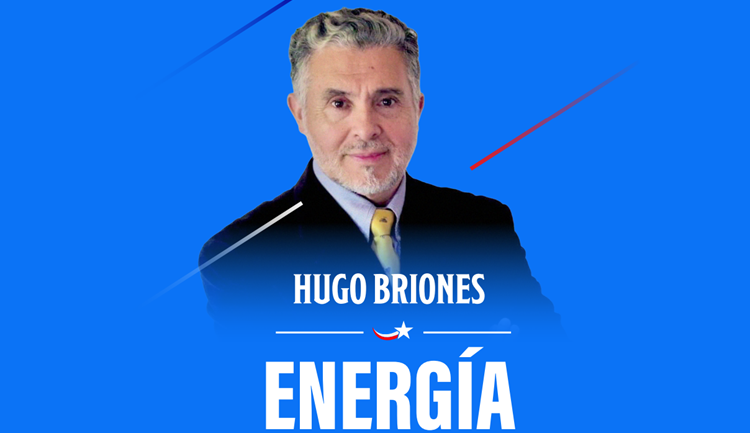
Hugo Briones has been appointed as Chile’s new Energy Undersecretary and will assume office on March 11, 2026, as part of the incoming administration of José Antonio Kast. He will serve under recently designated Energy Minister Ximena Rincón González.
Briones replaces Luis Felipe Ramos, who held the position since March 2023. His appointment comes at a technically sensitive moment for Chile’s electricity sector, as authorities seek to unlock stalled projects, restore system reliability and advance the country’s energy transition.
A 62-year-old electrical engineer, Briones brings more than three decades of experience in power generation and transmission infrastructure, including project development, engineering, construction and operations.
Between March 2023 and November 2024, he served as Project Manager at Transelec, Chile’s largest transmission operator. Earlier in his career, he held senior roles at:
-
Colbún (major generation company)
-
Mainstream Renewable Power (Latin America division)
-
Sigdo Koppers
-
Grupo Saesa
He has overseen thermal, hydroelectric and wind power plants across multiple regions of Chile, giving him direct operational experience in both conventional and renewable energy assets.
During his tenure, Ramos participated in the launch of Chile’s Green Hydrogen Explorer, a digital tool designed to estimate the levelized cost of energy (LCOE) by combining solar PV and wind power resources — a key step in advancing Chile’s green hydrogen strategy.
He also took part in Future Energy Summit Chile 2025, where he anticipated new decrees aimed at unlocking investment in:
-
Energy storage
-
Transmission infrastructure
-
Distributed generation
At the event, Ramos emphasized that energy storage is no longer a complementary solution but a structural component of Chile’s power system, particularly as solar and wind penetration increases.
Private sector reaction: technical expertise welcomed
Chile’s private energy sector has broadly welcomed Briones’ appointment, interpreting it as a signal of technical continuity and regulatory pragmatism.
Eduardo Andrade, Executive Secretary of Asociación Chilena de Comercializadores de Energía (ACEN), stated that Briones’ extensive industry background should facilitate constructive dialogue with market participants in what he described as a technically and regulatorily complex sector.
Similarly, Asociación Chilena de Energías Renovables y Almacenamiento (ACERA) highlighted the importance of appointing officials with proven expertise in infrastructure, regulation and complex project management.
Asociación Chilena de Energía Solar (ACESOL) also welcomed the designation, emphasizing Briones’ experience as a valuable asset for addressing regulatory and grid-related challenges tied to solar PV, distributed generation and battery energy storage systems (BESS).
Although Chile’s Ministry of Energy has historically avoided high political tension, the upcoming period is expected to be particularly demanding.
President-elect Kast’s energy agenda follows a market-oriented approach, prioritizing technical efficiency and minimizing direct subsidies. During the campaign, he proposed a structural reform of the electricity distribution segment, with a focus on:
-
Promoting distributed generation and distributed storage
-
Ensuring service quality for small consumers
-
Strengthening system reliability without major legal overhauls
A major area of debate involves Chile’s PMGD framework (Pequeños Medios de Generación Distribuida – Small Distributed Generation Units). The regime has faced criticism due to prolonged reliance on transitional pricing mechanisms and concerns about its operational alignment with the national grid.
The urgency of regulatory refinement has intensified following the nationwide blackout of February 25, 2025, which reignited discussions on grid stability, synchronous generation, system inertia and short-circuit capacity — technical services increasingly critical in high-renewables systems.
Kast’s program proposes expanding ancillary services markets, promoting synchronous generation where needed and reinforcing technical standards to ensure secure grid integration of variable renewable energy.