







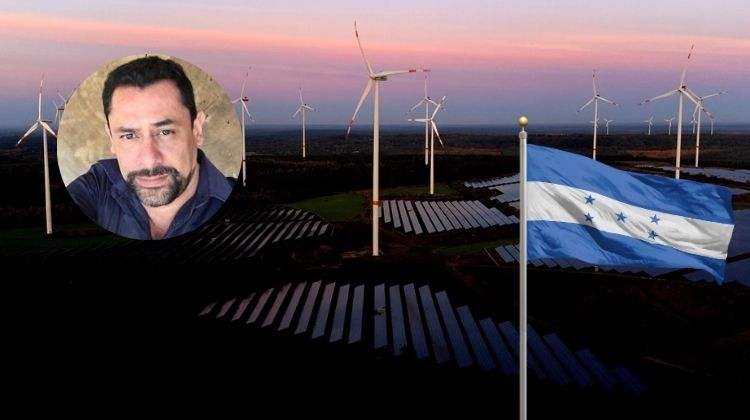
Honduras has opened a new window for investment in its power sector with a long-term tender for 1,500 MW of generation capacity, which remains open and has already attracted significant market interest. More than 10 companies—including firms from Latin America and outside the continent—have purchased the bid documents.
“The signal has already been sent, and there are many strong companies interested,” said Wilfredo Flores, commissioner at the Electricity Regulatory Commission (CREE), in an interview with Energía Estratégica. According to Flores, the process reflects an improving international perception of Honduras as a destination for power generation projects.
“We are seeing greater confidence in the sector’s institutions,” he added.
The tender was promoted by the current administration and supported by a broader effort to reposition Honduras’ power sector internationally. Both the state-owned utility National Electric Energy Company (ENEE) and the CREE have participated in regional and international forums to showcase opportunities in the Honduran electricity market.
This outreach has been complemented by technical advisory support from an Argentine consultancy, which has previously assisted similar auction processes in neighbouring countries such as Guatemala.
In parallel, Honduras has reformed its regulatory framework to enable, for the first time, short-term power tenders. While the tender documents for these processes are currently managed by the distribution company, the updated regulations allow generation contracts of up to four years, marking a structural shift from traditional long-term-only schemes.
“With the amendment we made to the law’s regulations, it is now possible to hold short-term auctions, opening up opportunities for faster investments,” Flores explained. Although political circumstances have delayed progress on this front, the CREE expects the mechanism to be activated at a later stage.
Political transition and energy mix diversification
An upcoming change of government is expected to bring further adjustments to energy policy. According to Flores, a sector counter-reform is under discussion, including greater market opening, a review of Law 46-2022, and changes to the classification of large and qualified consumers.
Authorities are also considering a revision of tariff signals to promote residential self-consumption, with distributed generation based on solar PV systems set to play a more prominent role, in line with regional renewable energy trends.
At the same time, the regulator has stressed the importance of strengthening the power mix with firm capacity to support the growing share of renewables. Honduras already operates a natural gas-fired power plant under a power purchase agreement (PPA), a technology that is also gaining relevance in other Central American markets such as El Salvador and Panama, particularly in response to climate change impacts affecting the region.
Against this backdrop, the ongoing 1.5 GW tender represents a concrete opportunity to accelerate investment in new generation capacity. With regulatory reforms under way, international technical backing and clearer market rules, Honduras is positioning itself as a strategic electricity market for future developments.
“We are confident that this process marks a before and after,” Flores concluded. “There is now a more modern regulatory base, clearer rules and confidence signals that simply did not exist before.”