






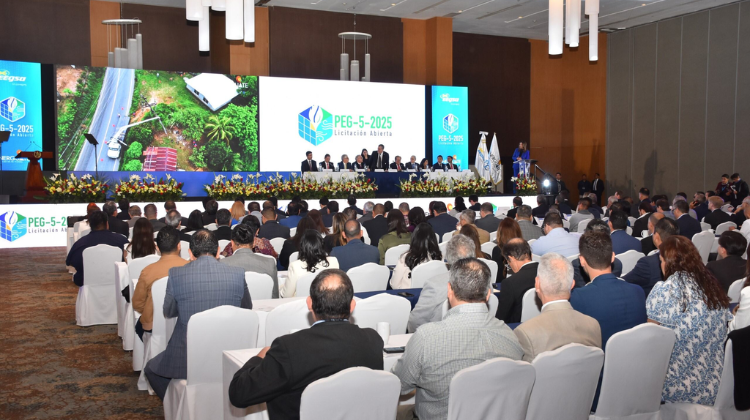
Guatemala’s PEG-5-2025 power tender has delivered unprecedented results. Of the 3,653.93 MW submitted, 1,242.43 MW correspond to solar PV projects with battery energy storage, making this the dominant technology in the process launched by the country’s main electricity distribution companies, Empresa Eléctrica de Guatemala S.A. (EEGSA) and Energuate.
The auction seeks to contract 1,400 MW of firm capacity under long-term power purchase agreements (PPAs). The total volume offered more than doubles the required capacity, confirming strong investor appetite and intensifying competition in Guatemala’s power market.
More than 34% of the total capacity offered corresponds exclusively to solar PV with storage. This signals a structural shift: the integration of photovoltaic generation and batteries is no longer a differentiating feature but a competitive standard.
In total, 1,933.93 MW — equivalent to 53% of all bids — come from renewable energy technologies. This reinforces Guatemala’s transition towards clean energy sources while ensuring grid reliability through storage-backed solutions.
The tender timeline remains on track:
-
Economic evaluation: 25 March 2026
-
Award decision: 16 April 2026
-
PPA signing: Up to three months after award
| Technology | Capacity (MW) |
|---|---|
| Solar PV + Battery Storage | 1,242.43 |
| Hydro + Solar Hybrid | 276.98 |
| Conventional Hydropower | 155.43 |
| Solar PV (without storage) | 141.10 |
| Wind Power | 31.50 |
| Geothermal | 24.25 |
Hybrid configurations are also present, reflecting a growing emphasis on grid integration, flexibility and operational stability.
During the preliminary stage, 51 companies expressed interest, with nearly 4.7 GW announced. After technical adjustments and administrative validations, 50 bidders formally submitted 3,653.93 MW — still far above the contracted requirement.
According to the distribution companies, “Guaranteeing reliable, stable electricity supply at competitive prices is a strategic priority.” This explains why battery energy storage systems (BESS) have taken centre stage in project design.
The dominance of solar-plus-storage in PEG-5 aligns with Guatemala’s long-term energy planning. Storage has been defined as a structural component to enable higher renewable penetration without compromising system reliability.
Under the national electricity expansion roadmap, batteries are described as a “key piece” in maintaining stability within a system experiencing growing levels of variable renewable energy.
In previous statements to Energía Estratégica, Ottoniel Isaías Alfaro, president of Asociación de Autoproductores con Energías Renovables de Guatemala (AAERG), stressed that battery storage is critical to reducing dependence on conventional generation during peak demand periods.
1 GW of additional renewables by 2040
Guatemala’s roadmap to 2040 includes an additional 1,000 MW of renewable energy capacity. Achieving this target will require flexible capacity, storage deployment and grid infrastructure upgrades to support investment in renewables.
Against this backdrop, PEG-5 is more than a procurement round for 1.4 GW of firm power. It reflects the maturity of Guatemala’s electricity market, where solar PV integrated with energy storage is emerging as the cornerstone of the next phase of expansion.
For international investors, the message is clear: in Guatemala, solar-plus-storage is no longer optional — it is the new baseline for competitiveness in renewable energy auctions.