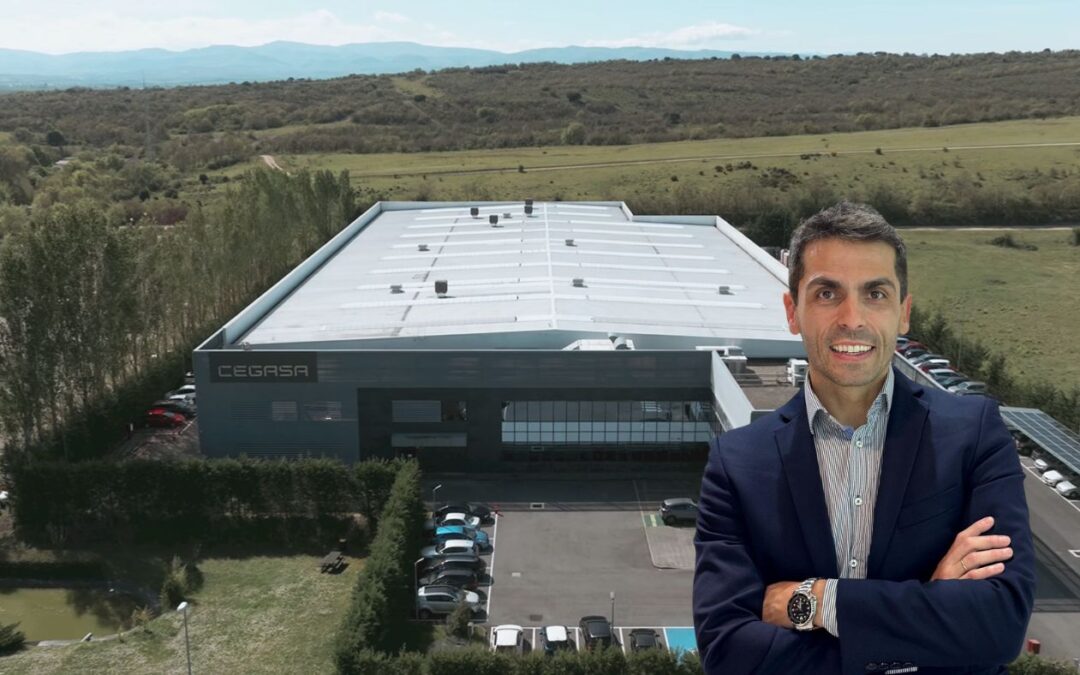







Martín Coll, Commercial Director of Hellonext for Spain, shared exclusive details about the company’s new strategic move into energy storage in a conversation with Energía Estratégica during GENERA 2025.
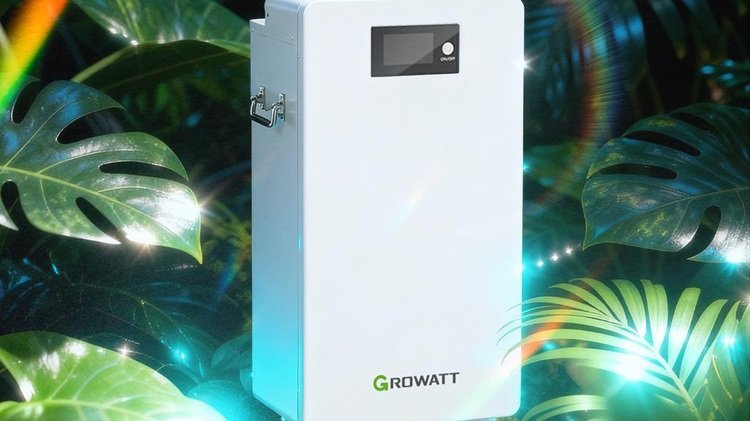
He explained that the decision is driven by concrete market demand and revealed that Hellonext is developing solutions for multiple customer profiles, with capacities of up to 30 MWh. Coll also discussed the company’s alliance strategy with Asian manufacturers, the role of European know-how as a competitive differentiator, and Hellonext’s track record in electric mobility, having closed 2025 with more than 400 EV chargers installed.
- Martín, to begin with, why are you entering this business?
Taking advantage of the fact that the group is very large and has extensive experience in installations, we started to see that many clients were asking for batteries. In particular, petrol stations that have 50 kW of contracted power but need an output of 150 kW. They were asking for a solution that would allow them to increase that power without increasing their contracted capacity.
- Petrol stations emerged as a new opportunity… How did you identify that moment to enter the storage business?
We prepared a specific solution for those cases. But we didn’t stop there. We saw that there was a very large niche in heavy industry, steelmaking and solar plants, and we started developing pilot projects with several of those clients to manufacture stationary batteries.
- And is it moving fast?
We are currently developing them, and we expect to achieve very good results in 2026. It is an ambitious path, but we are convinced.
- You will have to compete with China… What is the plan?
It is clear that there are very strong battery manufacturers, especially in Asia. We believe it makes no sense to compete against them, but rather to work alongside them, using their products and adding all of our European expertise. We want to add our knowledge of regulations, assembly, after-sales service and software integration to create a high-value solution. In this way, we can deliver a product that is competitive in terms of price and technical specifications, but with local support.
- At this point, have you already identified your main storage customers? Who are you selling batteries to today?
We have four clear profiles. The first is small petrol stations that need to increase output with a battery between 100 and 215 kWh. Then there is the logistics or warehousing industry, which wants to replace traditional generators with systems of up to 500 kWh or 1 MWh.
- What other types of customers are approaching Hellonext, looking for these solutions?
We are also seeing high-power EV charging hubs that ask for storage in order to avoid expanding the electrical infrastructure. And finally, larger customers such as solar plants or steel mills, which demand solutions of 2, 4, 25 or even 30 MWh. We can provide that capacity.
- Looking back, how would you assess this year for Hellonext in Spain?
We are quite satisfied. Considering how the year initially looked, especially with everything related to the MOVES subsidies, it has gone very well. We reached our targets and closed the year with more than 400 units installed. We started strongly, but between March and April, the MOVES programme was suspended. That, combined with the summer period, slowed customer activity. Fortunately, we already had large public contracts signed, which allowed us to maintain operations. Then, in autumn, MOVES was reactivated, and several clients returned with large orders.
- Did demand remain stable, or were there weaker months?
Normally, Q2 and Q4 are the most active quarters.
- Looking ahead to 2026, what kind of outlook do you expect?
We are waiting to see what happens. When MOVES was reactivated in the autumn, the funds were exhausted very quickly. Now we need to see whether more resources will be allocated or whether MOVES 4 will be launched. Everything is somewhat on hold.
- And what happens if the incentives are not renewed?
The market continues to function, but clearly at two different speeds. When there are incentives, everything accelerates. When there are none, the market still moves, but more slowly. Support does not always have to be financial: simplifying processes, such as obtaining permits, would also help.
- Permitting procedures are still a barrier, aren’t they?
We have clients waiting up to 18 months to install a 600 kW or 1 MW charging hub. That is far longer than desirable. Time is money, and those timelines should be reduced.
- In an increasingly competitive market, with new brands and solutions, where do you feel you have managed to stand out?
Our strategy is twofold: on the one hand, offering the full power range, from 3 kW to 480 kW, and on the other, standing out in after-sales service. We have one of the largest service teams in Spain, thanks to the support of Neertec, our in-house services company within the same group.
- The H2 4080 model was launched this year… How has the market responded?
The H2 4080 has been very well received, especially in indoor car parks. It is a very slim charger that does not interfere with parking space dimensions and delivers a very attractive power output. We have received a great deal of demand, particularly from charge point operators (CPOs).
Key statements – Summary table
| Topic | Key statement |
|---|---|
| Motivation to enter energy storage | “We saw that many clients started to demand batteries, especially at petrol stations.” |
| Customer demand for batteries | “They asked for a solution to deliver more power without increasing contracted capacity.” |
| Storage customer profiles | “We basically have three or four types of customers: petrol stations, industry, charging hubs and solar plants.” |
| Storage capacities offered | “We can offer solutions ranging from 100 kWh up to 30 MWh, depending on the customer.” |
| Partnerships with Asia | “It makes no sense to go against Asian manufacturers; we prefer to work with them.” |
| European added value | “We add our European expertise in regulations, assembly, after-sales and software.” |
| Expected results (2026) | “We are developing the batteries and expect very strong results in 2026.” |
| 2025 performance | “We are quite satisfied and closed the year having met our targets.” |
| Impact of MOVES programme | “When MOVES was reactivated in autumn, the funds were exhausted very quickly.” |
| Strategy without incentives | “The market moves at two speeds: faster with incentives, slower without them.” |
| Permitting timelines | “Some clients wait 18 months to install a 600 kW or 1 MW charging hub.” |
| Differentiation in EV charging | “We offer from 3 to 480 kW and have one of the largest after-sales teams in Spain.” |
| Reception of H2 4080 | “The H2 4080 is performing very well, with strong demand from CPOs.” |