











Yesterday, the European Commission published the new ‘Grids Package’. It contains legislative proposals as well as non-legal texts aimed at boosting grids investments and accelerating permitting, as well as coordinating grid network planning at EU-level.
The Package includes:
- Grid Package Communication here
- Permitting Amendments here
- TEN-E Amendments here
- Grid Connection Guidance here
- CfDs Guidance here
Teresa Ribera, Executive Vice-President for Clean, Just and Competitive Transition: “The European Grids Package is more than just a policy. It’s our commitment for an inclusive future, where every part of Europe reaps the benefits of the energy revolution: cheaper clean energy, reduced dependence on imported fossil fuels, secure supply and protection against price shocks. It symbolises our determination to overcoming challenges through unity, delivering a true EU response to a challenge of EU importance”.
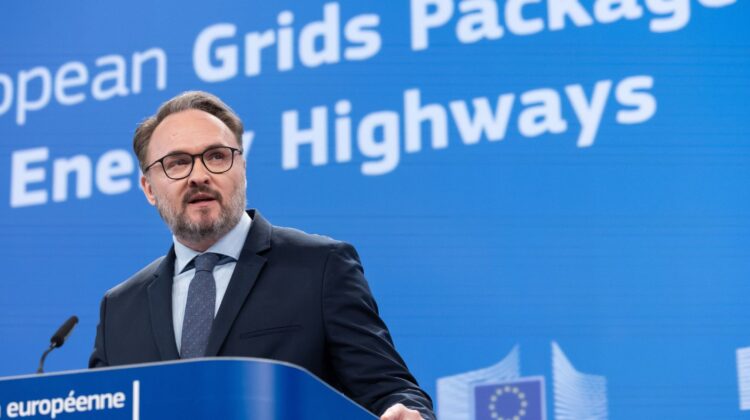
Dan Jørgensen, Commissioner for Energy and Housing: “A truly interconnected and integrated energy system is the foundation of a strong and independent Europe. To achieve it, we need an energy infrastructure network of cables, pipes and grids that is up to date, fully interconnected, and that enables clean, affordable, homegrown energy to flow freely and securely to every corner of our Union. This is exactly what we are proposing today: a common European energy project that supports affordable living, economic competitiveness, security and decarbonisation”.
While SolarPower Europe continues to analyse the package, we have issued the following immediate statement in reaction.
Walburga Hemetsberger, CEO of SolarPower Europe (she/her): “The Grid Connection Guidance is the highlight of the package, it hits the nail on the head. Member States now have clear instructions on how to design effective rules for connecting grid-friendly projects like hybrid solar + storage projects and remunerate users of flexible connection agreements. This publication will help Europe to make better use of the grid hardware that we have.
The European Commission has also made the long-overdue move to introduce targeted permitting legislation for energy storage. This means that Europe will be able to connect battery storage faster – be it as hybrid plants with solar, or stand-alone. This is a critical step toward 10x battery storage in Europe by 2030.
We do call on all co-legislators to keep those amendments focused on permitting. Targeted tweaks are good – they enhance the intended impact of the original legislation. Revision of the legal text which goes beyond that specific improvement would be unwise. Renewables need long-term legal certainty and implementation above all else.
The TEN-E amendment creates a new long-awaited governance for network planning at EU-level. For the first time, the European Commission will be responsible for ensuring that cross-border grid planning is aligned with our energy and climate goals.
However, we’re missing that vital spotlight on distribution system operators. These are the operators that can immediately reduce strain on the grid by ensuring we use energy from, and discharge energy to, the grid at optimal times. These stakeholders need to be remunerated for incorporating flexibility, like demand-response, and other non-wire solutions that can be rolled out quicker than costly grid upgrades.”
Notes
- In terms of next steps, the amendments to permitting and planning (TEN-E) legislation will go through a normal legislative process before adoption, while the communication and guidance are non-legislative, and will simply guide the future work of the European Commission and Member States.
- Flexible Connection Agreements are connection types where grid users agree to only use the connection when there is capacity. So when there is congestion (an abundance of energy), the grid user stops discharging or charging from the grid.
Summary Overview of Package elements
Permitting Amendments:
- Makes it more difficult for governments to designate no-go areas for renewables
- Accelerates the award of land permits to stand-alone storage and hybridisation of renewable energy plants with battery storage
- Mandates the creation of a digital platform for permitting
TEN-E Amendments:
- Establishes a central EU scenario for electricity and hydrogen transmission networks planning
- Creates 8 Energy Highways
- Places the Energy Efficiency First principle as a priority
Grid Connection Guidance:
- Recognises the need for grid transparency, digitalisation, and flexibility across all voltage levels.
- Places a strong emphasis on hybrid systems, energy storage, and grid-friendly projects
- Suggests introducing dynamic and time-of-use tariff
- Next steps The legislative proposals will now pass to the European Parliament and the Council under the ordinary legislative procedure. In parallel, the Commission will continue collaborating closely with Member States and all relevant stakeholders to implement key cross-border energy infrastructure projects – as recently published under the second Union list on Projects of Common Interest and Projects of Mutual Interest. Such collaboration will be pivotal in view of delivering swiftly on the Energy Highways initiative, as well as on the acceleration of permitting for renewable energy projects, storage projects and recharging stations.