










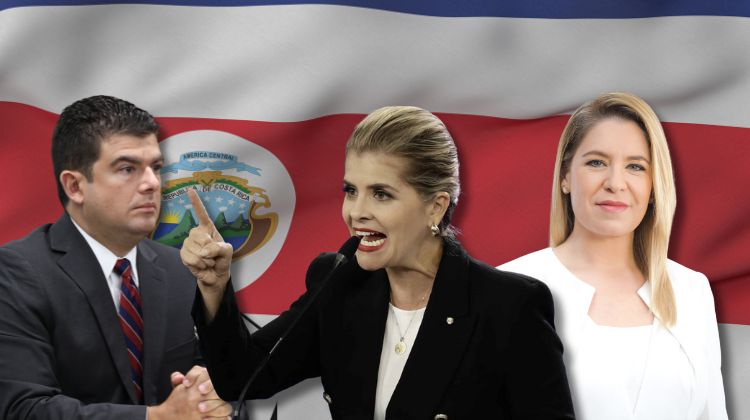
This Sunday, 1 February, Costa Rica will decide far more than its next president. Voters will also choose the energy transition model that will shape the country’s development in the coming years. According to the latest poll by the Centro de Investigación y Estudios Políticos of the University of Costa Rica (CIEP-UCR), ruling party candidate Laura Fernández, from the Partido Pueblo Soberano, leads the race with 43.8% voting intention and could secure victory in the first round—avoiding a run-off and consolidating an administration focused on opening up the energy market.
Costa Rica’s main challenge is no longer the decarbonisation of its power matrix—which already exceeds 98% renewable generation—but how to extend that transformation to transport, industry, energy storage and final energy consumption.
As previously reported by Energía Estratégica, the energy platforms of the three candidates with the highest voting intention—Laura Fernández, Álvaro Ramos (Partido Liberación Nacional) and Claudia Dobles (Coalición Agenda Ciudadana)—offer fundamentally different responses to this challenge.
Market opening and cost efficiency: Laura Fernández
Fernández’s plan follows a market-oriented approach. It proposes enabling private participation in geothermal projects, reviewing tariff structures to eliminate cost overruns, and transforming the National Electricity System so that the state-owned Instituto Costarricense de Electricidad (ICE) competes on equal terms with private players.
Her platform also includes strengthening regional grid interconnection and using organic waste to boost biogas and biomethane production, aligned with circular economy principles.
While the strategy aims to improve efficiency, reduce electricity tariffs and stimulate investment, energy sector sources argue that it lacks a clear roadmap to accelerate the broader energy transition. The prevailing view is that it largely represents continuity, with adjustments focused more on prices than on a structural transformation of the system.
Technology-driven transition and green finance: Álvaro Ramos
From a different standpoint, Ramos proposes a “second generation” of energy policies centred on advanced technologies, institutional modernisation and green finance. His plan promotes green hydrogen, marine energy and advanced geothermal, while enabling public–private partnerships (PPPs) so that ICE can procure generation and energy storage capacity more flexibly.
A key pillar is a Sustainable Finance Law that would allow Costa Rica to issue sovereign green bonds and establish a National Green Transition Fund. Ramos also proposes reforming the Ministerio de Ambiente y Energía (MINAE) to separate planning from operations, upgrading grids through smart grid deployment and strengthening distributed generation.
“The transition must cut across all sectors, not be limited to electricity,” Ramos has said, stressing the role of partnerships with strong technical and financial capacity.
State-led, just transition: Claudia Dobles
Dobles, meanwhile, advocates a deep transformation model led by the state. Her proposal seeks to convert RECOPE into a public clean energy company focused on green hydrogen, biomethane, energy storage and sustainable mobility.
ICE would retain its strategic role in generation, transmission and distribution, with expanded geothermal capacity and a controlled opening for solar PV and wind power under a solidarity-based scheme. Her programme includes legislation to ban hydrocarbon exploration and production, the creation of Energy Eco-Parks with utility-scale storage, and a dedicated regulatory framework for batteries.
Dobles also prioritises access to credit for households and communities—through fair tariffs—to enable them to become energy prosumers. The coalition frames this approach as a pathway towards a decarbonised economy with social equity and strong public leadership, building on environmental policies developed during previous Partido Acción Ciudadana (PAC) administrations.
The electoral landscape thus presents three clearly differentiated models:
-
Market liberalisation, focused on tariff reduction and competitiveness (Fernández)
-
Technology and green finance-led transition, emphasising innovation and investment tools (Ramos)
-
A just, state-led transition, prioritising public leadership and social equity (Dobles)
Differences are also evident in the envisioned role of ICE: Dobles positions it as the backbone of a solidarity-based system; Ramos as a flexible entity capable of strategic partnerships; and Fernández as one more player in an open market.
Fuel strategies further highlight the contrast: Dobles calls for a full phase-out of fossil fuels; Ramos focuses on emerging solutions such as green hydrogen; and Fernández prioritises efficiency through biogas and biomethane.
This Sunday, more than 3.7 million Costa Ricans will decide not only who becomes president, but also which energy transition pathway will define the country’s future.
| Topic | Claudia Dobles | Laura Fernández | Álvaro Ramos |
|---|---|---|---|
| Role of ICE | Strategic leader and guarantor of a solidarity-based system | Competitor on equal terms with private players | Flexible entity able to engage in PPPs |
| Private sector opening | Solar and wind under strong state regulation | Opening of geothermal and the wider power market | Strategic partnerships and agile procurement |
| Fuels | Transform RECOPE into a clean energy company; ban oil exploration | Biogas and biomethane production; cleaner fuels | Green hydrogen and next-generation energies |
| Core focus | Just transition, decarbonisation and prosumer communities | Tariff reduction and market competitiveness | Advanced technologies, grid modernisation and green finance |