











Chile has officially started construction of the Kimal–Lo Aguirre high-voltage direct current (HVDC) transmission line, a strategic piece of infrastructure designed to relieve one of the power system’s main bottlenecks: the limited capacity to deliver renewable generation from the north to central demand hubs.
Developed by Conexión Energía, the 1,346-kilometre line will link the Antofagasta Region with the Metropolitan Region of Santiago, enabling the evacuation of up to 3,000 MW of electricity.
The project is the first HVDC line ever built in Chile and one of the most ambitious undertakings in the country’s transmission history. Its core objective is structural: to unlock renewable energy capacity currently constrained in northern Chile by grid congestion.
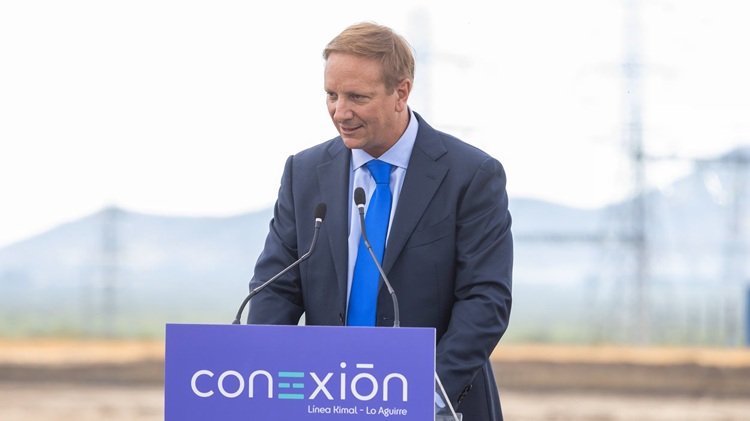
“Today marks the beginning of a new phase—more than three years of construction—where public-private coordination will remain critical to meeting deadlines, standards and commitments. Kimal–Lo Aguirre is no small challenge,” said Sebastián Fernández, Chief Executive Officer of Conexión Energía, at the groundbreaking ceremony.
Unlike conventional alternating current (AC) lines, HVDC technology enables the transmission of large energy blocks over long distances with lower electrical losses, greater system stability, improved operational control and more efficient land use.
The line will operate at 600 kV and cross dozens of municipalities along its route, supported by 2,692 transmission structures. Two converter substations will be installed at each end—one in Kimal (Antofagasta) and the other in Lo Aguirre, near Santiago—both essential for converting power between AC and DC for grid integration.
“This is not only Chile’s first HVDC project; it is also the longest transmission line ever built in the country, probably the most geographically challenging, and one that places Chile at the forefront of the Latin American transmission sector,” Fernández added.
Beyond its technical scale, Kimal–Lo Aguirre is a cornerstone of Chile’s decarbonisation strategy. By enabling renewable energy generated in the north—particularly solar PV and wind power—to reach central Chile with higher reliability, the line supports the country’s goal of achieving a 100% clean power matrix by 2050.
“With the construction and commissioning of this project, electricity costs will fall because cheaper energy from the north will reach areas where it is currently unavailable,” said Álvaro García, Chile’s Minister of Energy and Economy.
Conexión Energía’s involvement in Kimal–Lo Aguirre dates back to 2022, when the company established its first board and launched the environmental impact assessment. In April 2023, it secured a USD 480 million green loan, alongside voluntary negotiations with 491 private landowners.
The project was formally submitted to Chile’s Environmental Assessment System in October 2024 and received its Environmental Approval Resolution in November 2025. Between December 2025 and January 2026, the first containers of equipment arrived at Port Angamos and San Antonio Port, allowing construction to begin in February this year.
Given its scale and strategic relevance, Kimal–Lo Aguirre is set to become a backbone of Chile’s power system transformation—combining cutting-edge HVDC technology with a long-term roadmap aligned with the requirements of a modern, resilient and sustainable electricity grid.