











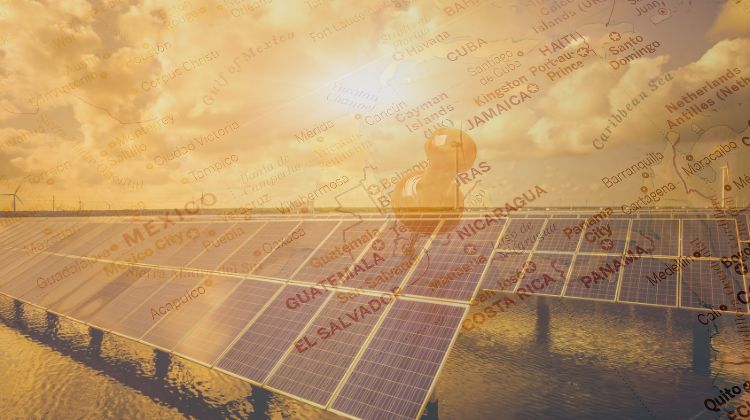
Solar energy development in Central America is progressing unevenly. Technical grid conditions, regulatory frameworks and perceived country risk are creating markedly different scenarios across markets, explaining why some countries maintain strong momentum while others face greater barriers to integrating new renewable energy generation.
Drawing on regional experience in utility-scale projects, Angélica Ferreira Piñeiro, Business Development Manager for Utility-Scale Projects LATAM at Yingli Solar, highlighted that these differences stem from structural factors that shape the sector’s growth trajectory.
“The varying pace across Central America is mainly driven by three structural variables,” she noted. “These are the actual capacity of the power system, regulatory design and country risk factors that ultimately determine the feasibility and progress of new solar PV projects.”
One of the key constraints is transmission capacity and grid access, which directly limit how much renewable energy can be deployed in each country.
Honduras: Grid capacity and regulatory barriers
In Honduras, for instance, technical constraints are restricting the addition of new large-scale capacity. Grid congestion at multiple connection points is hindering the development of utility-scale solar projects and reducing opportunities for new investments in renewables.
These challenges are compounded by regulatory changes that have reshaped the electricity market, particularly in the private contracting segment.
A significant shift has been the increase in the threshold required to qualify as a large electricity consumer, from levels in the hundreds of kilowatts to over 5 MW. This has considerably reduced the pool of potential off-takers.
“The increase in the threshold for qualified consumers to above 5 MW has significantly reduced the scope for private contracts,” Ferreira Piñeiro explained. This directly affects the ability to structure power purchase agreements (PPAs), one of the main mechanisms supporting solar PV development in the region.
Despite these limitations, Honduras is attempting to unlock new opportunities through public procurement. A 1.5 GW tender launched by the national utility ENEE aims to add new generation capacity, with the bid submission deadline recently extended by three months.
In parallel, the government is revising the auction model, moving away from a Build, Operate and Transfer (BOT) scheme and introducing reverse auctions.
Investor caution remains, however, amid outstanding debt with generators, ongoing contract renegotiations and regulatory uncertainty—factors that continue to influence the pace of renewable energy investment.
Guatemala: leading regional momentum
While some markets face structural constraints, Guatemala is currently one of the most dynamic environments for solar energy development in Central America.
Recent conditions have been shaped by drought linked to the El Niño phenomenon, which reduced hydropower output and increased reliance on thermal generation, driving up electricity prices.
This has created favourable conditions for new renewable energy capacity, particularly solar PV.
Guatemala also benefits from a more robust transmission network and a regulatory framework that enables smaller-scale projects, allowing for faster deployment compared to other regional markets.
Among the available mechanisms are renewable distributed generation schemes, which support projects of up to around 5 MW, facilitating quicker integration into the grid.
Additionally, one of the most significant initiatives in the country’s power sector is the PEG-5 tender, which seeks to procure up to 1.4 GW of new generation capacity.
“The level of participation in this process confirms strong market interest and reinforces the perception of momentum,” Ferreira Piñeiro said.
El Salvador: a mature but steady market
By contrast, El Salvador presents a more mature electricity market, where renewable energy growth is progressing at a steadier pace.
Current opportunities are mainly concentrated in commercial and industrial rooftop solar, alongside asset optimisation and selective development of new capacity.
At the same time, energy storage is beginning to gain relevance as a technical solution to support higher renewable penetration and improve grid integration.
However, storage is not yet the primary growth driver, but rather a complementary technology expected to play a larger role as the share of renewables increases.
Solar development in the region is also being shaped by international dynamics affecting supply chains and logistics.
Geopolitical tensions in the Middle East have disrupted key maritime routes such as the Suez Canal, the Red Sea and the Strait of Hormuz, leading to shipping rerouting, longer transit times and higher freight costs.
Meanwhile, the global solar PV module market is undergoing price adjustments following a period of intense pressure on manufacturers.
“Module prices are starting to align with actual production costs,” Ferreira Piñeiro noted.
In this context, logistics and transport costs are becoming increasingly critical in project planning, influencing both capital expenditure and the bankability of supply timelines.
Although global factors are introducing new variables, solar energy development in Central America continues to be primarily shaped by local structural conditions—namely transmission capacity, regulatory frameworks and the overall stability of each electricity market.