











Canadian Solar is taking firm steps to expand across South America, with a regional strategy centred on comprehensive technology solutions. Colombia, Peru and Argentina have been identified as the key growth markets through to 2026, amid new regulations, increasing grid reliability needs and rising demand for energy storage.
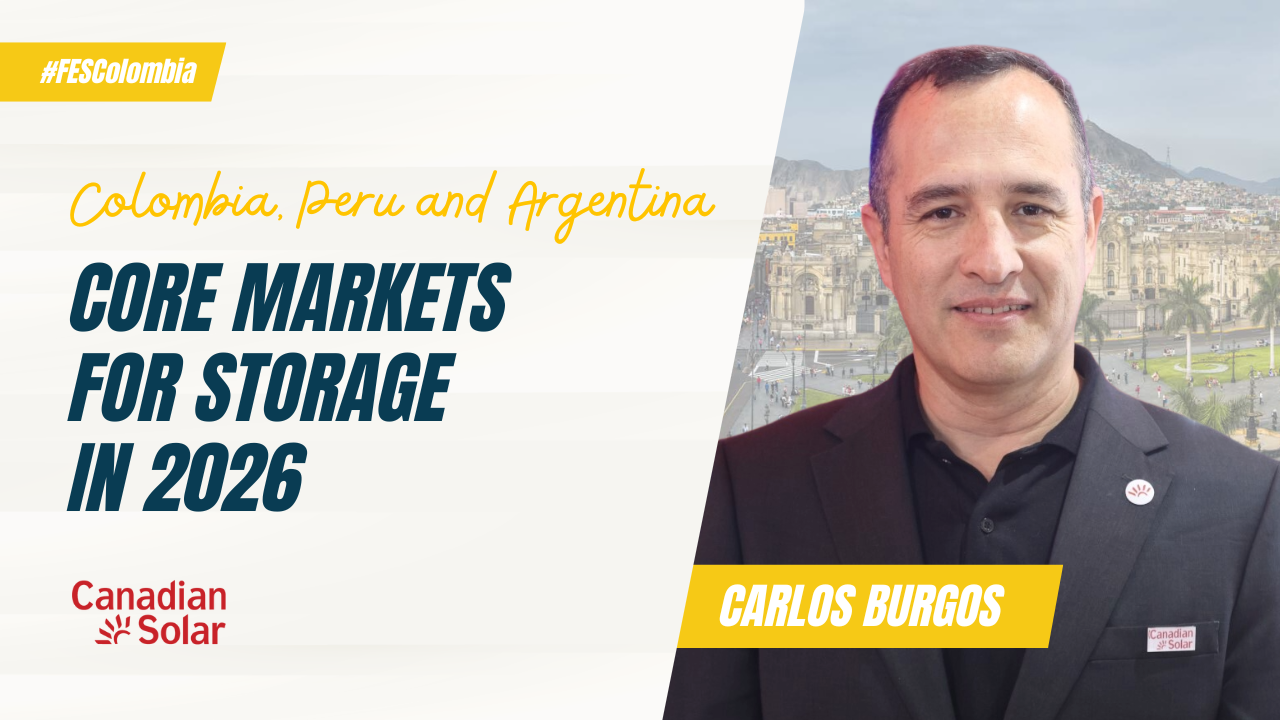
Speaking to Strategic Energy at the Future Energy Summit (FES) Colombia, Carlos Burgos, SR Sales Manager at Canadian Solar, outlined the company’s approach, which has moved away from selling standalone products to offering full system solutions.
These include solar panels, inverters, transformation centres and storage systems. By unifying these components under a single manufacturer, Canadian Solar aims to eliminate the technical incompatibilities that often arise between system elements in solar installations.
Watch the full interview with Carlos Burgos, SR Sales Manager at Canadian Solar, here: https://www.youtube.com/watch?v=Xxxps1PYnhg
Its portfolio spans all market segments — residential, commercial-industrial and utility scale. One of its most recent additions is the launch of hybrid inverters for the residential sector, a highly demanded technology in countries like Colombia and Ecuador, where hydropower dependency and threats from climate events like El Niño put the grid under pressure. These new solutions enable households to maintain supply without fully relying on the national grid.
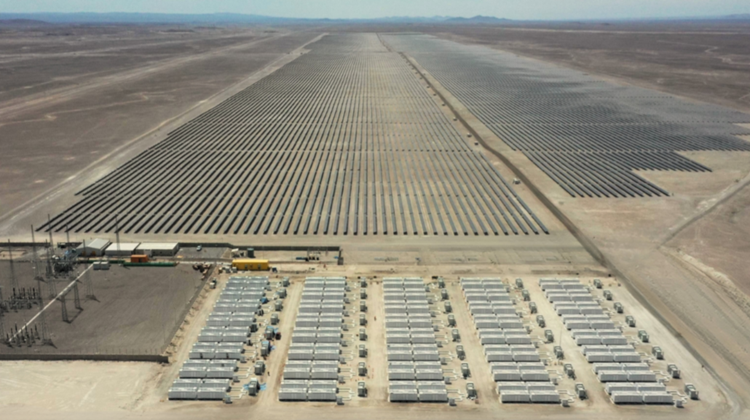
In the commercial and industrial (C&I) segment, Canadian Solar offers 277 kWh battery systems (C&I SolBank), while for large-scale deployments, it promotes the SolBank system, specifically designed for utility-scale operations. This integrated and modular approach directly addresses the region’s growing need for energy security and resilience.
Technology tailored to regional challenges
In Peru, Canadian Solar is already receiving requests for solar parks exceeding 200 MW, a sign of the acceleration expected by 2026. The country’s updated regulatory framework, which now mandates the inclusion of storage, creates direct opportunities for turnkey solutions like those offered by the company. In Colombia, the long-awaited approval of the “S Colombia” regulation is set to unlock large-scale storage deployment.
Meanwhile, Argentina is considered a high-potential market. Although macroeconomic uncertainty still holds back investment, Canadian Solar is tracking a pipeline of large-scale projects that are ready to launch once financial conditions stabilise. “Argentina will be a major player in renewables once its financial risks are overcome,” Burgos noted.
Other South American countries are also gaining momentum. In Chile, agrivoltaics are expanding rapidly, particularly in the south, driving demand for industrial solar and storage solutions. Ecuador is accelerating its transition in the wake of power rationing experienced in 2023. In Bolivia, where the energy matrix is heavily reliant on gas, the shift towards renewables is beginning to take shape.
Looking ahead, Canadian Solar plans to launch panels of up to 735 W without altering the current module format. The goal is to maximise energy density as land prices rise. The company also aims to introduce HJT technology, which enables greater efficiency in smaller surface areas — a strategic move to optimise space usage in large projects.
To address logistics in difficult geographies, the company is developing a flexible storage system known as SolBank Flex. This solution is designed for countries such as Colombia, Peru and Ecuador, where access to remote sites is often complex. It allows the transport of modular battery kits with reduced volume, making it easier to reach isolated areas and simplifying project implementation and logistics.
Intelligence is also being added to the inverter side. The company is incorporating artificial intelligence into its devices, enabling them to respond rapidly to grid signals such as frequency changes, voltage fluctuations or reactive power demands. “Inverters are the brains of solar installations,” Burgos pointed out, highlighting the need for smarter, more autonomous hardware.
The company’s flexibility reflects the diversity of technical and logistical challenges in South American solar projects. From limited road access and transport restrictions to unexpected connection distances, each project presents unique hurdles. As a result, Canadian Solar is adapting its offerings to suit local infrastructure, environmental conditions and regulatory landscapes.
“This summit is a great platform for all stakeholders in the sector to connect,” Burgos concluded, referring to the importance of events like the Future Energy Summit Colombia in accelerating the industry’s development.
With a robust technological offering, a regional focus and tailored solutions, Canadian Solar is positioning itself as a key partner in South America’s energy transition, with 2026 set as a turning point for the region’s solar and storage market.