










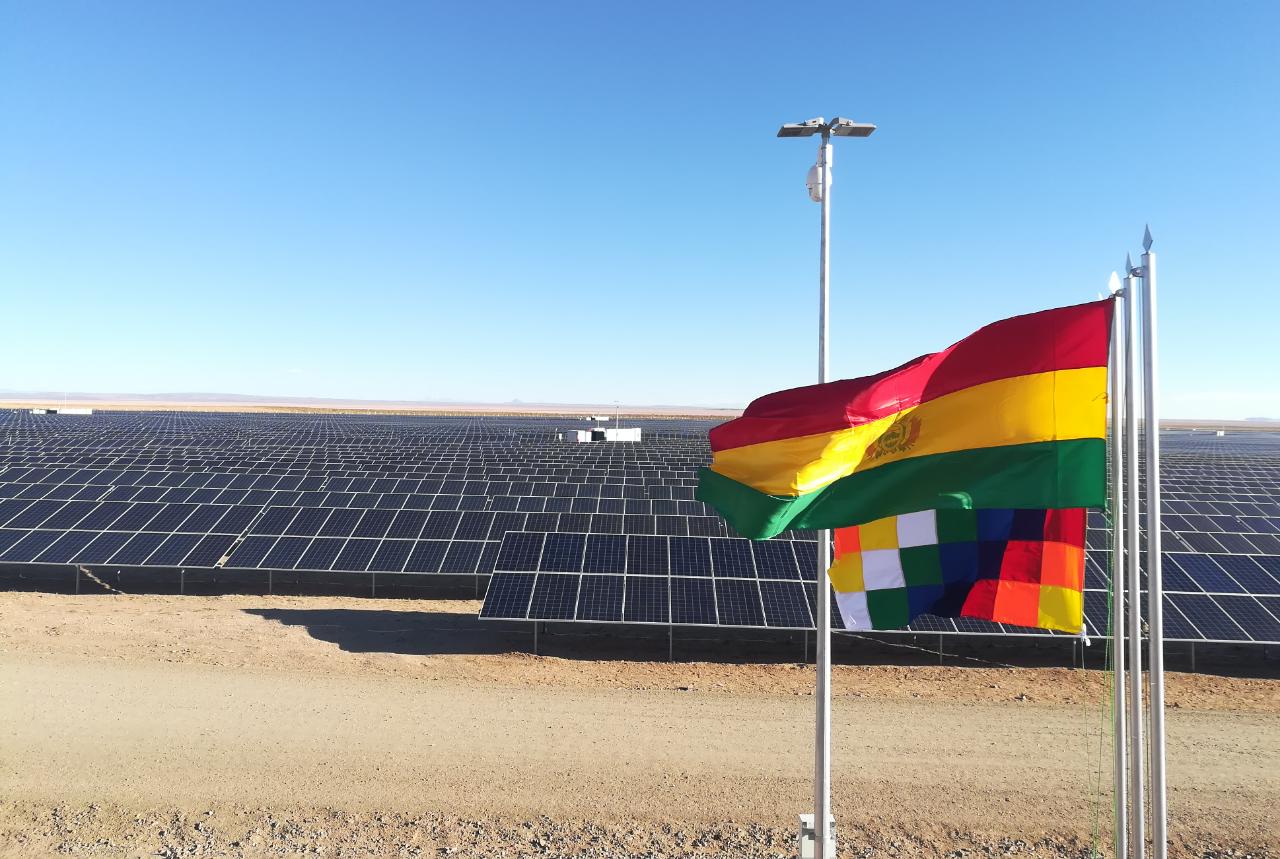
Bolivia is positioning itself as a rising renewable energy market in Latin America, with installed capacity surpassing 1,100 MW and forecasts indicating the country could approach 2,000 MW by the end of 2026.
According to Cristhian Romero, LATAM Business Development Manager at Gonvarri Solar Steel, investor interest is gaining momentum. “There is a clear market expectation. Utility-scale projects that have been in development for years are now close to materialising, driven by Bolivia’s growing energy demand,” he stated during an industry webinar.
By the end of 2025, Bolivia’s installed renewable capacity had exceeded 1 GW, according to industry sources. The country’s National Interconnected System (SIN) expansion plan—launched in mid-2024—foresees the addition of 4,670 MW of renewable capacity by 2050.
The goal is to reach at least 75% participation of non-conventional renewable energy (NCRE) in the generation mix, while expanding electricity coverage nationwide.
| Technology | Planned Capacity (MW) |
|---|---|
| Hydropower | 2,755 MW |
| Solar PV | 1,726 MW |
| Wind power | 1,027 MW |
| Geothermal | 100 MW |
| Biomass | 200 MW |
| Thermal (backup) | 2,468 MW |
This roadmap signals a structured, state-led energy transition strategy, as Bolivia’s power sector remains centrally managed, similar to Ecuador’s model.
The Bolivian government has announced a new Electricity Law aimed at modernising the regulatory framework, promoting distributed generation and self-consumption, improving integration of variable renewable energy, and expanding transmission infrastructure to strengthen grid reliability.
Additionally, on February 19, the Executive Branch enacted Supreme Decree No. 5549, expanding distributed generation projects up to 6 MW and incorporating medium-scale projects eligible for grid connection upon regulatory authorisation.
These policy updates are seen as positive signals for renewable energy investment, particularly for solar PV and utility-scale developments, where grid integration and permitting certainty are critical.
As Bolivia enters the radar of regional investors, Gonvarri Solar Steel is consolidating its footprint across neighbouring markets. The company has delivered more than 30 GW of solar trackers globally, including 8 GW across Latin America.
Its strategy focuses on early-stage engagement with EPC contractors, utilities and renewable energy investors, seeking to build long-term partnerships rather than purely transactional relationships.
Backed by nearly 70 years of industrial experience from its parent group Gonvarri Industries—and more than two decades in the photovoltaic sector—the company has strengthened its presence in Chile and Peru.
In Chile, Gonvarri has surpassed 1 GW of trackers supplied. In Peru, where it has operated since 2012, the company is currently supplying solar trackers for the country’s largest photovoltaic projects, totalling 480 MW and 350 MW.
Romero highlighted Peru’s accelerating construction pipeline: approximately 700 MW began construction last year, with another 700 MW expected to break ground this year. New regulatory frameworks could further boost direct contracting opportunities and investment in renewables.
Argentina and the next wave of utility-scale growth
Gonvarri also maintains operations in Argentina, where the electricity market is undergoing contractual restructuring and exploring new mechanisms to sustain renewable energy expansion.
“We have seen sustained growth in recent years, but today we see strong potential for utility-scale projects to re-energise the market. When regulatory changes occur in the power sector, solar projects typically lead the expansion due to lower CAPEX, faster construction timelines and permitting advantages,” Romero noted.
Across the Southern Cone, solar PV continues to gain competitiveness, supported by declining costs, scalable deployment and compatibility with battery energy storage systems (BESS).
Within this regional context, Bolivia’s combination of long-term planning, regulatory modernisation, and growing electricity demand is positioning the country as a potential new hub for utility-scale renewable energy investment in Latin America.