







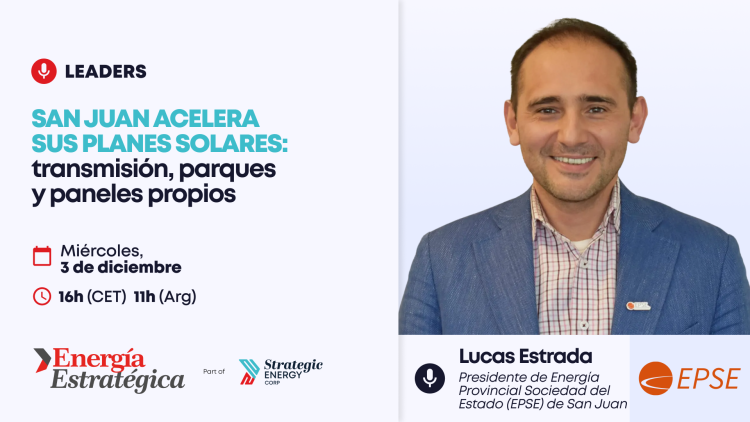
San Juan is advancing efforts to reinforce its status as Argentina’s leading province in solar power generation. With more than 30% of the country’s operational PV plants, the state-owned company called “Empresa Provincial Sociedad del Estado” (EPSE) is intensifying its strategy, centred on new infrastructure, photovoltaic initiatives and the production of domestic technology.
“Our export capability is reaching its limit; several areas are facing dynamic stability concerns, as generation vastly exceeds demand and sits far from consumption nodes,” warned Lucas Estrada, president of EPSE, during the Leaders interview series by Energía Estratégica.
To address this critical scenario, a 132-kV double-circuit transmission line is already under construction. It will contribute 180 MW of additional capacity to the grid and enable the interconnection between the Ullum and Albardón–Chimbas substations.
This upgrade will create room for two new solar parks. The first is Ullum Alpha, a 50-MW facility with 70% completion, developed by Genneia, which is expected to come online during the first half of 2026.
“We also maintain a portfolio of several photovoltaic projects that continue moving forward as we await the expansion of the transmission system. We have more than 350 MW under development in Tocota, where the plant factor surpasses 30%,” Estrada noted.
One of the most significant milestones in this process is the signing of a memorandum of understanding with PowerChina and Shanghai Electric to pursue new renewable ventures, potentially including battery systems. These projects—Tocota VI, VII and VIII—would add 350 MW and expand the province’s generation capacity.
“We remain in permanent dialogue with major system users, such as copper mining companies, as well as generators already operating or interested in establishing themselves in San Juan, in order to offer highly competitive power to industry,” added the EPSE president.
Similarly, the utility is developing smaller initiatives under the country’s distributed generation law, with projects ranging from 5 to 10 MW, some of which are classified as community generators. These aim to strengthen the grid in remote zones and support agricultural operations, with execution planned for 2026.
In parallel, the province is accelerating its commitment to domestic technology manufacturing. After delays caused by foreign trade conditions, the entity was able to conclude the contract and acquisition of the laminator required for proper plant operation, allowing an annual production capacity of 450–500 MW, far above the initially estimated 70 MW.
“Governor Marcelo Orrego has identified the launch of the solar panel factory as a flagship initiative. We expect the plant to begin operating between July and August 2026, following a 45-day assembly phase, another 45 days of commissioning and up to four months of testing,” he stated.
“The first stage will be performed without load to validate communication across machines; the second will assess module quality, efficiency, units produced per time and all relevant performance indicators,” Estrada explained. Once this process concludes, the panels will be shipped abroad for international certification, which is essential for accessing global markets.
EPSE is already mapping its international entry strategy, even evaluating potential cooperation with the United States amid tariff restrictions affecting Chinese-made PV modules, while also leveraging bilateral relations between Argentina and the U.S.
New market landscape and emerging technologies
The restructuring of Argentina’s wholesale electricity market has created a new environment for investment in generation. Under updated guidelines from the Secretariat of Energy, a dual system for energy and capacity will coexist, considerably improving project revenues.
Within this framework, EPSE revived a geothermal project it had explored for years, which could provide more than 50 MW of firm capacity.
“We are also waiting to finalise a number of energy—and especially capacity—contracts for our hydroelectric plants,” Estrada concluded.