










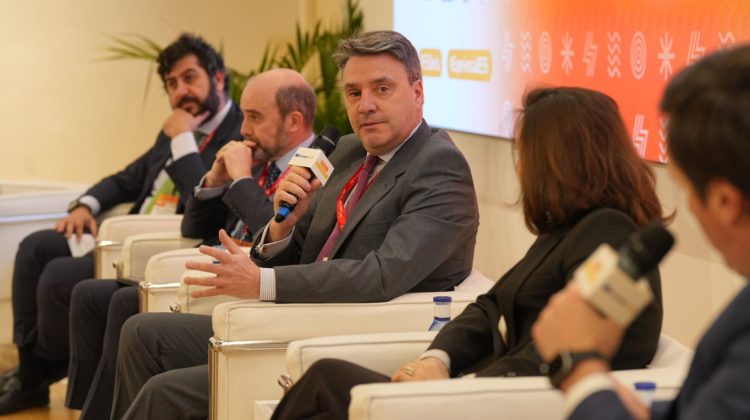
Spain must accelerate renewable energy permitting and update its long-term energy roadmap to sustain investment, according to executives from ACCIONA.
Speaking at Future Energy Summit (FES) Iberia 2026, Rafael Esteban, Global Chief Business Development Officer of ACCIONA, pointed to Germany as a benchmark for streamlined authorization processes and strategic energy planning.
Esteban described Germany’s renewable permitting framework as a strategic pillar of its energy system, enabling the rapid deployment of wind power, solar PV and battery energy storage systems (BESS).
“In Germany, renewable permitting is treated as a strategic priority. Projects move forward with remarkable speed,” he said, acknowledging that while the approach may raise concerns at times, the outcome is clear: accelerated implementation of renewables and grid integration.
By contrast, Spain continues to face prolonged administrative timelines. According to Esteban, the sector has repeatedly flagged permitting delays, yet no structural improvement has materialized.
“Renewable plants have taken too long to develop, and we have not seen meaningful progress,” he noted.
Beyond permitting, ACCIONA emphasized a more structural concern: long-term regulatory visibility.
Renewable energy assets—whether onshore wind, solar PV or hybrid storage projects—require decades to amortize. Institutional investors evaluating 25–30 year commitments depend on stable frameworks to assess risk, levelized cost of electricity (LCOE), and power purchase agreement (PPA) structures.
“These are projects that take years to develop and must operate for decades,” Esteban stressed.
Persistent regulatory uncertainty fuels debate within investment committees over where and how to allocate capital, particularly in markets facing evolving energy policies.
Revisiting Spain’s PNIEC
At the center of the discussion is Spain’s National Integrated Energy and Climate Plan (PNIEC).
Plan Nacional Integrado de Energía y Clima, which sets national renewable energy and decarbonization targets, no longer reflects current market realities, according to ACCIONA.
“I would welcome a revision of the PNIEC aligned with today’s market environment. It has become outdated,” Esteban stated.
While acknowledging Spain’s complex political and electoral context, he insisted that the sector requires a clear roadmap to guide strategic investment decisions and ensure grid expansion, electrification, and energy storage deployment proceed in sync.
Spain’s power system is now experiencing a structural shift. In previous years, the bottleneck centered on generation access. Today, congestion increasingly affects the demand side, with a surge in grid connection requests from industrial and electrification projects.
“We are now on the demand side where we previously were on generation—there is an enormous volume of connection requests,” Esteban warned.
Resolving this constraint is critical to sizing the next wave of renewable energy investment and determining which technologies—storage, hybridization, grid reinforcement—must be prioritized.