









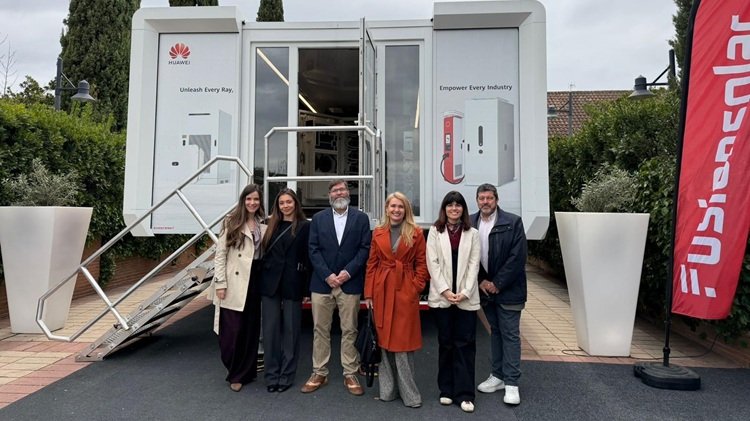
Huawei and Wattkraft, a Value Added Partner responsible for distributing Huawei FusionSolar products in Spain, have introduced the latest additions to the FusionSolar portfolio for 2026. The launch took place during a dedicated roadshow event held in Madrid, bringing together key stakeholders from the renewable energy sector.
The event was also attended by installation partners such as Sumsol and Saclima, alongside a wide range of clients and industry representatives operating in Spain’s solar PV market.
Among the main announcements was the LUNA2000-241-2S1 battery, one of Huawei’s flagship solutions for the commercial and industrial (C&I) segment. The system combines increased storage capacity, higher energy density, and a clear evolution in Huawei’s offering for industrial and commercial applications.
With a total capacity of 241 kWh, this cabinet-based solution expands Huawei’s storage portfolio and reinforces its positioning in applications such as backup power, microgrids and behind-the-meter energy management.
Beyond capacity, efficiency and operational performance are central to the new design. Improvements in cell density, combined with enhanced cooling and optimisation technologies, aim to deliver a more competitive solution—particularly for projects where total cost of ownership (TCO) is a critical factor.
Safety and operational reliability remain key priorities, consistent with Huawei’s technology approach. The battery features a dual cooling system—air and liquid—designed to ensure stable performance in demanding energy environments, reduce energy consumption and extend equipment lifespan.
In addition, the system is built on a C2C Dual-link Safety architecture, providing electrical and thermal protection from cell to application level. It includes detection of more than 13 types of faults, multi-layer protection against overcurrent and short circuits, and ultra-fast shutdown within 5 milliseconds. Additional safety features include oxygen barriers at pack level, directed gas exhaust, explosion-proof top venting and an integrated aerosol-based fire suppression system.
New inverters tailored to evolving market needs
Huawei has also introduced upgrades to its SUN2000-30/40/50K-MC0 inverter range, designed to accommodate higher-power PV modules and larger string configurations. This is enabled by the integration of two new 33A Maximum Power Point Trackers (MPPTs), enhancing system design flexibility and performance.
These inverters maintain a strong focus on safety and advanced monitoring. Key features include arc fault detection, automatic disconnection in case of overheating, and a range of protections aimed at mitigating electrical and operational risks.
Meanwhile, the next generation of the SUN2000 and SUN5000-150K-MG0 series introduces integrated optimisers, improving both system performance and diagnostic capabilities.
Notable benefits include:
- Detection of module and panel faults, even without optimisers in certain scenarios
- Identification of insulation issues such as moisture ingress, backsheet damage or exposed cables
- Protection against reverse currents, internal and external short circuits, and ground faults
- Compliance with rapid shutdown regulations
- Enhanced protection against overheating and electrical anomalies
These advancements position the new inverter solutions as more robust, intelligent and better suited to increasingly complex energy environments.
Industry perspective: smarter, integrated energy systems
Gavin Zhao, CEO of Huawei Digital Power Spain, highlighted the broader market trend:
“We are seeing a clear shift towards smarter, more integrated energy solutions capable of addressing increasingly complex needs across residential, C&I, utility-scale and electric mobility segments. With these innovations, Huawei is strengthening its commitment to combining storage, advanced management, microgrids and EV charging to help customers and partners improve efficiency, flexibility and energy security.”
Jesús Heras, Technical Director for Southwest Europe at Wattkraft, added:
“The real impact of this new generation lies in its ability to elevate energy storage to a new level of value for industry and large-scale installations. It is not just about adding capacity, but about integrating batteries, inverters and control systems that optimise operations, improve return on investment (ROI) and enhance safety and supply continuity in increasingly demanding environments.”
He also emphasised Wattkraft’s capability to tailor solutions to specific project requirements, delivering customised systems based on individual client needs.
Further innovations expected in 2026
Looking ahead, Huawei plans to continue expanding its portfolio with new solutions for utility-scale projects and electric mobility.
Key developments include:
- Next-generation large-scale battery systems, with higher-capacity solutions, including a 6 MWh system expected in the second half of 2026
- Advanced EV charging technologies, featuring a new architecture without Power Conversion Systems (PCS), operating directly in DC to improve efficiency and enable high-power charging in grid-constrained locations
Beyond hardware, Huawei is also advancing towards more intelligent, software-driven energy management systems. These solutions are designed to integrate demand, market pricing, storage and microgrid operation, enabling automated charge/discharge decisions, optimised consumption and enhanced energy resilience.
This roadmap reflects a broader industry shift towards digitalisation, grid integration and smarter renewable energy systems—key pillars for scaling solar PV and energy storage worldwide.