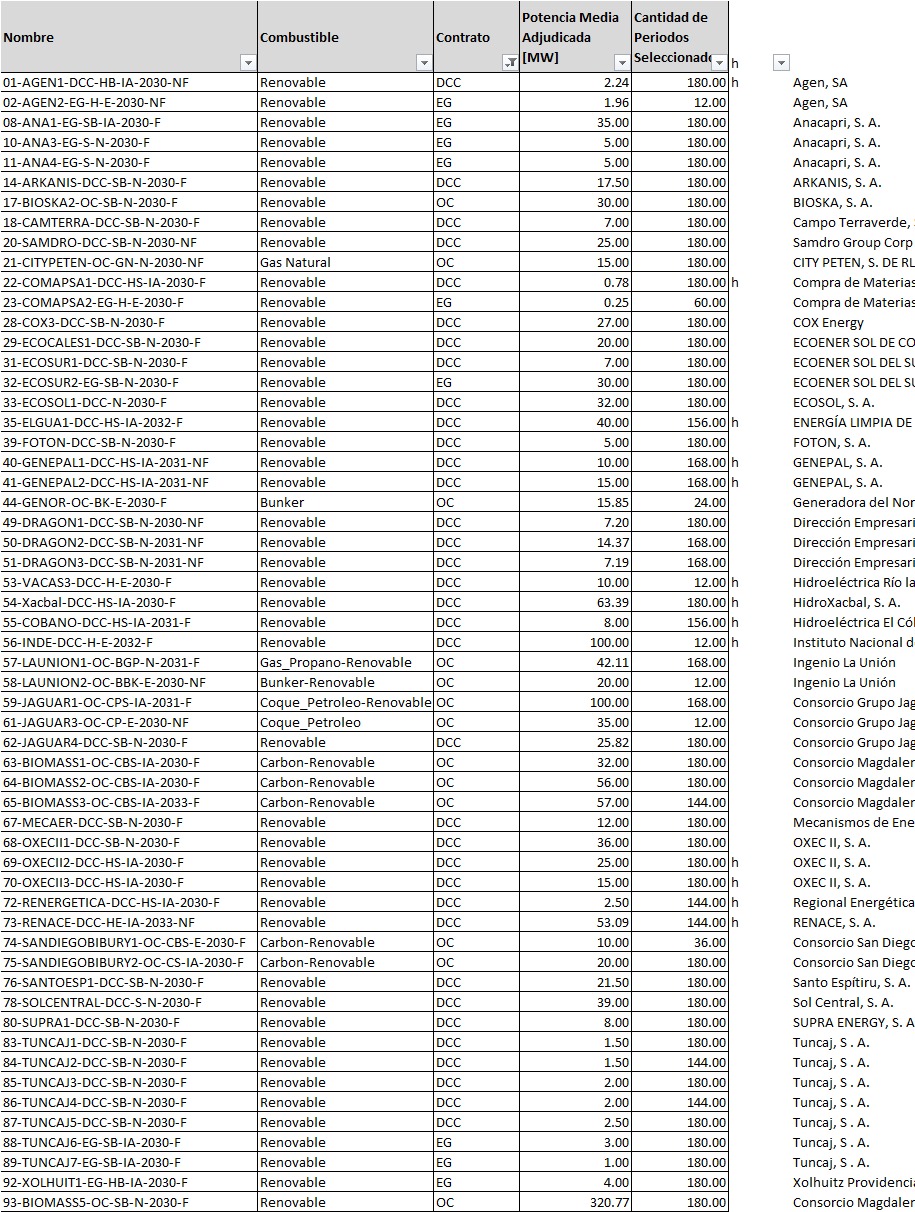








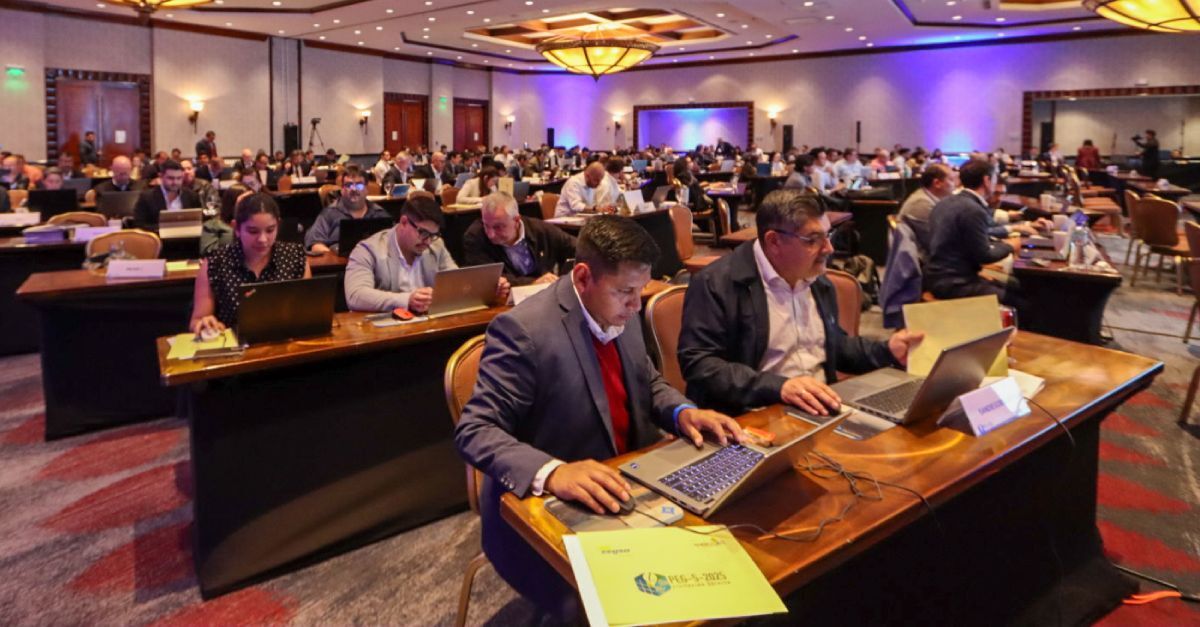
The PEG-5 tender in Guatemala has entered a decisive phase following the allocation of projects among companies, totalling more than 1,350 MW of renewable energy capacity (either as a primary or secondary fuel source).
The process reached a key milestone after a 14-hour uninterrupted reverse auction, with 57 financial bids submitted and an average single price of USD 101.09/MWh, reflecting the balance between capacity and energy offers.
According to a preliminary assessment by EEGSA and ENERGUATE, together with industry sources, a total of 48 projects are expected to be awarded. Of these, 45 include renewable energy participation — 37 fully based on non-conventional renewable energy (NCRE) and eight hybrid schemes.
In this context, the average price for purely renewable bids stands at USD 16.15/kW for capacity and USD 60.80/MWh for energy, setting key benchmarks for future renewable energy tenders across the region.
Tuncaj, S.A. leads with seven awarded projects, consolidating its position as the most prominent player in terms of the number of initiatives. It is followed by Consorcio Magdaler S.A. with four projects, while Anacapri, S.A., Consorcio Grupo Jaguar, Dirección Empresarial de Energía, and OXEC II, S.A. have secured three projects each.
A second tier of companies has been awarded two projects each, including Agen, S.A.; Compra de Materias Primas; Consorcio San Diego; ECOENER Sol del Sur; GENEPAL, S.A.; and Ingenio La Unión. Meanwhile, other companies — such as COX Energy, ECOENER Sol de Oriente, ECOSOL, S.A., Energía Limpia de Guatemala, FOTON, S.A., Generadora del Norte, Hidroeléctrica El Cóbano, Hidroeléctrica Río La Pasión, HidroXacbal, S.A., Instituto Nacional de Electrificación, Mecanismos de Energía, Regional Energética, RENACE, S.A., Samdro Group Corp, Santo Espíritu, S.A., Sol Central, S.A., SUPRA ENERGY, S.A., and Xolhuitz Providencia — have each secured a single project.
This distribution confirms a mixed structure between concentration and diversification, where some players expand their presence while others enter with targeted participation, broadening the base of the electricity system.
In terms of capacity, leadership shifts. Consorcio Magdaler S.A. reaches 465.77 MW awarded, resulting from four projects (32 MW, 56 MW, 57 MW and 320.77 MW). The latter — BIOMASS5 with 320.77 MW — stands as the largest individual project within PEG-5.
At the opposite end, Compra de Materias Primas totals just 1.03 MW, distributed across two projects (0.78 MW and 0.25 MW), the latter being the smallest in the entire tender.
Periods and supply structure
The analysis of awarded contract periods helps to understand the contractual depth of the process, a central aspect for system stability.
At this point, Tuncaj, S.A. once again leads with 1,188 total periods, derived from seven projects — five with 180 periods and two with 144 — consolidating its position not only in volume but also in contract duration.
At an individual level, 180-period contracts are repeated as a standard across a large share of the awards, including the BIOMASS5 project, indicating a certain level of uniformity among the most robust contracts within PEG-5.
By contrast, Hidroeléctrica Río La Pasión and the Instituto Nacional de Electrificación record the lowest figures, with 12 periods each for their respective projects. This is also the minimum across the entire tender, although other companies such as Agen, S.A., Ingenio La Unión, and Consorcio Grupo Jaguar present projects with the same duration.
Overall, PEG-5 is reshaping Guatemala’s electricity sector, combining strong corporate participation, technological diversity, and a heterogeneous distribution of capacity and contracts.
The result is a broader and more competitive market, where large-scale developments coexist with smaller initiatives, defining a new stage for the country’s energy system.
FES Guatemala: The energy sector gathers in the region
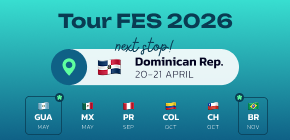
The analysis of PEG-5 comes alongside one of the most relevant energy sector events in Central America: Future Energy Summit Guatemala, which will take place on 14 May in Guatemala City.
The event will be held at the Real InterContinental Guatemala in just over a month and forms part of a regional tour aimed at strengthening exchange between companies, authorities, and energy sector specialists.
In this context, the meeting will address key topics such as tenders, renewable energy expansion, energy storage, and the evolution of electricity markets, in line with processes such as PEG-5 that are shaping the country’s energy system.
For more information on participation, agenda, and networking opportunities, interested parties can visit the official FES website or contact [email protected].
Read the full list of companies: