











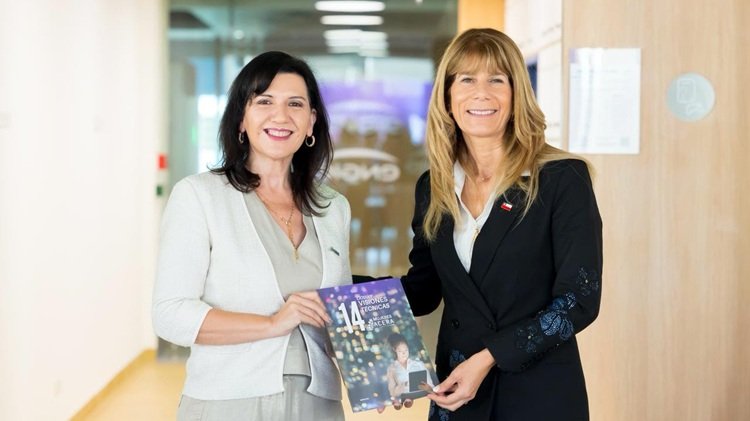
The Chilean Renewable Energy and Storage Association (ACERA) submitted 14 technical proposals to Ximena Rincón, Chile’s Minister of Energy, during a high-level working breakfast focused on accelerating electrification, renewable energy deployment and energy storage integration.
The document, titled “14 Technical Perspectives from Women of ACERA 2026”, brings together expert contributions from female professionals across ACERA member companies. It aims to inform the country’s energy transition agenda, with a strong emphasis on grid integration, system reliability and high penetration of renewables and battery storage.
This initiative comes at a time of heightened geopolitical uncertainty, particularly due to the conflict in Iran, which has exposed Chile’s vulnerability to international fossil fuel price volatility. Currently, 63% of Chile’s total energy consumption depends on imported fossil fuels, underscoring the urgency of accelerating the transition towards domestic renewable energy sources.
Key focus areas for Chile’s energy transition
The proposals were presented as a technical input to support regulatory dialogue and policymaking. Discussions during the meeting addressed several critical areas shaping the sector’s development in 2026:
- Secure integration of renewable energy into the national power system
- Scaling up energy storage systems (BESS) to enhance flexibility
- Expansion of transmission infrastructure to support grid integration
- Electrification of energy demand as a pathway to energy independence
- Electromobility and its role in increasing electricity consumption
- Artificial intelligence for grid optimisation in renewable-based systems
- Strengthening institutional capabilities across the energy sector
- Improved communication strategies to enhance consumer understanding
Beyond capacity: electrification as the next step
Unlike conventional position papers, the dossier delivers 14 specialised, experience-based perspectives addressing key operational and regulatory challenges of a modern power system.
A central message from ACERA is that the next phase of Chile’s energy transition goes beyond adding renewable capacity. Instead, it requires accelerating electrification across end-use sectors, while ensuring that the power system can integrate renewable generation and storage efficiently, securely and cost-effectively.
To achieve this, the document highlights several enabling conditions:
| Key Enabler | Role in the Energy Transition |
|---|---|
| Energy storage | Provides flexibility and supports grid stability |
| Transmission infrastructure | Enables large-scale renewable integration |
| Regulatory evolution | Aligns market rules with new technologies |
| Investment signals | Encourages deployment of renewables and storage |
Diverse expertise shaping the debate
The dossier also reflects the growing diversity of professional backgrounds contributing to Chile’s energy debate. Engineers, lawyers, economists and specialists in power markets, grid operation, sustainability, project development and strategic communications provide complementary insights into the transformation of the energy sector.
Ana Lía Rojas, Executive Director of ACERA and host of the meeting, emphasised that the initiative reflects the association’s commitment to deepening technical dialogue and improving enabling conditions for renewables and storage to reach their full potential.
Meanwhile, Minister Ximena Rincón stressed the need to increase electricity demand to avoid curtailment of renewable energy, positioning Chile as a potential regional energy hub in Latin America. She highlighted the importance of expanding interconnections with neighbouring countries and leveraging regional resources to strengthen energy leadership.