











PCR is deepening its renewable energy expansion strategy in Argentina with a pipeline exceeding 500 MW of wind and solar projects, while also evaluating participation in the country’s emerging energy storage market.
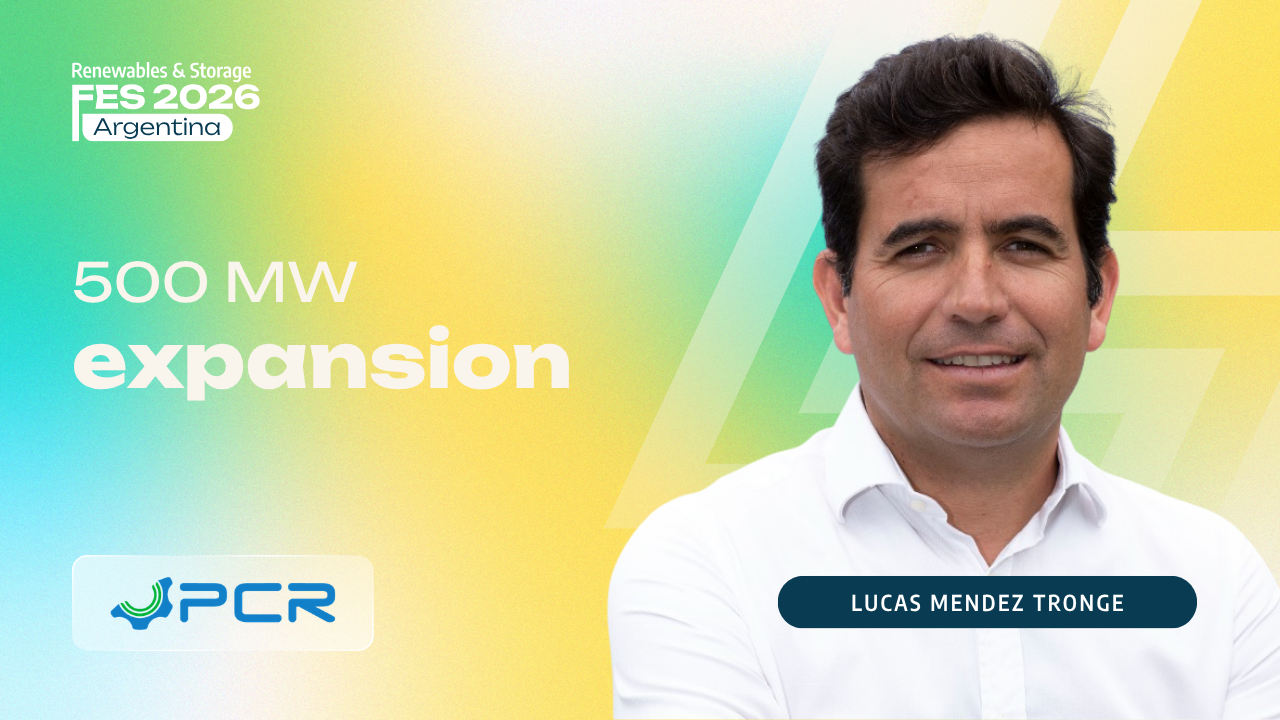
“We are analysing the different nodes included in the AlmaSADI battery tender,” said Lucas Méndez Trongé, Director of Institutional Affairs and Communications at the Argentine energy company PCR, referring to the call to incorporate 700 MW of stand-alone Battery Energy Storage Systems (BESS) across different points of the national grid.
“We will have to see how we compete. It seems there will be strong competition and many players involved, so we will see how we perform in this first experience with BESS systems,” he added during a featured interview at Future Energy Summit (FES) Argentina.
Renewable projects pipeline
In terms of renewable energy development, the company already has 545 MW in operation and 220 MW under construction, while also planning new projects enabled by transmission infrastructure expansions and dispatch priority awards in Argentina’s Renewable Energy Term Market (MATER).
Watch the full FES Argentina interview: https://youtu.be/Z4kqftmZiLM
“We have close to 180 MW with dispatch priority in Buenos Aires province, which became possible thanks to a recent transmission expansion. We also have a **solar project in northern Argentina of around 350 MW that could be built,” the executive explained.
The project in question is PS La Aconquija, which obtained 210 MW in the unified first and second quarter 2025 MATER auction. The initiative also includes the installation of series capacitors at the Monte Quemado substation on both sides of the Cobos – Monte Quemado and Monte Quemado – Chaco 500 kV corridor, enabling an additional 350 MW of transmission capacity.
“With this project, we will strengthen PCR’s solar business line, since in photovoltaics we currently only operate a hybrid wind-solar park in San Luis. This would therefore be our next step in solar PV,” Méndez Trongé emphasised.
Among the projects currently under development are the 37 MW expansion of the Mataco – San Jorge wind farm — which will increase its capacity from 203.4 MW to 240 MW in Buenos Aires province — and the Olavarría wind farm, which will add around 185 MW.
The latter is being developed under Argentina’s Large Investment Incentive Regime (RIGI) and also includes electric infrastructure upgrades at the Olavarría and Ezeiza substations, which will increase evacuation capacity along the 500 kV transmission line connecting Bahía Blanca with Abasto.
“The Olavarría wind farm is progressing according to schedule. We have already completed around 20 turbine foundations, while at the same time we are working on the construction of the two transmission expansion projects,” Méndez Trongé explained.
“We are moving at a good pace, so the expansion of the transmission system will likely be inaugurated at the end of March or early April, probably with national authorities present,” he added.
Regulatory certainty for new projects
Beyond technological opportunities, PCR stresses the importance of stable regulatory frameworks to support the continued growth of the renewable energy sector in Argentina.
In this regard, the executive highlighted the role of the Large Investment Incentive Regime (RIGI) as a tool for large-scale projects. However, due to its minimum investment requirement of USD 200 million, it is “not very common for renewable projects”.
In the case of the Olavarría wind farm, the project was able to reach that threshold thanks to its integration with major electrical infrastructure works.
Nevertheless, the executive believes that the sustained development of the sector requires the continuation of incentives established under Argentina’s renewable promotion framework.
“For the entire renewable sector to maintain that incentive, what we need is the renewal or extension of Law No. 27,191,” Méndez Trongé said.
Following the expiration of the current scheme at the end of 2025 — which mobilised more than USD 8 billion in investment over the past decade — the sector is now pushing for a new legislative stage to extend fiscal stability guarantees.
“There is a bill currently in Congress that we will try to push forward again in March through the Chamber of Renewable Energy Generators and Value Chain (CEA), where PCR currently holds the presidency. We are interested in maintaining that stability and certainty framework so we can continue bringing new projects online,” he said.
“In short, RIGI is a useful tool, but for smaller projects, we still need Law No. 27,191, because it provides the same stability umbrella as RIGI. What the sector is seeking is investment certainty and clear rules of the game,” he concluded.