










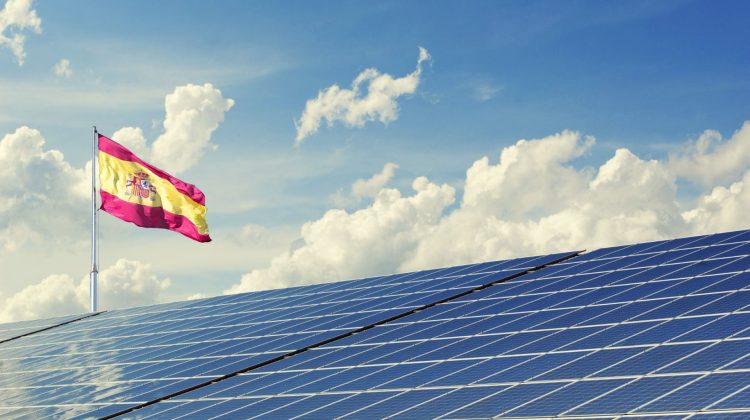
Spain significantly expanded its renewable capacity in 2025, consolidating the transformation of its electricity system.
According to the Electricity System Report published by Red Eléctrica, Spain’s transmission system operator, nearly 10 GW of new renewable capacity was added during the year, of which around 9 GW corresponded to solar photovoltaic (PV) energy.
When self-consumption installations are also considered, the renewable capacity added exceeds 11 GW, reflecting the strong momentum of the sector.
This growth allowed Spain’s installed electricity capacity to reach 142,558 MW, with 67.1% corresponding to renewable technologies. When self-consumption is included, total capacity rises to 150,809 MW, of which 68.9% corresponds to renewable generation.

Energy storage is also gaining prominence within the electricity system.
According to the report, installed storage capacity stands at 3,427 MW, of which 3,331 MW correspond to pumped-storage hydropower and 96 MW to battery energy storage systems. Together, these technologies represent around 2.4% of Spain’s installed power capacity.
The use of these solutions also reached historic levels during the year. Electricity consumption associated with pumped-storage systems reached 9,204 GWh, while turbined generation amounted to 5,886 GWh, highlighting the growing role of storage as a tool to facilitate the integration of renewable generation into the power system.
Electricity demand was another key indicator for the system in 2025, increasing for the second consecutive year.
National electricity consumption reached 256,086 GWh, representing a 2.8% increase year-on-year. If electricity produced by self-consumption installations is included, total consumption would exceed 269 TWh, raising the annual growth rate to 3.7%.
For the energy sector, this growth in demand is particularly relevant at a time when Spain is moving towards greater electrification of its economy, driven by the development of new energy-intensive industries.
Among them are data centres linked to artificial intelligence and cloud services, whose expansion is generating growing competition for access to electrical capacity.
In fact, the Spanish government has already granted around 12 GW of grid capacity to projects associated with data centres. This comes in a context where a new phase of competition for access to electricity capacity is also expected for electrified industrial projects, renewable hydrogen developments and other large energy consumers.
At the same time, the country is preparing new demand tenders across 75 nodes of the electricity network, following the recent allocation of 928 MW, marking a new stage in the planning of electricity demand growth and the integration of additional renewable generation.
In this context, industry stakeholders continue to stress the need to accelerate the electrification of the economy.
“We need higher electricity consumption to grow as a country, expand industry and generate more business,” recently said Pedro González Onieva Johansson, Director General of AEGE, Spain’s association of large electricity consumers.
In terms of generation, renewable energy once again led Spain’s electricity mix.
In 2025, renewables accounted for 55.5% of total electricity generation, while the share rises to 56.6% when estimated generation from self-consumption is included.
Within the mix, wind power remained the leading source of generation for the third consecutive year, producing 58,801 GWh and accounting for 21.6% of total generation.

It was followed by nuclear energy with a 19% share, and solar photovoltaic with 18.4%, which once again reached a record level of production at 50,188 GWh during the year.
The development of electricity networks continues to be a key element supporting this energy transformation.
In 2025, Red Eléctrica increased its investment in the transmission network to €1.424 billion, representing a 45.9% increase compared with the previous year, within the framework of Spain’s 2021–2026 electricity planning programme.
These investments allowed the addition of 486 kilometres of new transmission lines and 212 new substation positions, bringing the total length of the transmission network to 46,155 kilometres, while transformation capacity reached 99,071 MVA.
However, the development of new electrical infrastructure remains one of the main challenges for Spain’s energy sector.
The recent publication of distribution grid capacity maps confirmed what the renewable sector had been warning about for some time: 83.4% of grid nodes are currently saturated, limiting the possibility of new connections for both renewable generation projects and large electricity consumers.
This situation becomes even more relevant given the strong pipeline of renewable projects.
In the first weeks of the year alone, 50 renewable initiatives entered environmental assessment, representing more than 2,500 MW of capacity, with solar PV accounting for over 90% of the proposed capacity.
These projects are mainly located in Castilla-La Mancha, Andalusia, Extremadura and Aragón, with developers such as Opdenergy, Forestalia, Iberdrola, Elawan and Capital Energy leading several of the proposals.
Some projects involve plants exceeding 100 MW, and in several cases include co-located energy storage systems.
In this context, Spain closed 2025 with more than 80 GW of installed renewable capacity.
However, the country’s National Energy and Climate Plan (PNIEC) aims to reach 74% renewable electricity generation by 2030.
To achieve this target, Spain will need to install more than 50 GW of additional renewable capacity over the next four years, which will require reinforcing electricity networks, accelerating administrative processes and maintaining stable regulatory frameworks to support new investment in renewable energy.