











The escalation of the conflict in the Middle East has once again shaken global energy markets, pushing up gas and oil prices and exposing the vulnerability of many electricity systems to fossil fuel volatility.
In Europe, the effect has been particularly visible. The cost of generating electricity with gas increased by more than 50% in the first ten days following the start of the conflict, driven by the surge in gas prices on international markets.
At the same time, the European Union paid around 2.5 billion euros in additional fossil fuel imports in just ten days, reflecting the weight these resources still have in the bloc’s energy mix.
“We would expect some impact on electricity prices,” said Chris Rosslowe, Senior Energy Analyst at Ember, who noted that the effect tends to be greater in countries where gas plays a central role in electricity price formation, such as Italy.
The link between gas and electricity prices is explained by the structure of the European power market. Under the marginal pricing system, the most expensive technology required to meet demand sets the final price for the entire electricity system. In many cases, this technology is gas or coal generation; when their prices increase, electricity costs tend to follow the same trend.
The growth of renewable energy, however, is gradually reshaping this dynamic. As the share of clean energy in power generation rises, the need to rely on fossil fuel plants to meet demand declines.
Rosslowe highlighted Spain as one of the clearest examples of this shift.
“The expansion of wind and solar power is the main driver behind the decoupling between gas and electricity prices in Spain.”
Data reflects this evolution. The combined share of solar and wind in Spain’s electricity generation increased from 33% in 2021 to 42% in 2025, reducing the influence of gas in the electricity market to just 15% of hours. In Italy, by contrast, gas set the power price in 89% of hours, showing a much higher dependence on fossil fuels.
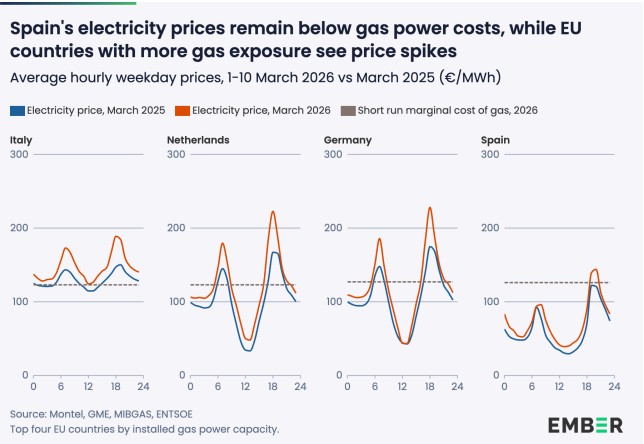
Rosslowe said the Spanish case demonstrates how renewable energy can act as a shield against gas price volatility, particularly in a global context that has already experienced two major fossil fuel price shocks within just five years.
According to a report from the energy think tank Ember, the world installed a record 814 GW of solar and wind capacity in 2025, a 17% increase compared with the previous year.
To put this into perspective, the electricity generated by the capacity added in the last year alone could replace more than one-seventh of global gas-fired generation, or nearly twice the total annual volume of liquefied natural gas (LNG) exports from Qatar.
Solar power accounted for the largest share of new capacity additions, with almost 4 GW of solar installed globally for every 1 GW of wind power.
In total, 647 GW of solar capacity were added worldwide in 2025, compared with 582 GW in 2024, representing an 11% year-on-year increase.
Latin America: exporters and importers facing the energy shock
The volatility in energy prices triggered by the conflict also has implications for Latin America, although the effects will vary depending on the energy structure of each country.
“This impacts Latin American energy systems differently depending on whether a country is a net exporter or importer of hydrocarbons,” explained Wilmar Suarez, Energy Analyst at Ember.
Oil and gas exporting countries such as Brazil, Colombia and Venezuela could benefit from higher revenues from external sales, driven by rising international prices.
By contrast, importing economies such as Chile and Peru would face higher energy costs, which could place pressure on trade balances and potentially be passed on to transport and electricity prices.
Beyond these differences, the current context could also accelerate structural changes in the region towards energy efficiency programmes and the deployment of renewable energy.
At the global level, renewables continue to gain share in electricity systems. In the European Union, they account for around 44% of power generation, driven mainly by the growth of solar and wind power, while in Latin America, the share is even higher.
According to data from the Latin American Energy Organisation (OLADE), more than 65% of the region’s electricity already comes from renewable sources, dominated by hydropower but with sustained growth in solar and wind.
Rosslowe said electrification could become a key factor in reducing exposure to energy crises.
The analyst added that the final price of electricity is one of the most important drivers of electrification, and that fiscal policies encouraging the use of clean electricity would help reduce dependence on imported fossil fuels while strengthening energy security.